- Who is it for?
- Ages 8–14
- How long is it?
- 53 min
- What does it include?
- Synced read-along and a quiz
- What does it cost?
- Free — no sign-up required
About this audiobook
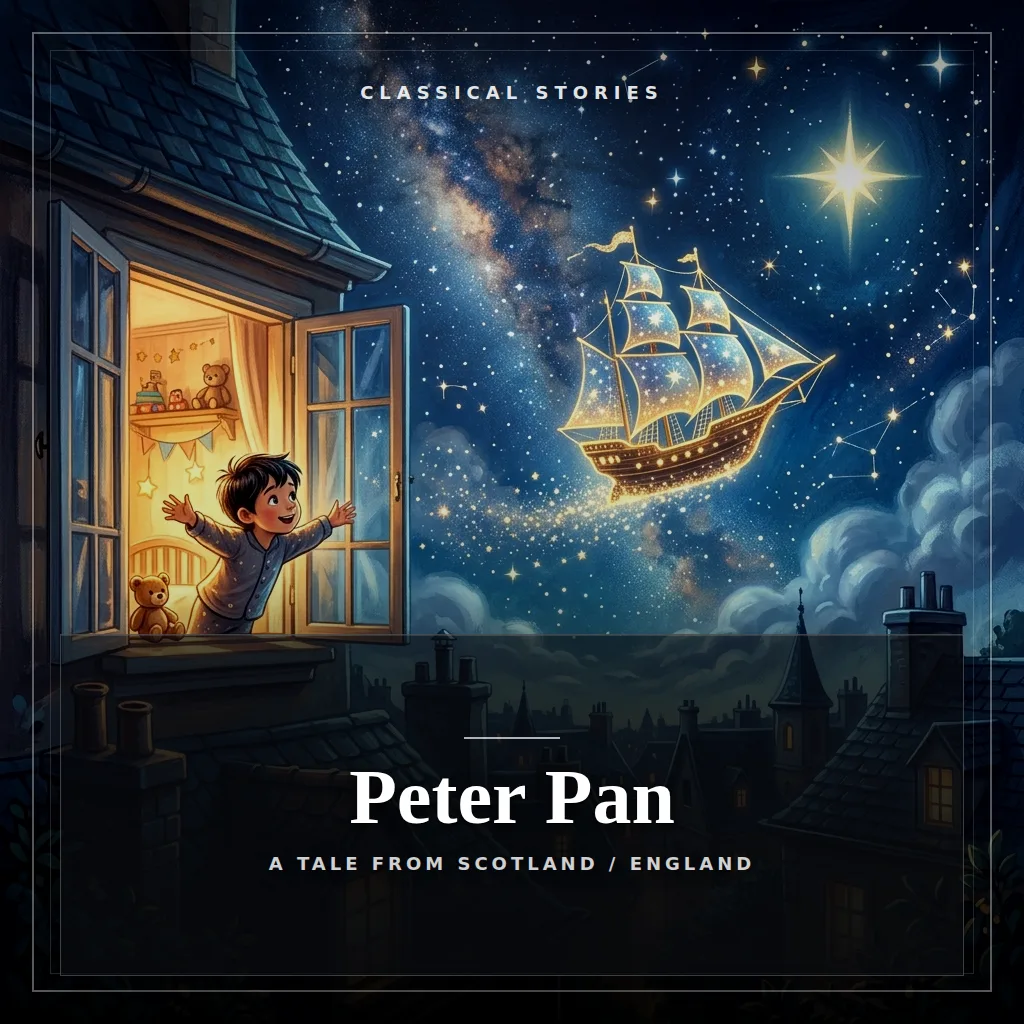
In the Darling family nursery, Wendy, John, and Michael are visited by Peter Pan, a boy who can fly and refuses ever to grow up, come in search of his lost shadow. Peter teaches the children to fly and whisks them off to Neverland, where he leads a band of Lost Boys and wars endlessly with the pirate Captain Hook — himself pursued by a crocodile that swallowed a ticking clock and now announces its coming. There are mermaids, a fairy named Tinker Bell, an Indigenous princess, and grand adventures, with Wendy becoming a kind of mother to the boys. But the pull of home grows, and the story turns wistful: the children choose to grow up after all, while Peter, who cannot, flies back alone to a nursery window — and returns, years later, to find Wendy grown and her own daughter waiting, the window always left open for the boy who never changes.
Why it's worth a listen
One night a boy who can fly slips through a nursery window looking for his lost shadow, and carries three children off to Neverland — a place of pirates, mermaids, a ticking crocodile, and lost boys who never grow older. J. M. Barrie's bittersweet classic is more than an adventure: beneath the flying and the sword-fights runs a wistful question about childhood, and about the window a mother always leaves open.
What listeners will learn
Subjects: world stories, literature, cultural literacy.
- character
- setting
- conflict
- choice
- consequence
- theme
- retelling
- peter
- classical
- stories
Questions for after listening
- Retell the central conflict in order.
- Name one important choice and what happened because of it.
- How did the setting or tradition shape the story?
A question to keep
Is it better to stay a child forever, or to grow up — and what is gained and lost each way?
Chapters
- The Shadow in the Drawer
- Second Star to the Right
- The Island of Lost Things
- The Captain and the Clock
- The Pull of the Window
- A Question to Keep
- A Question to Keep
Read a transcript preview
All children, except one, grow up. They soon know that they will grow up, and the way Wendy knew was this. One day, when she was two years old, she was playing in a garden, and she plucked another flower and ran with it to her mother. I suppose she must have looked rather delightful, for Mrs. Darling put her hand to her heart and cried, "Oh, why can't you remain like this forever?" This was all that passed between them on the subject, but henceforth, Wendy knew that she must grow up. You always know after you are two. Two is the beginning of the end. In the misty green country of Scotland, a brilliant storyteller named J. M. Barry first wrote down this tale at the very beginning of the 20th century. He drew upon the games, the laughter, and the quiet longings of children in Great Britain, weaving them into a legend that has been told in a thousand different ways across the world. But of all the ways to hear it, the best way is in the quiet of the evening, when the wind brushes against the window pane, and the shadows on the wall seem just about ready to take flight. The Darling family lived in a tall brick house in London. It was a house full of life, containing three children. Wendy, the eldest, who was full of maternal wisdom. John, who loved battles and maps, and little Michael, who still smelled faintly of babyhood and warm milk. There was also Mr. Darling, who was very good at sums and cared deeply about what the neighbors thought, and Mrs. Darling, who was a lovely lady with a sweet, mocking mouth, and a tiny kiss that lived in the right hand corner of her lips, which no one, not even her husband, could ever quite reach. And finally, there was Nana, a large, prim Newfoundland dog, who served as the children's nurse, bathing them, carrying them on her back, and keeping a watchful eye on their behavior. It was a happy home, but it was also a home where strange things began to happen. Mrs. Darling was the first to notice them. When she was tidying up her children's minds at night, as all good mothers do, sorting through the day's thoughts and packing them away neatly, she kept finding a name she did not recognize. Peter. She found it in John's mind, written in bold letters, and in Michael's, where it was scribbled in crayon. But in Wendy's mind, the name was everywhere, surrounded by drawings of strange birds, lagoon waters, and a tiny glowing light. "Who is Peter, my dear?" Mrs. Darling asked Wendy one evening. "He's Peter Pan, mother," Wendy said, as if it were the most natural thing in the world. "He comes and plays with us when we are asleep. He is quite small, you know, and he still has all his baby teeth." Mrs. Darling smiled and shook her head, believing it to be nothing more than a childish dream. But a few nights later, she was awakened by a slight rustle in the nursery. She sat up in her chair and saw a boy in the room. He was dressed in autumn leaves and the cobwebs of wild trees, and he was staring at her with eyes that shone like stars. Beside him, hovered a speck of light no larger than a fist, darting about the room like a frantic golden bee. Before Mrs. Darling could scream, Nana entered the room, growling low in her throat. The boy leaped for the window, springing out into the night with the agility of a wild thing. But Nana was quick. She snapped her jaws shut just as he escaped, and though the boy got away, his shadow was left behind. Nana had shut the window so quickly that the shadow had been cleanly severed, trapped inside the nursery. Mrs. Darling did not know what to do with a boy's shadow. It was quite soft and flat, like a black velvet coat. She decided to roll it up carefully and put it in the bottom drawer of the nursery wardrobe, intending…
Published 2026-07-11 · Updated