- Who is it for?
- Ages 8–14
- How long is it?
- 45 min
- What does it include?
- Synced read-along and a quiz
- What does it cost?
- Free — no sign-up required
About this audiobook
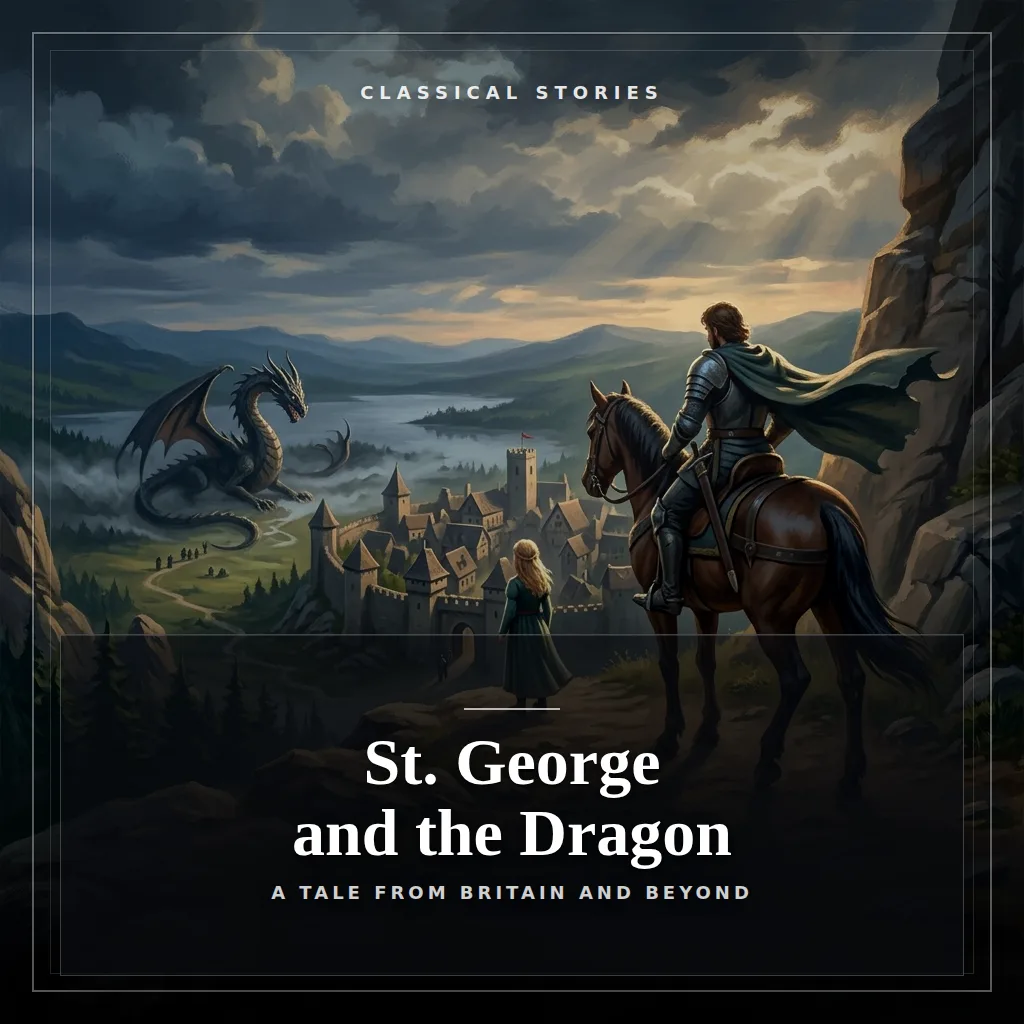
A dragon takes up residence near a city and poisons the land with its breath, and to keep it from attacking, the townsfolk agree to feed it — first their sheep, and then, when the flocks are gone, one person each day, chosen by lot. Grimly, year by year, they accept this bargain, until the day the lottery falls upon the king's own daughter, and even the king cannot buy her out. As she waits by the dragon's lake, dressed as a bride for the beast, a knight named George rides by and stops. Rather than ride around the horror as others have, he asks why they tolerate it at all — and then chooses to end it, facing the dragon so the town need never make its terrible bargain again.
Why it's worth a listen
A town keeps a dragon quiet by feeding it — first sheep, then, when the sheep run out, people chosen by lottery — and everyone has simply accepted this, until the lottery falls on the king's own daughter. Then a knight riding by asks the question no one else has dared: why are you feeding the dragon at all? The classic dragon-and-knight tale, with a sharp edge about the terrible things people accept when they've done them long enough.
What listeners will learn
Subjects: world stories, literature, cultural literacy.
- character
- setting
- conflict
- choice
- consequence
- theme
- retelling
- george
- dragon
- classical
Questions for after listening
- Retell the central conflict in order.
- Name one important choice and what happened because of it.
- How did the setting or tradition shape the story?
A question to keep
When everyone has agreed to a terrible arrangement, what does it take for one person to say 'no more'?
Chapters
- The Shadow on the Lake
- The Bronze Urn
- The Bride of the Beast
- The Traveler from Cappadocia
- The Spear and the Sash
- A Question to Keep
Read a transcript preview
The water of the great lake had once been as clear as spun glass, so pure that you could see the small silver fish darting through the reeds at the bottom. But that was before the shadow fell. That was before the earth began to breathe poison. The city of Saline, which lay in the shelter of the blue misted mountains, was a place of wide streets, white stone houses, and gardens that smelled of rosemary and sweet apricot blossoms. For generations, the people of Saline had lived by the rhythm of the seasons. They planted their barley when the rains came, they harvested their olives in the autumn, and they gathered in the evenings to tell stories under the shade of the ancient sycamore trees. They were people who believed that if you worked hard, treated your neighbors with kindness, and kept your gates locked at night, the world would treat you reasonably in return. Then, the dragon came. It did not arrive with a sudden fiery invasion, nor did it swoop down from the clouds like a bird of prey. It came slowly, crawling out of the deep uncharted marshes far to the south, dragging its heavy body across the plains until it found the cold deep waters of the lake. It liked the water. It liked the shelter of the reeds. And so, it stayed. At first, the people of Saline did not understand what had arrived on their doorstep. They only knew that the wind blowing from the lake had turned sour. It smelled of wet ashes, scorched iron, and old stagnant pools. Soon, the sheep that drank from the shallows began to pine and die. The grass along the shore turned a bruised, oily black, curling into dust at the touch of a boot. When the bravest hunters of the city rode out to investigate, they saw the beast. It was larger than any creature of the earth had a right to be. Its scales were the color of tarnished copper, overlapping like the tiles on a temple roof. And when it breathed, a thick yellow mist rolled from its nostrils. This mist was not fire, not yet, but it was deadly. It clung to the ground, choking the lungs of any creature that drew it in, turning green leaves to brown rot in a matter of minutes. The hunters shot their arrows, but the iron tips simply sparkled against the dragon's hide and fell into the mud. The beast did not even turn its head. It merely let out a low rumbling hiss that vibrated through the souls of the hunters' boots, a sound like grinding stones that made their horses rear in terror and bolt back toward the city walls. That night, the elders of Saline gathered in the council hall. The air was thick with panic. "We must fight it," said one of the younger merchants, his hand resting on the hilt of his sword. "We must gather every man who can carry a spear and march to the lake. We cannot let a monster rule our water." But the oldest counselor, a man whose beard was as white as the salt flats, shook his head. "And how many of our sons will return from that march? The beast's breath is poison. Before our spears can even reach its neck, our men will be choking on their own lungs. We cannot fight what we cannot approach." "Then what do we do?" asked another. "The wind is shifting. If that yellow mist reaches the city gates, we will all perish in our beds." It was then that the first compromise was born. It was a small compromise, the kind of bargain that seems reasonable when you are frightened and cannot see any other way out. "The beast is hungry," the old counselor said softly. "All creatures of the wild seek food. If we give it what it wants, it will have no reason to come to our walls. It will stay by the lake, quiet and full." "And what does it want?" the mayor asked. "Food," said the counselor. "Two sheep a day. We will drive them to the edge of the water…
Editorial review
Quality reviewed · 92/100 on . Certificate EL-49E6-B6D1 is bound to the exact narrated script.
The review checks factual care, audience fit, teaching quality, structure, tone and source honesty. Read the editorial standards.
Published 2026-07-11 · Updated