- Who is it for?
- Ages 8–14
- How long is it?
- 50 min
- What does it include?
- Synced read-along and a quiz
- What does it cost?
- Free — no sign-up required
About this audiobook
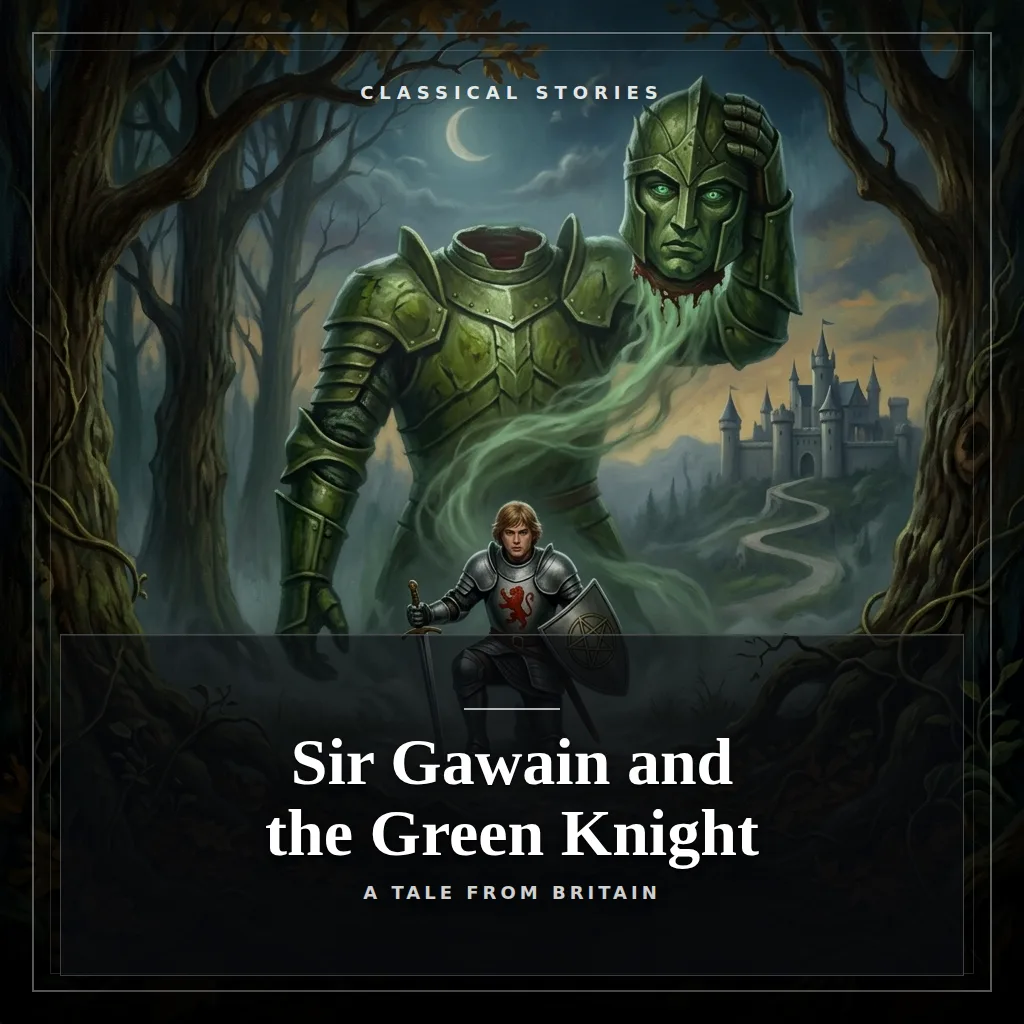
At Camelot's New Year feast, a huge Green Knight rides in and dares any knight to strike him one axe-blow, on condition that the striker seek him out in a year and a day to receive one in return. Gawain takes up the challenge and beheads him — whereupon the Green Knight calmly picks up his own head, repeats the appointment, and rides out. A year later Gawain sets off to keep his terrible bargain. He shelters at a castle whose lord proposes a merry game: each day the lord will give Gawain whatever he catches hunting, if Gawain gives him whatever he gains in the castle. For three days the lord's wife tests Gawain with kisses he honestly hands over — but on the last day she gives him a green sash said to protect his life, and this one thing, out of fear, he keeps back. At the Green Chapel the axe falls three times: two feints, and a third that only nicks him — for the Green Knight was the lord all along, and the nick is for the one small thing Gawain hid, out of the love of life.
Why it's worth a listen
A giant knight, green from head to horse, rides into King Arthur's Christmas feast and offers a game: strike me one blow with my own axe, and in a year seek me out to take the same in return. Young Sir Gawain accepts — and spends the year keeping a promise that walks him toward his own death, tested along the way by a courtesy game he doesn't realize is the real trial. The most human of the Arthurian tales, about honesty, courage, and being gently, forgivably imperfect.
What listeners will learn
Subjects: world stories, literature, cultural literacy.
- character
- setting
- conflict
- choice
- consequence
- theme
- retelling
- gawain
- green
- knight
Questions for after listening
- Retell the central conflict in order.
- Name one important choice and what happened because of it.
- How did the setting or tradition shape the story?
A question to keep
When keeping your word means walking toward your own doom, does courage mean going anyway — and is it failure to also want to live?
Chapters
- The Feast of the Holly Branch
- The Head in the Hall
- The Ride into the North
- The Game of Hunts and Gifts
- The Green Sash and the Cold Morning
- The Three Strokes
- A Question to Keep
Read a transcript preview
If you had been sitting in the Great Hall of Camelot on that long ago Christmas Eve, you would have thought you were at the very center of the world. And in many ways, you would have been. This is a story that comes to us from the green mist-shrouded hills of Britain, written down over 600 years ago by a poet whose name we do not know, though we still speak his words today. It is a tale of chivalry, which was the old code of knights, a promise to be brave, kind, loyal, and true. There are many ways to tell this story, for it has been whispered around fires and written in heavy leather-bound books for centuries. But this is the way it has come down to us, rich with the smell of pine, the ring of steel, and the cold breath of winter. In those days, King Arthur was young, and his court was full of laughter. The round table was not yet a place of tragic wars and broken promises, but a circle of friends who believed they could make the world gentle and just. For 15 days, they had been celebrating the winter holidays. The hall was a forest of holly and ivy, the air thick with the scent of roasting venison, spiced wine, and the sweet waxy smoke of a hundred beeswax candles. Tapestries of gold and blue stirred against the stone walls as the wind howled outside, reminding everyone of how warm and safe they were within. Yet, King Arthur had a custom, a strange and youthful whim. On any great feast day, he refused to sit down to eat until he had heard a marvel. He wanted a story of a dragon, a giant, a magical rescue, or some strange knight riding in with a challenge. He wanted to feel the spark of wonder before he broke bread. So, on this New Year's Day, the court waited. Queen Guinevere sat on her high dais, surrounded by her ladies, her gray eyes shining like stars. Next to her sat Sir Gawain, the king's young nephew. Gawain was the very model of what a knight should be. He was not the strongest, that was Lancelot, nor the most solemn, but Gawain was the most courteous. He possessed a voice like warm honey, a heart that knew no malice, and a reputation for absolute honesty. Just as the servants began to bring in the first silver platters of food, the massive oak doors of the hall did not merely open. They flew back on their hinges with a sound like a clap of thunder. A freezing gust of wind swept through the room, blowing out half the candles and sending the tapestries flying. And then, there rode into the hall, a figure so strange, so immense, and so terrible, that the laughter in the room died instantly, swallowed by a deep, breathless silence. It was a man, but he was a giant of a man, broader in the shoulders than any knight of the round table, with a chest like an oak tree and thighs like stone pillars. Yet it was not his size that made the court freeze, nor was it the great warhorse he rode, though the beast was as massive as a hill. It was his color. The man was green. Not a pale, sickly green, but a brilliant, vibrant emerald green, like the moss that grows in the deepest parts of the forest. His skin was green. His long, thick hair, which fell over his shoulders like a heavy mantle, was green. His bushy beard, trimmed like a bush of holly, was green. His clothes, a rich woolen tunic, a heavy cloak lined with soft fur, were the color of fresh pine needles. Even his horse was green, its mane and tail woven with threads of gold and green ribbons, its harness studded with emeralds that flashed in the dimming candlelight. He carried no shield, no helmet, and no spear. In one hand, he held a branch of holly, bright green and heavy with scarlet berries, the symbol of peace. But in his other hand, he held an axe. It…
Editorial review
Quality reviewed · 96/100 on . Certificate EL-9E5E-A8E4 is bound to the exact narrated script.
The review checks factual care, audience fit, teaching quality, structure, tone and source honesty. Read the editorial standards.
Published 2026-07-11 · Updated