- Who is it for?
- Ages 8–14
- How long is it?
- 30 min
- What does it include?
- Synced read-along and a quiz
- What does it cost?
- Free — no sign-up required
About this audiobook
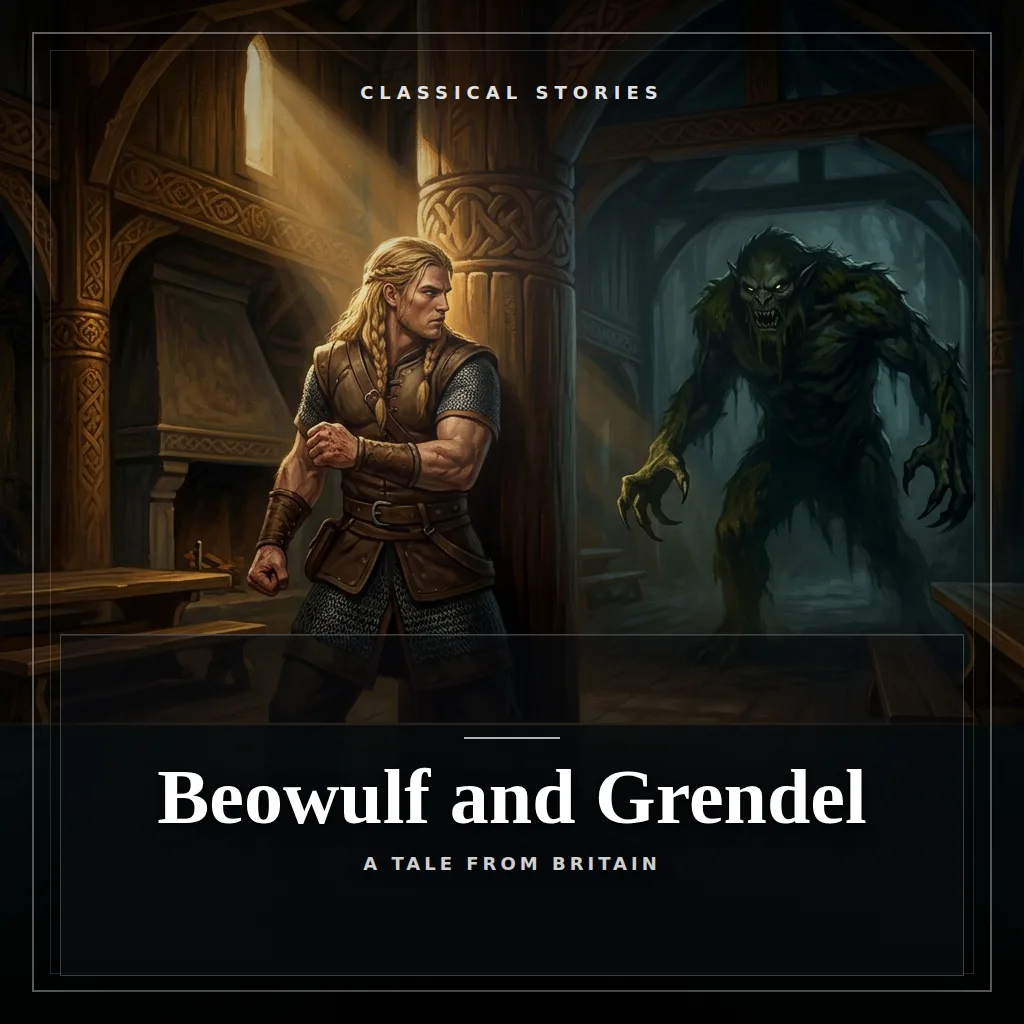
King Hrothgar builds a magnificent mead-hall, Heorot, but its light and laughter draw the monster Grendel, who comes from the moors each night to raid the sleeping hall, until no one dares stay there and joy is gone from the kingdom. Across the sea, the young hero Beowulf hears of their sorrow and sails with his warriors to help a people not his own. Boasting that Grendel uses no weapons, Beowulf will use none either, and waits in the darkened hall. When Grendel bursts in, Beowulf seizes the monster in a grip no creature has ever escaped; they wrestle, the great hall shuddering, until Beowulf tears the monster's arm away and Grendel flees to die in the fens. The hall's joy returns — though the poem knows that one monster's mother, and one hero's last dragon, still wait in the years to come.
Why it's worth a listen
The oldest great poem in the English language: a golden hall haunted by a monster that comes in the night, a people who have lost all hope, and a hero from across the sea who chooses to face Grendel with no weapon at all, hand against claw in the dark. Beowulf is where English storytelling begins — thunderous, brave, and older than almost everything.
What listeners will learn
Subjects: world stories, literature, cultural literacy.
- character
- setting
- conflict
- choice
- consequence
- theme
- retelling
- beowulf
- grendel
- classical
Questions for after listening
- Retell the central conflict in order.
- Name one important choice and what happened because of it.
- How did the setting or tradition shape the story?
A question to keep
What makes someone cross the sea to fight another people's monster — and what does a hero owe to strangers?
Chapters
- The Golden Roof in the Wilderness
- The Shadow of the Moors
- The Call Across the Cold Sea
- The Boast in the Dark
- The Grip of Iron
- A Question to Keep
Read a transcript preview
Listen. If you could travel back through the mists of more than 10 centuries, past the tall stone castles of medieval knights, past the grand stone cathedrals, you would find yourself in a wilder, darker world. This is the world of the Anglo-Saxons, the ancient people of Britain who carved their lives out of the edge of the northern wilderness. They were people of the sea and the forest, and they spoke a language we call Old English, a tongue that sounds like the crashing of waves and the clashing of iron shields. They did not write their stories in printed books to be read in silence. Instead, they gathered together in the cold winter nights, crowding close to the warmth of a great fire to listen to a single voice. A storyteller, whom they called a scope, would strike a wooden harp and sing of heroes, monsters, and the great deeds of the past. The story they loved most of all, the oldest great epic in the English language, is the tale of Beowulf. It is a story that has survived fires, wars, and the passage of a thousand years. And it begins, as all great things in that ancient world did, with the building of a hall. In those days, Denmark was ruled by a great and wise king named Hrothgar. He was a man of many victories, a ringgiver who shared his wealth generously with his warriors. To celebrate his power and to provide a safe haven for his people, Hrothgar ordered his craftsmen to build a hall grander than any the world had ever seen. For months, the forests echoed with the sound of axes. Great oaks were felled, and giant timbers were hauled to a high ridge overlooking the sea. The craftsmen worked with gold and iron, carving intricate patterns of dragons and vines into the heavy wooden pillars. When it was finished, they named the hall Het, which means the hall of the heart, after the noble stag whose antlers decorated the gables. Het was a wonder. Its roof was covered in plates of gold that caught the morning sun, shining like a second star over the gray northern waters. Inside, it was a place of absolute safety and joy. Long tables lined the walls, laden with roasted meats, fresh bread, and horns of sweet honey mead. In the center of the hall, a massive stone hearth held a fire that never went out, casting a warm, flickering glow over the faces of the king's warriors. Every night, the hall rang with laughter and the sweet clear notes of the harp. The king's poet would stand by the fire and sing of the creation of the earth, of how the Almighty made the sun and the moon to light the land, and how the green fields were brightened by the hand of the creator. It was a song of order, of light and of community. In a world that was cold, dark and dangerous, Het was a fortress of human warmth. But just beyond the light of the fire, where the shadows of the forest began, the wilderness was watching. Down in the dark places of the earth, where the cold mists rose from the black bogs and the stagnant pools of the fens, lived a creature who hated the light. His name was Grendel. Grendel was a monster, a giant of shadow and claw, but he was also something sadder. He was an exile. The old stories say he was descended from the ancient bitter line of Cain, cursed to wander the waste places of the world, forever shut out from the company of human beings. He knew nothing of friendship, nothing of the warm touch of a hand, and nothing of the peace of a home. He lived in the dripping dark, sleeping in cold caves beneath the black water, with only the crying of the marsh birds for company. Every night, as the wind blew from the sea, Grendel stood on the edge of the moors and listened. The night air carried the sound of Het's joy across the hills. He heard the sweet ringing tone of the harp. He heard…
Published 2026-07-11 · Updated