- Who is it for?
- Ages 8–14
- How long is it?
- 45 min
- What does it include?
- Synced read-along and a quiz
- What does it cost?
- Free — no sign-up required
About this audiobook
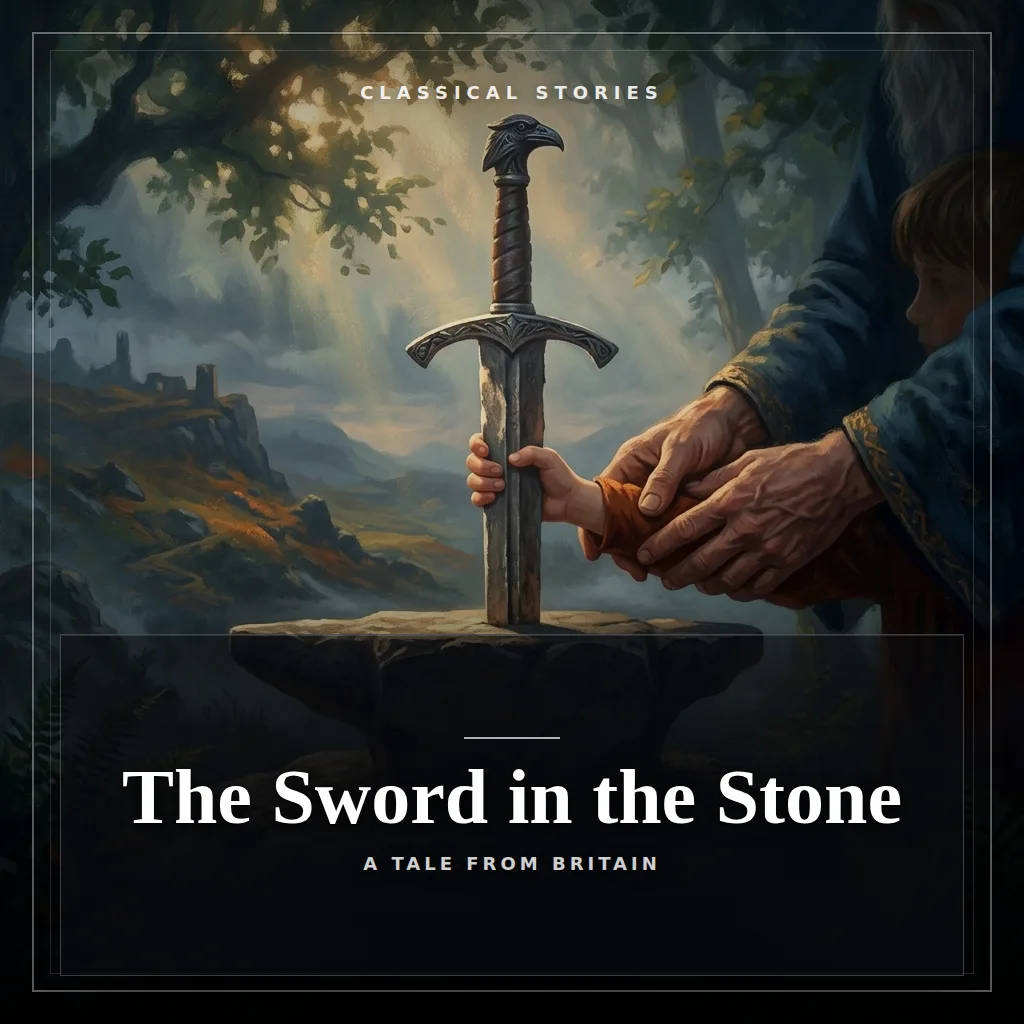
When King Uther dies without a known heir, Britain falls into years of quarrel — until there appears in a London churchyard a stone, an anvil, and a sword, with gold letters promising the crown to whoever draws it. Every duke and baron in the land heaves at it and fails. Years later, at a New Year's tournament, a sixteen-year-old squire named Arthur — raised by kind Sir Ector, never told where he came from — is sent galloping back for his brother's forgotten sword. The inn is locked. The churchyard is on the way. And there is a perfectly good sword sticking out of that stone.
Why it's worth a listen
A kingdom without a king, a churchyard stone with a sword through it, and a squire's errand-boy who only wanted to fetch a blade for his brother. The season closes with the legend that begins all of Arthur — where the proof of a king is not strength but the small faithful things done when nobody is looking.
What listeners will learn
Subjects: world stories, literature, cultural literacy.
- character
- setting
- conflict
- choice
- consequence
- theme
- retelling
- sword
- stone
- classical
Questions for after listening
- Retell the central conflict in order.
- Name one important choice and what happened because of it.
- How did the setting or tradition shape the story?
A question to keep
If no one expected anything of you, what would you quietly become?
Chapters
- The Hollow Throne
- The Silent Iron
- The Boy Who Was Good at Small Things
- The Errand and the Stone
- The Gift of the Blade
- The Barons' Pride
- A Question to Keep
Read a transcript preview
A kingdom without a king is like a house with its roof torn off. The rain comes in, the wind howls through the bedrooms, and the people who live inside spend all their time shivering in the corners, wondering when the walls will finally fall. [000:19] In the old chronicles of Britain, the land of green hills, mist-shrouded forests, and ancient stone circles, there is a story that has been told for nearly a thousand years. It comes from a time when the world was younger, darker, and much more dangerous than it is now. In those days, the island of Britain was a place of great beauty, but it was also a place of great sorrow. For many years, the land had been ruled by a strong and terrible king named Uther Pendragon. He was a man of iron will, and while he lived, the greedy barons and the prideful dukes kept their swords in their sheaths. They feared him. But fear is a cold sort of glue. And the moment King Uther died, the glue melted. He left behind no known heir, no older son to take the crown, and no clear path forward. Before the king's body was even cold in the earth, the great lords of the realm began to look at one another with hungry eyes. "The throne is empty," whispered the Duke of Cornwall, "and my castle is the strongest." "The throne is mine," muttered the King of Lot from the cold northern reaches. "My men are the fiercest." For years, the kingdom fell into a dark and lawless winter. There was no single king to hold the scales of justice, so might became right. If a powerful baron wanted a farmer's land, he simply took it. If a duke wanted to tax a town until the children had nothing to eat but boiled grass, there was no court of appeal to stop him. The roads became overgrown with briers and infested with thieves. The great halls, once filled with music and the sharing of bread, became fortresses where men slept with their daggers under their pillows. But there was one man who did not join the scramble for power. His name was Merlin. Merlin was not a baron, nor was he a knight. He was a man of the wild places, a counselor who knew the speech of birds, the movements of the stars, and the deep quiet magic that runs through the earth like water through gravel. He had seen the darkness coming long before King Uther drew his last breath. On the very night King Uther died, when the castle was in a panic and the lords were already arguing in the corridors, Merlin had walked out of the back gates, carrying a bundle wrapped in a rough wool blanket. Inside the blanket was a baby, only a few weeks old, whose eyes were as clear and blue as a winter sky. Merlin did not take the baby to a palace. He did not take him to a great fortress where he would be taught to look down on others from a high stone wall. Instead, he rode through the night, far away from the shouting and the clatter of iron, into the deep quiet valleys of the West. There, in a valley where the sheep grazed peacefully and the oak trees stood like old guardians, lived a knight named Sir Ector. Sir Ector was not the richest lord in Britain, nor was he the most famous, but he was something much rarer in those dark days. He was a kind man. He loved his land, he cared for his servants, and he kept his word, even when it was difficult. Merlin knocked on Sir Ector's door in the gray light of dawn. When the knight opened it, Merlin did not give a long speech. He simply held out the bundle. "Take this child, Ector," Merlin said, his voice sounding like the rustle of dry leaves. "Raise him as your own. Do not tell anyone where he came from. Do not even tell him. Let him grow up far from the court, far from the whispers of the ambitious, and let…
Published 2026-07-10 · Updated