- Who is it for?
- Ages 8–14
- How long is it?
- 43 min
- What does it include?
- Synced read-along and a quiz
- What does it cost?
- Free — no sign-up required
About this audiobook
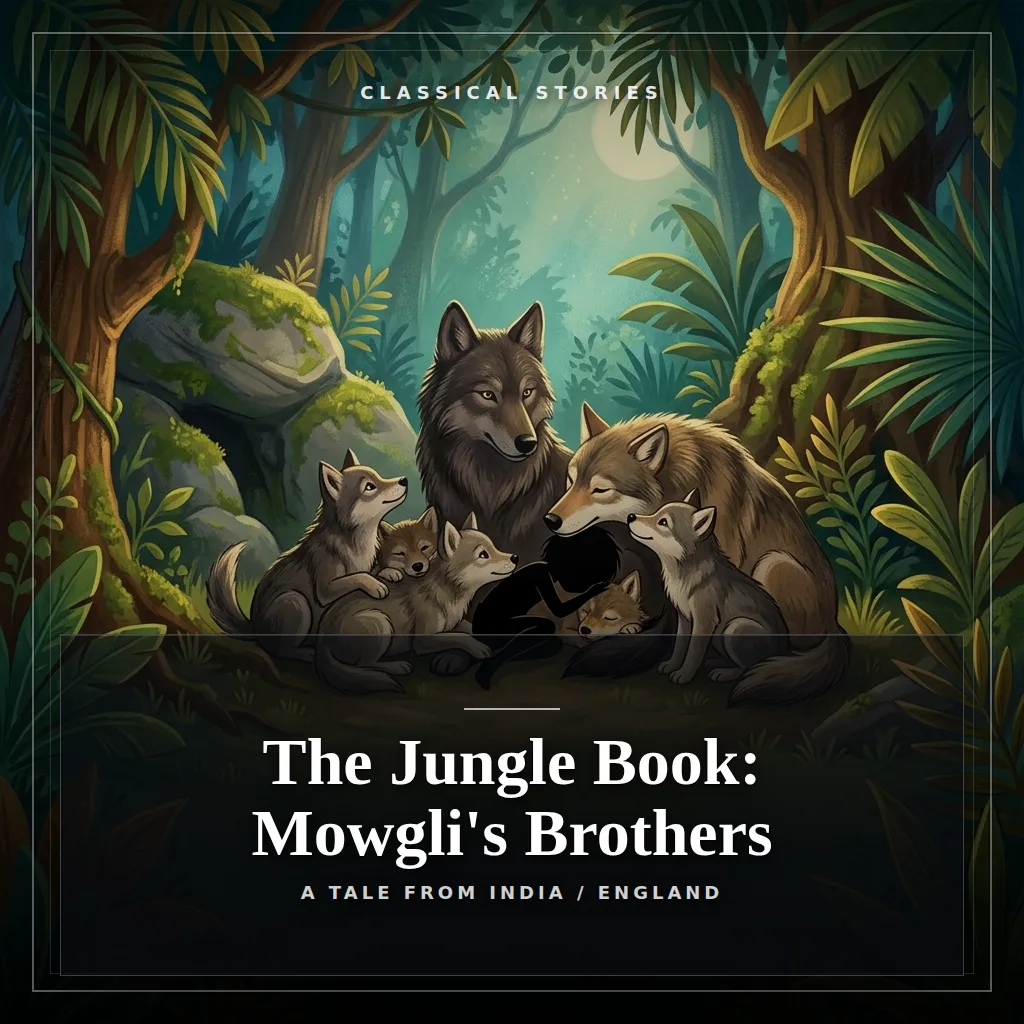
One evening a human toddler wanders into the cave of Father and Mother Wolf, just as the lame, man-hating tiger Shere Khan comes hunting him. Mother Wolf defies the tiger and the pack takes the 'man-cub' in, naming him Mowgli. He is raised as a wolf, and taught the Law of the Jungle by Baloo the bear and protected by Bagheera the black panther, who buys his life into the pack with a fresh-killed bull. Mowgli grows up beloved by the jungle but never fully of it, always shadowed by Shere Khan's grudge and by the pack's slow doubt about whether a man can truly run with wolves. When the old wolf leader weakens and the pack turns, Mowgli must use the one thing the jungle fears — the Red Flower, fire — to face down the tiger, and comes to understand that he stands between the world of beasts and the world of people, fully at home in neither.
Why it's worth a listen
A human baby toddles into a wolf den one night, and instead of being eaten is adopted into the pack and raised as a wolf cub — taught the Law of the Jungle by a wise bear and a black panther, and hunted all the while by the tiger who wanted him first. From Kipling's classic, the story of Mowgli, the boy who belongs to the jungle and to people both, and to neither quite completely.
What listeners will learn
Subjects: world stories, literature, cultural literacy.
- character
- setting
- conflict
- choice
- consequence
- theme
- retelling
- jungle
- mowgli
- brothers
Questions for after listening
- Retell the central conflict in order.
- Name one important choice and what happened because of it.
- How did the setting or tradition shape the story?
A question to keep
Where do you truly belong when you are raised between two worlds — and who gets to decide?
Chapters
- The Shadow at the Cave Mouth
- The Price of a Life
- The Law of the Woods
- The Whispering Grass
- The Red Flower
- A Question to Keep
Read a transcript preview
It was 7:00 of a very warm evening in the Seoni Hills in the heart of India. The air was thick with the scent of dry grass, dust, and the sweet heavy perfume of the Mahua blossoms. The sun had dipped below the jagged edge of the hills, leaving behind a sky the color of a bruised plum. In a deep, cool cave on the side of a ridge, Father Wolf woke from his day's rest. He scratched himself, yawned, and spread out his paws one after another to get rid of the sleepy feeling in their tips. Beside him lay Mother Wolf, her big gray nose dropped among her four tumbling, squealing cubs, while the moon shone into the mouth of the cave where they all lived. This is a story that has been told in many ways, across many years, traveling from the campfire stories of India to the written pages of England and out into the wider world. It is a tale of the wild, but more than that, it is a story about where we belong and who gets to decide who we are. "Og," said Father Wolf. "It is time to hunt again." He was about to spring down the hill when a little shadow with a bushy tail crossed the threshold and whined. It was Tabakwi, the jackal, the dish licker, the teller of tales, the beast whom the wolves of India despise, because he runs about making mischief, eating rags and pieces of leather from the village heaps. But the wolves are also afraid of him, because Tabakwi, more than anyone else in the jungle, is apt to go mad, and then he runs through the forest biting everything in his path. "Enter then, and look," said Father Wolf stiffly, "but there is no food here." "For a wolf, no," said Tabakai, licking his lips as he glanced at the plump cubs. "But for a mean person like myself, a dry bone is a good feast." He scuttled to the back of the cave, where he found the bone of a buck with some meat on it, and sat cracking it merrily. "All thanks for this good meal," he whispered, his eyes gleaming with malice. "And how beautiful are the noble children. How large their eyes. Indeed, I should have remembered that the children of kings are men from the beginning." Now, Tabakai knew as well as anyone that there is nothing so unlucky as to compliment children to their faces, and he rejoiced to see mother and father wolf look uncomfortable. Then he sat still, enjoying the quiet mischief he had made, and said spitefully, "Sheer Khan, the lame one, has shifted his hunting grounds. He has told me that he will hunt among these hills for the next moon." Sheer Khan was the tiger who lived near the Wayne Gunga River, 20 miles away. "He has no right," Father Wolf said angrily. "By the law of the jungle, he cannot change his quarters without due warning. He will frighten every head of game within 10 miles, and I, I have to kill for two these days." "His mother did not call him Lungri, the lame one, for nothing," said Mother Wolf quietly. "He has been lame in one foot from his birth. That is why he has only killed cattle. Now the villagers of the Wengunga are angry with him, and he has come here to make our villagers angry. They will scour the jungle for him when he is far away, and we and our children must run when the grass is set a light. Indeed, we are very grateful to Sheer Khan." "Shall I tell him of your gratitude?" asked Tabaki. "Out!" snapped Father Wolf. "Go hunt with thy master. Thou have done mischief enough for one night." "I go," said Tabaki quietly. "You can hear Sheer Khan below in the thickets. I might have saved myself the message." Father Wolf listened, and below in the dark valley that ran down to a little river, he heard the dry, angry, snarly, sing-song whine of a tiger who has caught nothing and does not care if the whole jungle knows…
Editorial review
Quality reviewed · 92/100 on . Certificate EL-BD65-D4EF is bound to the exact narrated script.
The review checks factual care, audience fit, teaching quality, structure, tone and source honesty. Read the editorial standards.
Published 2026-07-11 · Updated