- Who is it for?
- Ages 8–14
- How long is it?
- 39 min
- What does it include?
- Synced read-along and a quiz
- What does it cost?
- Free — no sign-up required
About this audiobook
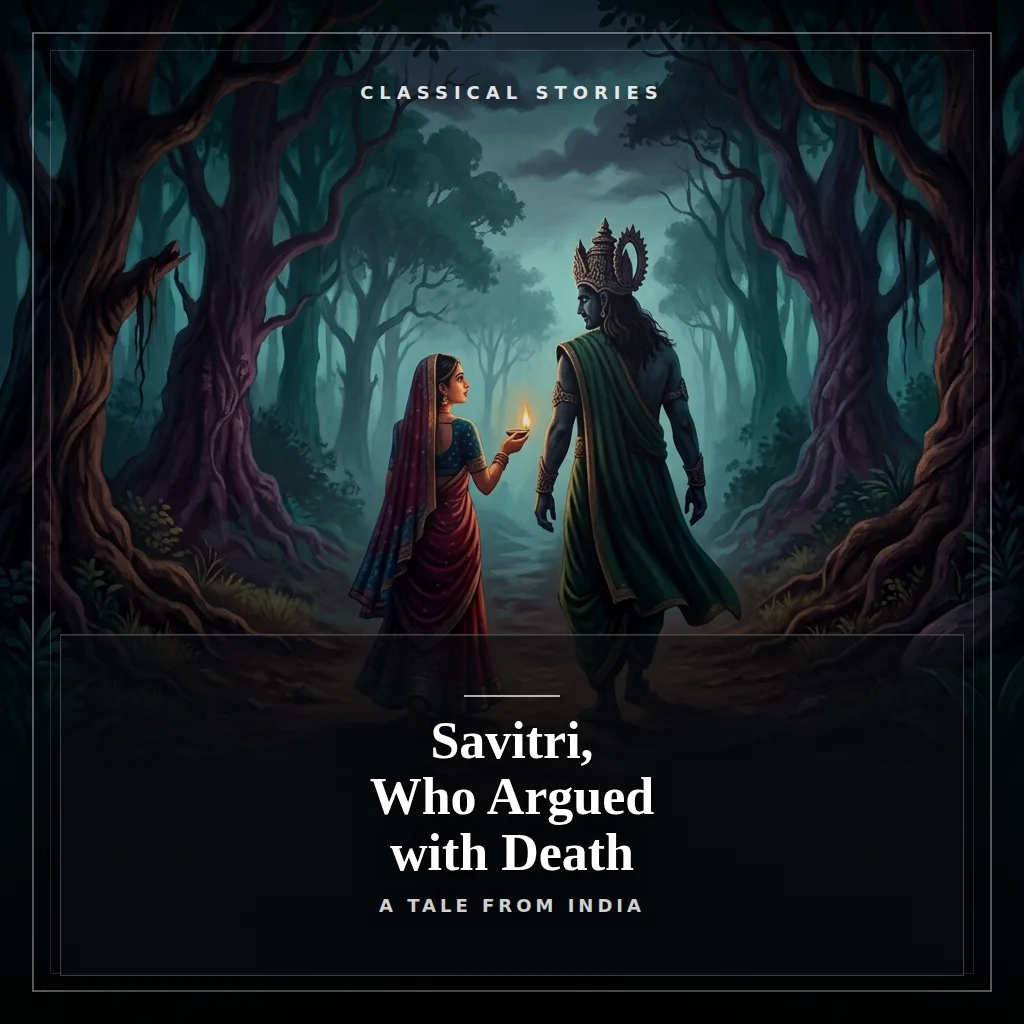
Princess Savitri, given the rare freedom to choose her own husband, chooses Satyavan — a woodcutter prince living in forest exile with his blind father — and will not be argued out of it even when the sage Narada reveals the terrible catch: Satyavan has exactly one year to live. She marries him anyway, counts the days in secret, and on the appointed afternoon follows him into the forest. When Yama, the lord of death himself, comes to carry the soul away — a duty too weighty for his messengers — Savitri does the one thing no one has ever done. She follows, and she talks.
Why it's worth a listen
She chose her husband knowing he had one year to live; when Death himself came to collect, she followed on foot. What wins the day is not magic and not tears but wisdom offered so precisely that Death keeps granting favors just to be rid of her — until one favor turns out to be a trap built of pure logic. The cleverest conversation in world literature, and she wins it walking.
What listeners will learn
Subjects: world stories, literature, cultural literacy.
- character
- setting
- conflict
- choice
- consequence
- theme
- retelling
- savitri
- argued
- death
Questions for after listening
- Retell the central conflict in order.
- Name one important choice and what happened because of it.
- How did the setting or tradition shape the story?
A question to keep
What can words do when nothing else is left?
Chapters
- The Princess Who Had to Choose
- The Weight of a Single Year
- The Shadow Under the Banyan Tree
- The Lord of Justice
- The Great Bargain
- A Question to Keep
Read a transcript preview
Long ago, in a kingdom where the rivers ran wide and the air was sweet with the scent of jasmine, there lived a princess named Savitri. She was not like other princesses of her time, nor indeed of any other. To understand Savitri, you must understand the light that seemed to follow her. It was not just that she was beautiful, though the poets of ancient India wrote that her face had the quiet radiance of the autumn moon. It was her mind, her spirit, and her presence. She carried herself with a stillness so profound and an intelligence so bright that when she walked into a room, the chatter of the court fell silent. When young princes came from distant lands to seek her hand in marriage, they would stand before her, look into her clear, steady eyes, and find themselves suddenly speechless. They felt as though they were standing before a goddess rather than a mortal woman. One by one, they would bow, step backward, and leave her father's palace without ever finding the courage to ask for her hand. They were simply too awed to speak. Her father, King Ashvapati, was a good and wise ruler, but as the years passed, he became to worry. He watched his daughter grow into a wise young woman, yet she remained entirely alone. One morning, he called her to his side in the great hall, where the morning sun filtered through the carved stone pillars, casting patterns like golden lace upon the floor. The oldest son of all, Satya's own father. My daughter, the king said gently. The princes of our world look upon you and see a light too bright for them to approach. They are afraid of their own unworthiness. Therefore, I am going to give you a gift that is rarely given to any princess. I want you to take your golden chariot, your wisest counselors, and a guard of trusted soldiers. Go out into the world, travel through the cities, the plains, and the deep forests. Look upon the men of our land. Find the one who is your equal in heart and mind, and choose him yourself. Whomever you choose, I will welcome as my son. Savitri bowed her head, touched her father's feet in a gesture of deep respect, and accepted the challenge. Her journey lasted for many months. The golden wheels of her chariot rolled through bustling market towns where spices were piled high in colorful mounds. She traveled past vast fields of green rice and golden barley, and along the banks of the sacred Ganges River. Yet, in all the grand palaces and wealthy cities, she found no one who made her heart stir. The men she met were either full of pride because of their wealth, or eager to impress her with clever words that felt hollow. At last, the chariot turned away from the kingdoms of stone and gold and entered the great quiet forests. In ancient India, the forest was not just a place of wild animals. It was a sanctuary. It was where sages, scholars, and fallen kings went to live simple lives of meditation and peace. Here, the air was cool under the canopy of massive sal and banyan trees. The only sounds were the rushing of clear streams, the calls of peacocks, and the low rhythmic chanting of holy men. Deep within one of these forests, Savitri's chariot came to a halt near a humble hermitage. There, standing in a clearing, was a young man. He was not wearing silk or gold. He wore the simple, rough bark cloth of a forest dweller. His hands were calloused from hard work, and he carried a bundle of freshly cut firewood on his shoulder. Yet, when he turned to look at the approaching chariot, Savitri saw that his posture was as regal as any king's. His face was remarkably handsome, but more than that, his eyes were filled with a deep, quiet peace. This was Satyavan. Savitri soon learned his story from the elders of the forest. Satyavan was indeed a prince, but a prince in exile. His father, the old King Dyumatsena, had gone blind in his…
Published 2026-07-10 · Updated