- Who is it for?
- Ages 8–14
- How long is it?
- 43 min
- What does it include?
- Synced read-along and a quiz
- What does it cost?
- Free — no sign-up required
About this audiobook
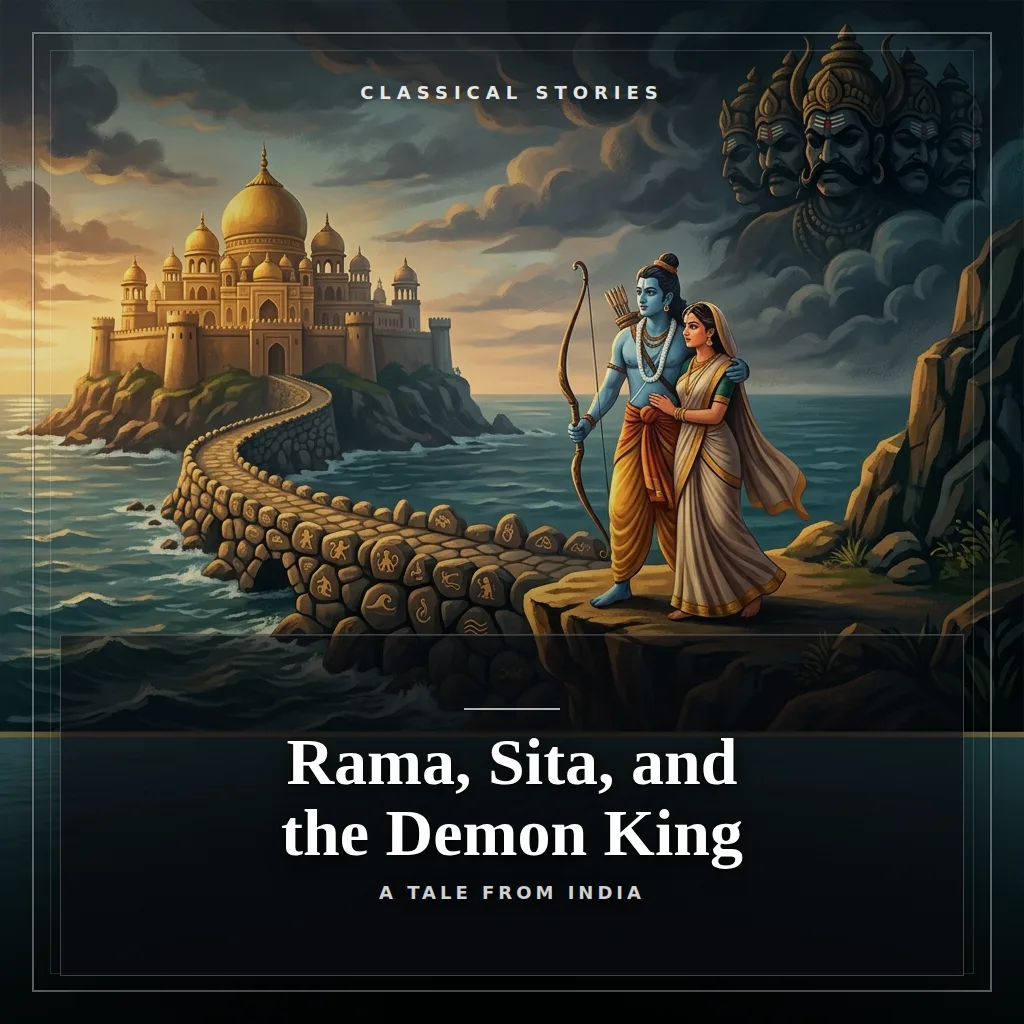
On the eve of Rama's coronation, an old promise is called in: his father owes Queen Kaikeyi two boons, and she claims them — her own son crowned, and Rama exiled to the forest for fourteen years. Rama accepts with a calm that has amazed listeners for two thousand years; Sita and his brother Lakshmana refuse to be left behind. The forest years are almost happy — until a golden deer, a crossed line, and the demon king Ravana's flying chariot take Sita to the island fortress of Lanka, and the greatest rescue in world literature begins.
Why it's worth a listen
One of the most beloved stories on Earth, told for thousands of years and still celebrated every autumn in lamplight. A prince keeps a promise that costs him a throne; a queen's courage outshines her captor's whole golden city; a monkey hero leaps an ocean in a single bound. Adventure on the grandest possible scale, wrapped around the hardest questions about duty and love.
What listeners will learn
Subjects: world stories, literature, cultural literacy.
- character
- setting
- conflict
- choice
- consequence
- theme
- retelling
- rama
- sita
- demon
Questions for after listening
- Retell the central conflict in order.
- Name one important choice and what happened because of it.
- How did the setting or tradition shape the story?
A question to keep
When keeping a promise costs you everything, what makes a person keep it anyway?
Chapters
- The Promise of Ayodhya
- Into the Great Green Wild
- The Flight of the Demon King
- The Leap of the Monkey King
- The Bridge of Stones
- A Question to Keep
Read a transcript preview
If you were to stand in the city of Ayodhya on the eve of the great coronation, you would think the sun itself had decided to come down and live among human beings. For weeks, the air had smelled of crushed cardamom, roasting sesame, and the sharp, sweet perfume of fresh jasmine garlands. Every wall of every house had been whitewashed until it gleamed like pearl. And across every doorway, the citizens had hung strings of bright green mango leaves to bring good fortune. The streets were not made of dirt or stone on this night. They were paved with the petals of marigolds, thrown by the thousands, by people who could not stop singing. Tomorrow, their beloved prince Rama was to be crowned king. To understand why the people sang so loudly, you must understand who Rama was. In the ancient land of India, where this story has been told and retold for well over 2,000 years, Rama was more than just a prince. He was the very definition of light. He was strong, yes, but his strength was never cruel. He was wise, but he never made others feel foolish. When he spoke, his voice was like the sound of a deep bell at evening. And when he looked at you, you felt as though you were the only person in the world. Beside him stood Sita, his wife. She was a princess born from the earth itself, found as a baby in a furrow of a plowed field by her father, King Janaka. Sita did not merely walk through the world, she graced it. She possessed a courage that was quiet and deep, like water beneath a mountain. Together, Rama and Sita were the heartbeat of Ayodhya. But stories, like the weather, do not stay golden forever. Deep inside the palace, far from the singing crowds, the air was heavy and cold. In a chamber draped in dark silks, King Dasharatha, Rama's aging father, lay weeping on the floor. Standing over him was his youngest queen, Kaikeyi. Once, Kaikeyi had been a warrior queen. Years ago, on a battlefield far away, the wheel of the king's chariot had broken in the middle of a furious fight. Kaikeyi had not panicked. She had wedged her own hand into the broken axle to keep the chariot steady, saving the king's life. In his immense gratitude, King Dasharatha had promised her two boons, two wishes that she could claim at any time of her choosing. For years, Kaikeyi had kept those wishes tucked away like dry seeds, waiting for the right moment. And now, poisoned by the bitter whispers of her old maid servant, Manthara, who feared that Rama's coronation would leave Kaikeyi's own son Bharata with nothing, the queen decided to plant them. "I claim my boons tonight, my king," Kaikeyi said, her voice cold as iron. The old king, still smiling from the joy of the coming day, nodded. "Ask what you will, my queen. It is yours." "First," Kaikeyi said, "I demand that my son, Bharata, be crowned king tomorrow in Rama's place." The king gasped, the smile freezing on his face. "And the second?" "Second," she whispered, "Rama must be banished from the kingdom. He must live as an exile in the dark, dangerous Dandaka forest for 14 years. He must wear the rough bark of trees and live as a hermit, far from the sight of men." King Dasharatha felt as though a spear had pierced his chest. He fell to his knees, begging her, weeping, offering her his wealth, his palaces, his very life, if she would only spare Rama. But Kaikeyi stood as still as a carved stone. A promise in those days was not a light thing. It was the foundation of the world. If a king broke his word, the sun would cease to shine and the earth would split apart. This was Dharma, the great cosmic order of duty, truth, and righteousness. When the morning sun rose, it did not light a coronation. It lit a palace of mourning. Rama was called to his father's chambers. He found the old king unable to speak, choking on his tears, while Kaikeyi…
Published 2026-07-10 · Updated