- Who is it for?
- Ages 8–14
- How long is it?
- 40 min
- What does it include?
- Synced read-along and a quiz
- What does it cost?
- Free — no sign-up required
About this audiobook
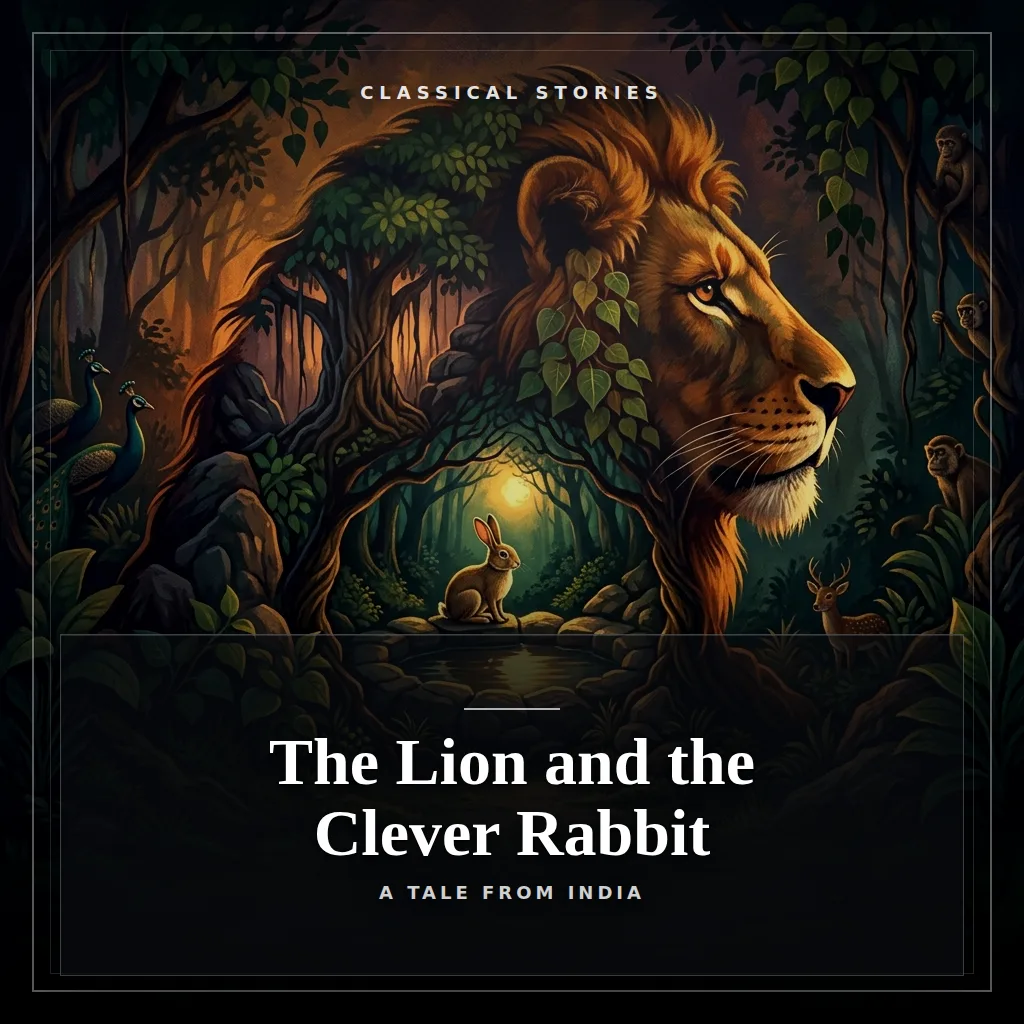
A fierce lion hunts so wildly that the terrified animals of the forest make a deal: rather than have him kill many each day, they will send one animal to him for dinner, if only he will stop the carnage. The lottery goes on until at last it is the clever little rabbit's turn. The rabbit takes his time, arriving late and calm, and tells the furious lion he was delayed by another lion who claimed to be king of the forest. Enraged, the lion demands to see this rival — and the rabbit leads him to a deep well, where the lion peers in, sees his own reflection glaring back, roars, and leaps in to fight it.
Why it's worth a listen
A proud lion terrorizes the forest until the animals strike a bargain: they will send him one dinner a day if he stops the slaughter. When the little rabbit's turn comes, he saunters up late, unbothered, with a story about 'another lion' down a well — and leads the bully straight to his own reflection. The Panchatantra's classic proof that wit beats muscle.
What listeners will learn
Subjects: world stories, literature, cultural literacy.
- character
- setting
- conflict
- choice
- consequence
- theme
- retelling
- lion
- clever
- rabbit
Questions for after listening
- Retell the central conflict in order.
- Name one important choice and what happened because of it.
- How did the setting or tradition shape the story?
A question to keep
When something big and strong is bullying everyone, can the smallest one still win — and how?
Chapters
- The Shadow Over the Canopy
- The Hardest Bargain
- The Slowest Walk in the World
- A Whisper of Rivals
- The Deep, Still Water
- A Question to Keep
Read a transcript preview
If you stood very still in the ancient forest of Naimisha, you could hear a thousand different songs at once. You would hear the high, sweet whistle of the green pigeon high in the wild fig trees. The low rhythmic hum of the cicadas vibrating in the heat, and the gentle rustle of dry teak leaves as a family of spotted deer moved through the shadows. It was a world of green and gold, of deep cool rivers and hidden glades where the wild ginger grew thick and sweet. This beautiful land in the warm heart of ancient India is the home of some of the oldest stories in the world. More than 2,000 years ago, wise teachers gathered these tales into a famous book called the Panchatantra, which translates to the five books of wisdom. These were not just stories told to pass the time. They were quiet lessons in how to live, how to find true friends, and how to survive in a world that is often much bigger and stronger than you are. The story you are about to hear is one of the most famous of them all, passed down through hundreds of generations, told by grandmothers under the shade of great banyan trees, and by travelers resting near the cooling waters of the well. And like all great stories, it begins with a shadow. The shadow in the forest of Naimisha did not come from a cloud. It came from a mountain of muscle, gold fur, and terrible pride. His name was Basuraka, and he was the king of the forest. Basuraka was a lion of immense size. His mane was like a dark storm cloud framing a face of chiselled stone. When he walked, the very earth seemed to tremble beneath his heavy velvet paws. His claws were as long and sharp as curved daggers, and his eyes burned with a restless amber fire. If Basuraka had only hunted when he was hungry, the forest might have lived in peace. After all, the animals of Naimisha understood the law of the woods. They knew that the lion was a predator and that it was his nature to hunt. But Basuraka did not hunt for food alone. He hunted for sport. He hunted because he loved the feeling of panic rising from the grass. He hunted to hear the desperate beating of wings and the frantic thud of hooves. On any given morning, the great lion would leap from the shadows, striking down three, four, or five deer, when he only needed one to satisfy his hunger. He would leave the others to waste under the hot sun, untouched, while he swaggered back to his cave, licking his paws and roaring at the sky. "I am the king," his roar seemed to say. "Everything that walks, crawls, or flies belongs to me." Because of his endless, wasteful hunting, a great silence fell over the forest of Naimisha. The birds stopped singing their morning songs, fearing that the slightest note would draw those terrible amber eyes. The monkeys no longer chattered in the canopy. They sat frozen on the high branches, their small hands gripping the bark, watching the forest floor with wide, terrified eyes. The deer grew thin, because they were too frightened to step into the open meadows to graze on the sweet clover. Every creature lived in a state of constant, exhausting dread. No one knew who would be next. A mother rabbit would go out to find a few dandelion leaves for her kits and never return. A young boar would go to the river for a drink of cool water and vanish into the reeds. The forest, which should have been a place of vibrant life, was turning into a quiet house of fear. The animals realized that if things continued this way, there would soon be no one left. The forest would be empty, and the lion would rule over nothing but dust and dry bones. They needed a plan, and they needed it quickly. But how do you speak to a storm? How do you bargain with a creature who thinks only of his own strength? One evening, when…
Editorial review
Quality reviewed · 98/100 on . Certificate EL-957E-B371 is bound to the exact narrated script.
The review checks factual care, audience fit, teaching quality, structure, tone and source honesty. Read the editorial standards.
Published 2026-07-11 · Updated