- Who is it for?
- Ages 8–14
- How long is it?
- 48 min
- What does it include?
- Synced read-along and a quiz
- What does it cost?
- Free — no sign-up required
About this audiobook
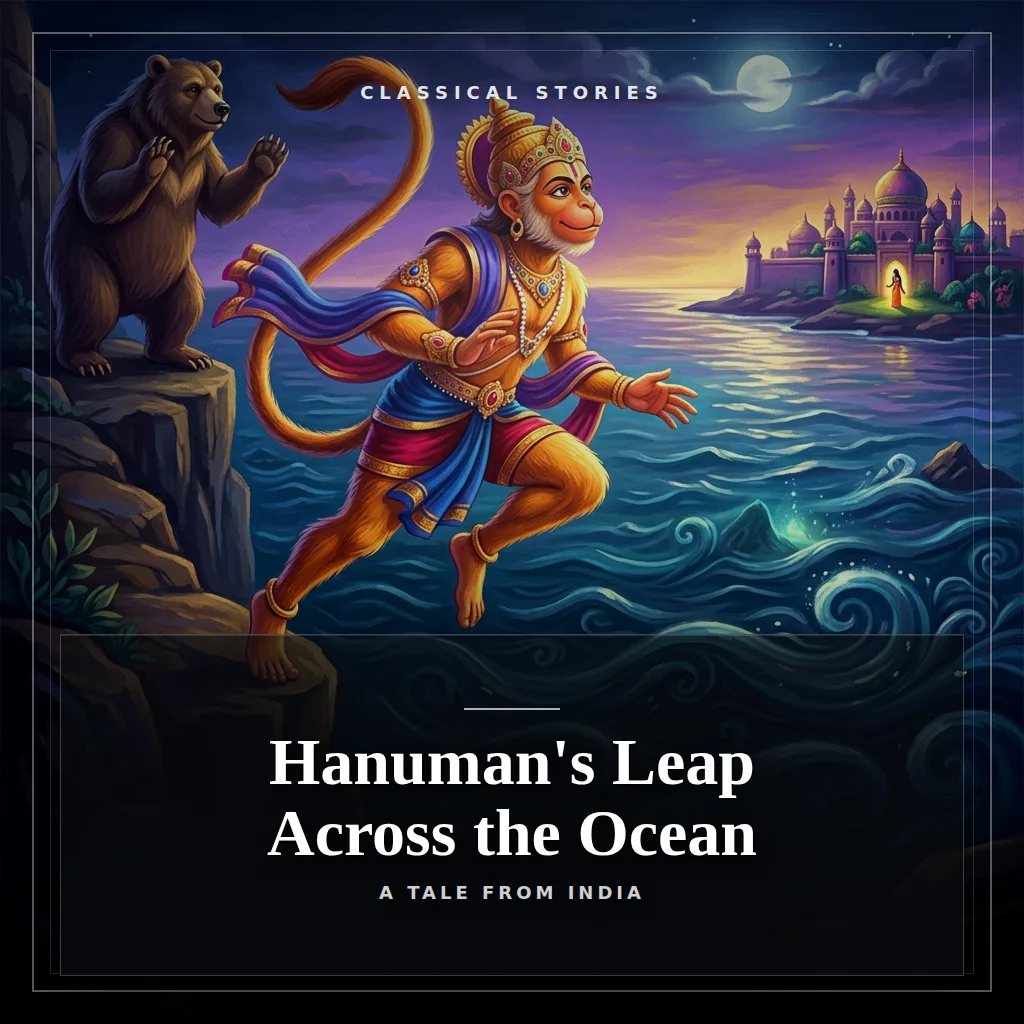
Hanuman, the monkey hero, was so mischievous and mighty as a child — trying to eat the sun, mistaking it for fruit — that the gods placed a gentle forgetting on him, so he would not know his own vast powers until he truly needed them. Years later, in the search for the captured queen Sita, the monkey army reaches the ocean's edge and despairs: no one can cross to the island fortress of Lanka. Then an old bear reminds Hanuman who he is — and, remembering at last, he grows huge, gathers himself on a mountaintop, and leaps the whole sea in one tremendous bound to carry hope to a captive queen.
Why it's worth a listen
The mightiest, most joyful hero of the Ramayana leaps across an entire ocean in a single bound to find a captured queen — but only after a friend reminds him of powers he had completely forgotten he possessed. A soaring adventure about courage, devotion, and remembering who you really are.
What listeners will learn
Subjects: world stories, literature, cultural literacy.
- character
- setting
- conflict
- choice
- consequence
- theme
- retelling
- hanuman
- leap
- across
Questions for after listening
- Retell the central conflict in order.
- Name one important choice and what happened because of it.
- How did the setting or tradition shape the story?
A question to keep
How do you find your true strength when you have forgotten you ever had it?
Chapters
- The Mango in the Sky
- The Edge of the World
- The Silence of the Waves
- The Bear's Whisper
- The Mountain That Bowed
- The Golden Flight
- Landfall on Lanka
- A Question to Keep
Read a transcript preview
Long, long ago, in the ancient, sun-drenched lands of India, the world was a place where the line between the earth and the heavens was as thin as a thread of silk. In those days, the forests were deep and green, filled with trees that whispered secrets to the wind, and the rivers ran sweet and clear from the snow-capped peaks of the mountains. It is from this rich soil, and from one of the greatest stories ever told, the epic known as the Ramayana, that our tale comes today. For thousands of years, under the shade of wide banyan trees and in the warm glow of oil lamps, families have gathered to tell this story in dozens of different ways, passing it down like a precious golden coin from one generation to the next. And at the heart of this story is a hero who is loved by millions, a monkey named Hanuman, whose heart was as vast as the sky. Even if, for a long time, he completely forgot who he was. To understand how someone could forget their own strength, we must go back to the very beginning, to the days when Hanuman was just a child. He was no ordinary baby. His mother was Anjana, a beautiful heavenly being, and his father was Vayu, the God of the wind itself. Because he was the son of the wind, Hanuman had the breeze in his blood and the storm in his spirit. He could not sit still. He didn't crawl, he bounced. He didn't toddle, he leaped. His laughter was like the rustling of a thousand dry leaves in a playful autumn gale, and his mischief was legendary across the forest. One morning, when the world was still cool and dewy, baby Hanuman woke up with a terrible, rumbling hunger in his belly. His mother had gone out to gather wild berries, and the little monkey was left to his own devices. He rubbed his eyes, patted his stomach, and looked up into the eastern sky. There, just rising over the edge of the world, was a magnificent, glowing, perfectly round orb. It was a deep, rich orange, radiating a warm, sweet light that seemed to fill the morning air with the scent of summer. To the eyes of a very hungry, very young monkey, this was not the sun, the giant star that warms the earth. No, this was obviously a fruit. It was the largest, ripest, most delicious-looking golden mango he had ever seen, just hanging there on the branch of the horizon, waiting to be plucked. "Mango!" Hanuman thought, his eyes turning into wide, shining circles of delight. He did not hesitate. He did not wonder if the fruit was too high or if he was too small. He simply crouched low on his branch, wiggling his tail, and took a mighty breath. The wind, recognizing its child, swirled around his ankles and gathered beneath his feet. With a joyous shriek that echoed through the valleys, Hanuman leaped. It was a leap that defied the laws of the earth. He did not fall back down. Instead, he soared upward, higher and higher, leaving the treetops behind, then the clouds, then the very air itself. He flew like an arrow shot from a divine bow, his small hands outstretched, his mouth open, ready to take a giant bite out of the golden mango in the sky. The gods in their heavenly palaces looked out of their windows and rubbed their eyes in disbelief. Who was this tiny, golden-furred creature hurtling through the cosmos toward the sun? The sun god, Surya, felt the heat of the approaching child and was astonished that the boy did not burn. Instead, the wind child seemed to absorb the light, glowing brighter with every league he traveled. But the king of the gods, Indra, who rode a magnificent white elephant through the clouds, saw this as a threat to the cosmic order. If a baby monkey ate the sun, the world would be plunged into eternal darkness. The stars would wander, the crops would wither, and the songs of the birds would cease. With a heavy heart, Indra lifted his…
Editorial review
Quality reviewed · 96/100 on . Certificate EL-797F-4C28 is bound to the exact narrated script.
The review checks factual care, audience fit, teaching quality, structure, tone and source honesty. Read the editorial standards.
Published 2026-07-11 · Updated