- Who is it for?
- Ages 8–14
- How long is it?
- 39 min
- What does it include?
- Synced read-along and a quiz
- What does it cost?
- Free — no sign-up required
About this audiobook
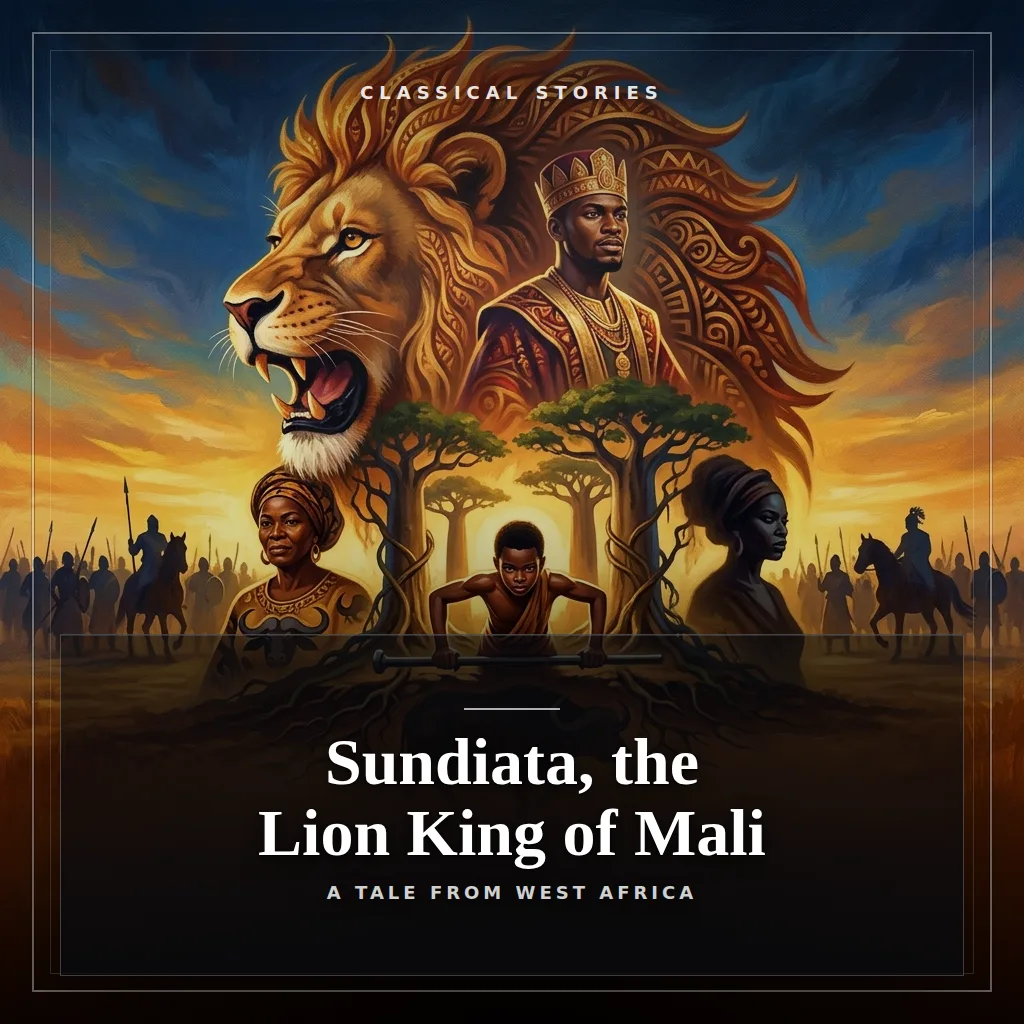
A hunter's prophecy tells the king of Mali to marry the ugliest woman who ever came to his court: Sogolon, the buffalo woman, whose son will make Mali's name eternal. But the boy Sundiata cannot walk. For years he drags himself while the king's first wife mocks, until the day her cruelest insult — aimed at his mother — reaches him. He calls for an iron staff. The iron bends. The lion stands. And that is only the beginning: exile, a sorcerer-king who conquers Mali, and the long road back to the battle of Krina and the great charter that followed it.
Why it's worth a listen
West Africa's great epic has been kept alive for seven hundred years not in books but in trained voices — the griots of Mali, who can sing a kingdom's whole memory. Their hero spends his childhood unable to walk while the royal court laughs; then one day he pulls himself upright on an iron staff that bends like a bow. A story about mothers, patience, exile — and a kingdom won back without hatred.
What listeners will learn
Subjects: world stories, literature, cultural literacy.
- character
- setting
- conflict
- choice
- consequence
- theme
- retelling
- sundiata
- lion
- king
Questions for after listening
- Retell the central conflict in order.
- Name one important choice and what happened because of it.
- How did the setting or tradition shape the story?
A question to keep
What do the people who laugh at you today owe you tomorrow — and what will you owe them?
Chapters
- The Voice in the Strings
- The Weight of the Lion
- The Iron That Bent
- The Sorcerer’s Shadow
- The Spear and the Treaty
- A Question to Keep
Read a transcript preview
[ 00:00] If you close your eyes and listen, really listen, you can hear the wind moving through the dry grass of the West African Savannah. It is a warm wind, carrying the scent of red earth, wood smoke, and the sweet, sharp promise of rain. And if you listen beneath the wind, you will hear a sound like falling water, the bright cascading notes of the Kora. The Kora is an instrument made from a giant gourd, sliced in half and covered with polished cowhide, with a long hardwood neck and 21 strings that stretch upward like the branches of a tree. For 700 years, the players of this instrument have been more than just musicians. In the great land of Mali, among the Monde peoples, they are called Griots. A Griot is a living library. They do not keep their stories on paper, where ink can fade or pages can burn. They keep them in their lungs, in their fingers, and in the deep chambers of their memory. They sing the names of grandmothers and grandfathers who lived before the great empires were born. They remember who made peace, who broke promises, and who built the roads we still walk upon. This is one of their greatest stories. The tale of Sundiata Keita, the Lion King of Mali. It is a story that has been told in a thousand different ways, by a thousand different voices, but its heart remains as solid as the red stone of the mountains. Our story begins in the ancient kingdom of Niani, a place of green valleys and busy markets, ruled by a king named Nare Magan Konate. He was a handsome king, well loved by his people, but he was troubled. One day, a forest hunter came to his court. This hunter was no ordinary tracker of beasts. He was a seer, a man who could read the whispers of the brush and the patterns of the stars. The hunter sat before the king, unrolled a pouch of sacred cowry shells and cast them onto the dirt. He looked at the way they fell, squinting through the dust. "Great king," the hunter said, his voice like dry leaves scraping together. "Your destiny is a path of gold, but it must start in the mud. Soon, two hunters will come to your gates. They will bring with them a woman from the distant land of Doe. She will be hunchbacked with bulging eyes and skin like the bark of an old tree. People will call her Sogolon, the Buffalo woman, because they think she is ugly and wild. But you must marry her." The king's court fell silent. The king already had a beautiful wife, Sasuma Berete, who had given him a strong, handsome son named Dankaran Tuman. Why should he marry a woman who was mocked by the world? "Do not look at the vessel," the hunter warned, pointing a long finger at the king. "Look at what the vessel holds. From this buffalo woman, you will father a son. He will be the greatest king ever to walk the earth. He will unite the clans. He will sweep away the darkness, and he will make the name of Mali eternal. But remember, the seed of a great tree must spend a long time in the dark before it reaches for the sun." The king did not forget the prophecy, and indeed, months later, two hunters arrived at the palace gates. Between them walked a woman named Sogolon Keju. She was just as the seer had described. Her back was curved like a river stone. Her face was rough, and she kept her eyes cast down to the earth to avoid the cruel stares of the courtiers. Queen Sasuma, the king's first wife, laughed aloud when she saw her. "Is this the prize of Niani?" she mocked from her high seat. "Is this the rival for my beauty?" But King Nare Magan remembered the hunter's shells. He looked past the curved spine and the rough skin. He saw the quiet, fierce dignity in Sogolon's eyes, the spirit of the wild buffalo, ancient and unbreakable. He welcomed her with honor, and in…
Published 2026-07-10 · Updated