- Who is it for?
- Ages 8–14
- How long is it?
- 48 min
- What does it include?
- Synced read-along and a quiz
- What does it cost?
- Free — no sign-up required
About this audiobook
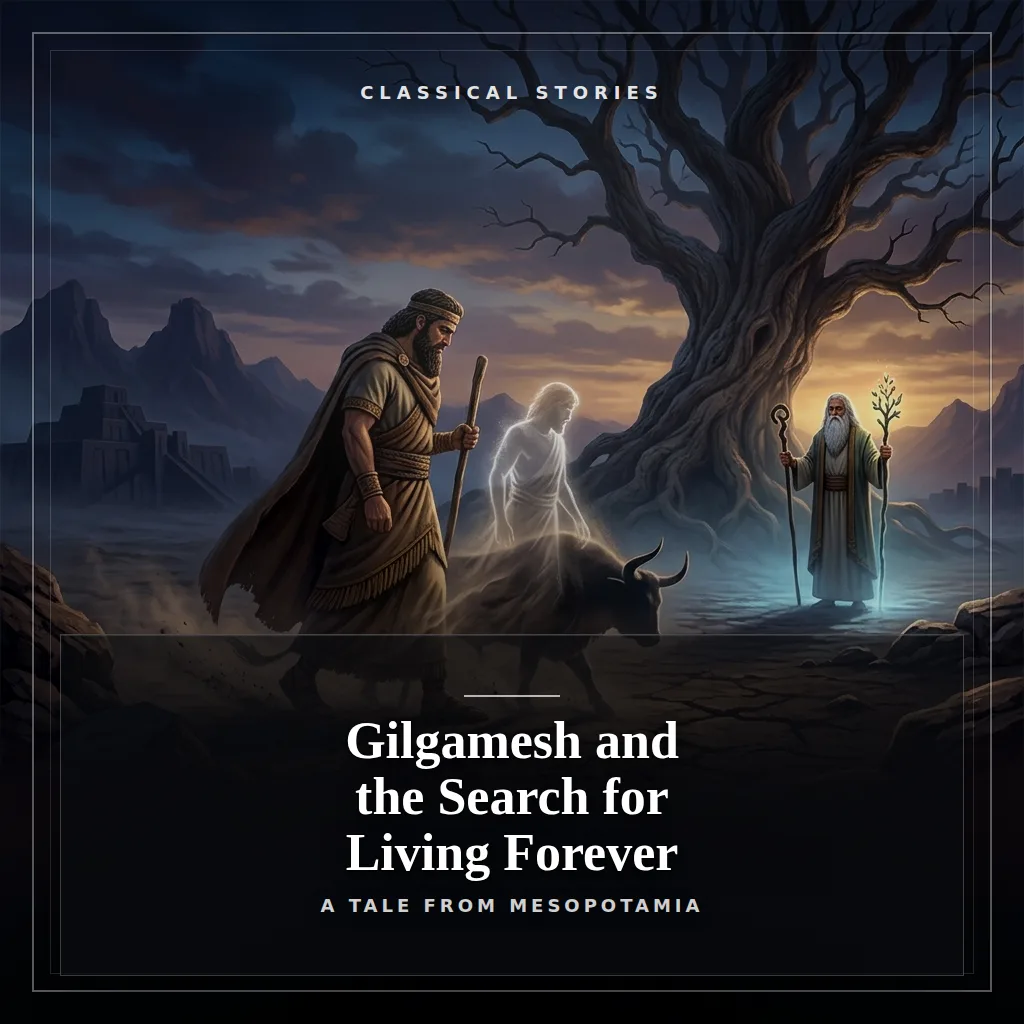
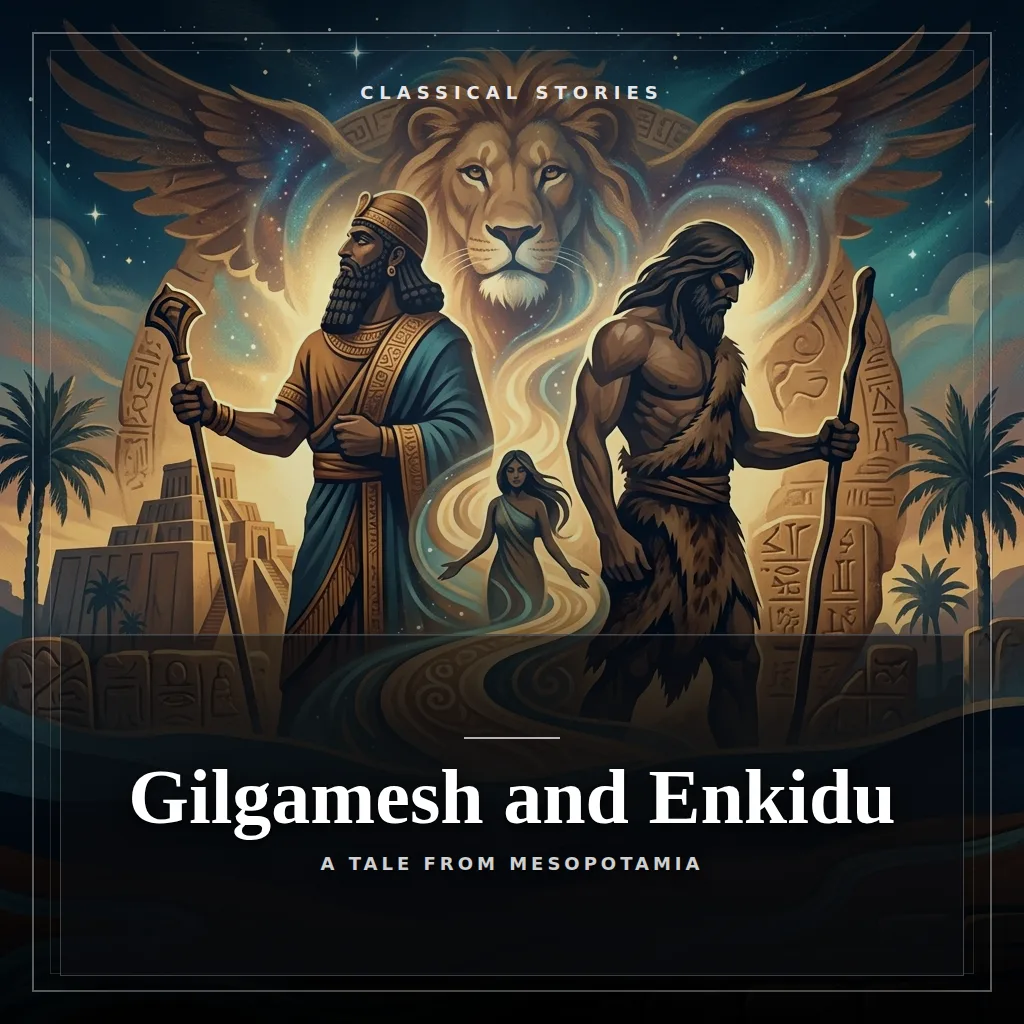
Gilgamesh, king of Uruk, is two-thirds god and entirely exhausting: strongest of men, builder of walls, and so restless that his own city prays for relief. The gods' answer is not a punishment but a mirror — Enkidu, a wild man shaped from clay, who runs with gazelles and frees animals from hunters' traps. When the wild man finally strides into Uruk and blocks the king's way, the wrestling match shakes the doorposts; and when neither can throw the other, something happens that neither expected. The two become inseparable — and together they go looking for adventures big enough for the both of them.
Why it's worth a listen
Before Greece, before Rome, before nearly everything: a story pressed into clay four thousand years ago — and it turns out to be about friendship. The gods build a wild man to humble a king who is too strong, and instead of enemies the two become brothers. Listen to the oldest story humans thought worth keeping, and hear how little we have changed.
What listeners will learn
Subjects: world stories, literature, cultural literacy.
- character
- setting
- conflict
- choice
- consequence
- theme
- retelling
- gilgamesh
- enkidu
- classical
Questions for after listening
- Retell the central conflict in order.
- Name one important choice and what happened because of it.
- How did the setting or tradition shape the story?
A question to keep
Can one true friend change what kind of person you are?
Chapters
- The King Who Was Too Loud
- The Wild Man of the Grasslands
- When Two Mountains Collide
- Into the Whispering Cedars
- The Bull and the Sentence
- The Long Grief of the King
- A Question to Keep
Read a transcript preview
If you could travel back in time, past your grandparents, past the kings and queens of the Middle Ages, past the empires of Rome and Greece, past even the building of the great pyramids of Egypt, you would eventually find yourself in a hot, dry land between two shimmering rivers. This is ancient Mesopotamia, the land between the Tigris and the Euphrates, in what is now the country of Iraq. 4,000 years ago, this was a world of sun-baked mud brick, green fields of barley, and bustling cities that rose like mountains out of the desert. And if you walked into one of those cities, a city called Uruk, you might see a scribe sitting in the shadow of a temple wall. In his hand, the scribe holds a small flat slab of wet clay. With a pointed reed, he presses tiny wedge-shaped marks into the mud. Tap, tap, tap. The marks look like the footprints of birds. This is cuneiform, the oldest writing in the world. And the story that scribe is pressing into the clay is the oldest story we have ever found. It is the story of a king, a wild man, and a friendship that changed the world. The king's name was Gilgamesh. Now, if you were to ask the people of Uruk about their king, they would first point to the walls of the city. These were not just ordinary walls. They were massive, high, towering ramparts made of burnt brick that gleamed like copper in the desert sun. Gilgamesh had built them. They would point to the great orchards, the vast clay pits, and the magnificent temple of the goddess Ishtar. Gilgamesh had built those too. Gilgamesh was two-thirds God and one-third human. He was taller than any other man, stronger than a wild bull, and his beauty was like the sun rising over the eastern mountains. But there was a problem with Gilgamesh. He was exhausting. Imagine a fire that never goes out, a wind that never stops blowing, or a drum that beats day and night, right next to your ear. That was Gilgamesh. Because he had the strength of the gods, but the restless mortal heart of a human, he did not know what to do with himself. He never slept, he never rested. And because he could not rest, he would not let anyone else rest either. "Build the walls higher!" he would shout at dawn, his voice booming through the streets of Uruk. "Dig the clay pits deeper!" he would command at noon. He kept the young men of the city working until their hands bled and their backs bent with fatigue. He kept the young women dancing and serving at his feasts until they fell asleep on their feet. He took whatever he wanted, whenever he wanted it, because there was no one in the world who could say no to him. There was no one who could match his strength. And so he lived in a state of terrible, angry loneliness, though he was surrounded by thousands of people. The elders of Uruk sat in the shade of the great gates, wringing their hands. Their knuckles were white with worry. "He is our shepherd," they whispered, "but he harries the flock like a wolf. A king should protect his people, not wear them away like water on stone." Finally, the people of Uruk could bear it no longer. They lifted their voices to the heavens, crying out to the great gods who live in the sky. "You made him," they prayed. "You made him stronger than any man, but he is too much for us. Please, send us help. Send us someone who can stand against him. Create his equal, a person who can match his stormy heart, so that they may contend with one another, and Uruk may finally find peace." The gods in their high, quiet heavens listened. They heard the crying of the city, and they felt a great pity for the tired people of Uruk. The sky gods turned to Aruru, the goddess of creation, the mother of all things. "Aruru," they said, "you created Gilgamesh. Now, create his double. Let him be…
Editorial review
Quality reviewed · 94/100 on . Certificate EL-A674-E350 is bound to the exact narrated script.
The review checks factual care, audience fit, teaching quality, structure, tone and source honesty. Read the editorial standards.
Published 2026-07-10 · Updated