- Who is it for?
- Ages 8–14
- How long is it?
- 39 min
- What does it include?
- Synced read-along and a quiz
- What does it cost?
- Free — no sign-up required
About this audiobook
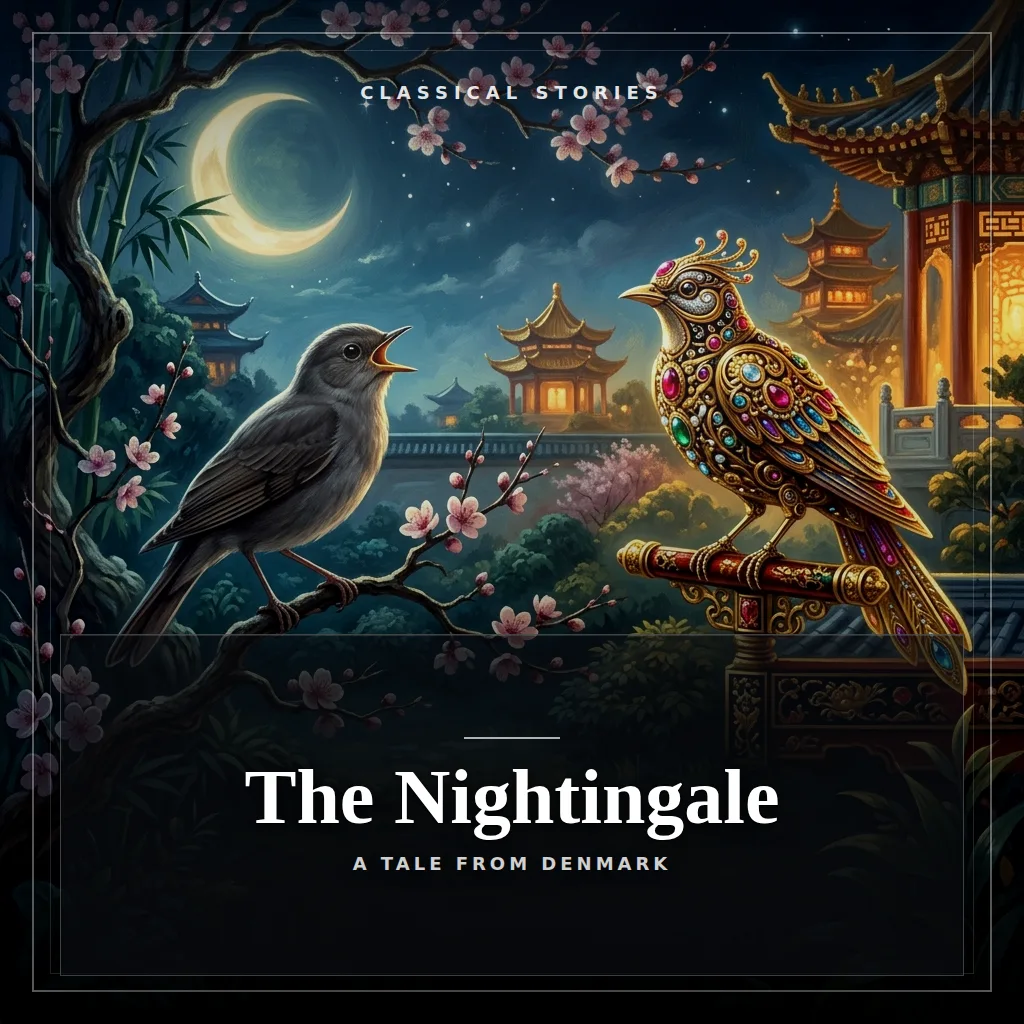
The emperor of China, in his porcelain palace, learns that travelers praise one thing above all his treasures: a plain little nightingale that sings in the forest by the sea. He has the bird brought to court, and its song moves everyone to tears. But then a rival ruler sends a gift — a mechanical nightingale, encrusted with jewels, that sings one set tune whenever wound. The court is dazzled; the artificial bird can be repeated endlessly and always sounds the same, so the real nightingale, unnoticed, slips away back to the woods. Years pass; the mechanical bird wears out and falls silent. Then the emperor lies gravely ill, and no jeweled song can help him — until the real nightingale, hearing of his sorrow, returns to his window and sings, and its true song does what all the treasure in the palace could not.
Why it's worth a listen
An emperor discovers that the most beautiful sound in his kingdom comes from a plain little nightingale in the woods — until a gift arrives of a jeweled mechanical bird that sings the same song over and over, and the real bird is forgotten and flies away. Then, one night, only real song can do what jewels cannot. Andersen's exquisite fable about the real and the artificial, and what we truly need.
What listeners will learn
Subjects: world stories, literature, cultural literacy.
- character
- setting
- conflict
- choice
- consequence
- theme
- retelling
- nightingale
- classical
- stories
Questions for after listening
- Retell the central conflict in order.
- Name one important choice and what happened because of it.
- How did the setting or tradition shape the story?
A question to keep
What is the difference between something dazzling and something true — and which do you want beside you at the end?
Chapters
- The Palace of Porcelain and the Hidden Song
- The Kitchen Girl’s Guide
- Tears of True Song
- The Glittering Rival
- The Silent Spring
- The Visitor at the Window
- A Question to Keep
Read a transcript preview
In the ancient empire of China, there stood a palace so magnificent that its name was whispered in every corner of the earth. It was built entirely of the finest, most delicate porcelain, smooth as polished ice, and so fragile that to touch the walls was to risk shattering a dream. If you walked through its high, gleaming halls, you had to tread as softly as a cat, for the slightest stumble might send a tremor through a thousand years of beauty. This story comes to us from Denmark, written down nearly 200 years ago by a man named Hans Christian Anderson. He was a writer who loved the quiet corners of the world where truth hides, and he set this tale in a storybook version of China, a place of glittering gardens, silent courts, and deep mysterious forests. Surrounding the emperor's porcelain palace was a garden that stretched further than a person could walk in a single afternoon. In this garden grew the most extraordinary flowers, and to the grandest of these flowers, the imperial gardeners had tied tiny silver bells. Whenever the wind blew, the bells would tinkle and chime, so that no one could pass by without looking at the blossoms. The emperor's garden was a masterpiece of order. Every path was swept, every hedge was trimmed to perfection, and every stream flowed exactly where it was told to flow. But if you kept walking past the neatly manicured lawns, past the silver bells and the sculpted trees, the garden began to change. The paths faded into moss, the hedges grew wild and tall, and suddenly, you found yourself in a vast, dark forest that stretched all the way down to the deep blue sea. It was a place of giant pines and thick shadows, where great ships could sail right under the overhanging branches of the trees. And in one of these trees, just where the forest met the ocean, lived a little nightingale. The nightingale was not grand to look at. It did not have the bright, fiery feathers of a pheasant or the proud sweeping tail of a peacock. It was a small, dusty gray bird, so plain that if it sat still on a branch, you would pass right by without ever noticing it. But when the sun began to sink below the horizon, and the first stars blinked into the sky, the nightingale would open its beak and sing. Its song was unlike anything else in the world. It was not just a series of pretty whistles, it was a voice that seemed to hold the very heart of the earth. It sang of the cool night wind, of the silent depth of the sea, of the joy of being alive, and of the sweet, aching sorrow of things that must pass away. When the poor fishermen came down to the shore at night to cast their heavy nets, they would stop and stand completely still, forgetting their cold hands and their empty pockets. How beautiful it is, they would whisper into the dark. And though they had to return to their hard work, the music stayed with them like a warm coal in their chests. From all over the world, travelers came to admire the emperor's city. They gasped at the porcelain palace, they marvelled at the silver bells in the garden, and they wrote long, glowing accounts of everything they saw. But when they wandered into the deep forest and heard the nightingale, they all said the same thing. This is the best of all. When the travelers returned to their own lands, they wrote books about their journeys. The books were filled with praise for the grand buildings and the silver bells, but at the end of every chapter, they wrote, But the nightingale is the most wonderful thing of all. And the poets wrote beautiful verses about the little gray bird that lived by the sea. These books traveled across oceans and mountains, and eventually, they found their way back to the porcelain palace. One afternoon, the emperor of China sat in his golden armchair, reading one of these new books. He nodded his head, his imperial crown…
Editorial review
Quality reviewed · 94/100 on . Certificate EL-FA97-FA72 is bound to the exact narrated script.
The review checks factual care, audience fit, teaching quality, structure, tone and source honesty. Read the editorial standards.
Published 2026-07-11 · Updated