- Who is it for?
- Ages 8–14
- How long is it?
- 53 min
- What does it include?
- Synced read-along and a quiz
- What does it cost?
- Free — no sign-up required
About this audiobook
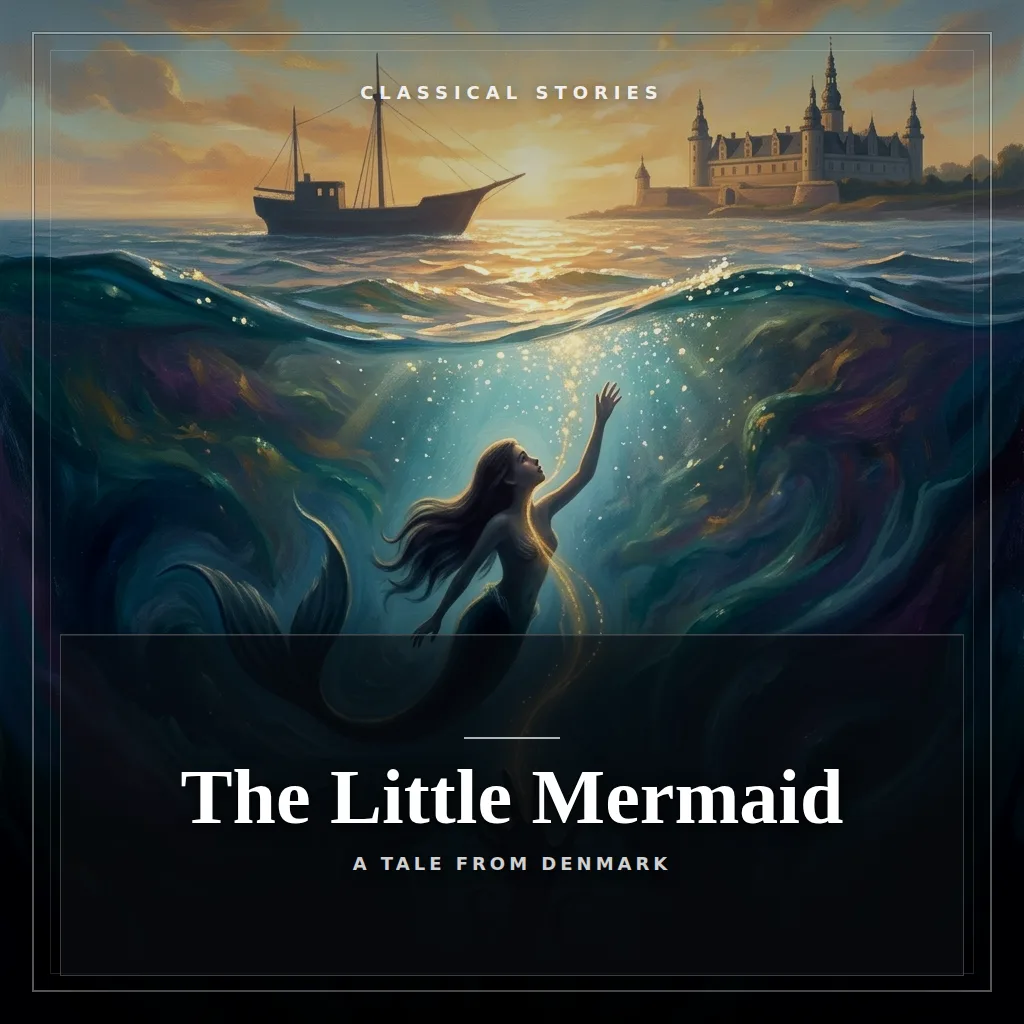
The youngest of the sea-king's daughters longs for the world above the waves, and on her first rise to the surface she saves a prince from drowning and falls in love — with him, and with the idea of the human soul that mermaids do not have. She goes to the sea-witch, who gives her legs in exchange for her beautiful voice, warning that every step will feel like knives and that if the prince marries another, she will not win a soul but dissolve into sea-foam. Voiceless, she wins the prince's fondness but not his love; he marries another, mistaking that princess for the girl who saved him. Offered a last cruel escape she cannot take, the little mermaid chooses mercy over herself — and Andersen gives her not the ending she sought but a gentler, stranger hope beyond it.
Why it's worth a listen
Andersen's original is stranger, sadder, and more beautiful than any retelling: a mermaid who longs not just for a prince but for a human soul, and who trades her voice — and endures pain with every step on her new legs — for the smallest chance at both. Told gently and honestly, it is one of the most moving fairy tales ever written, about longing, sacrifice, and a kind of hope that outlasts the ending you expect.
What listeners will learn
Subjects: world stories, literature, cultural literacy.
- character
- setting
- conflict
- choice
- consequence
- theme
- retelling
- little
- mermaid
- classical
Questions for after listening
- Retell the central conflict in order.
- Name one important choice and what happened because of it.
- How did the setting or tradition shape the story?
A question to keep
What does it mean to love someone, and to want a life, enough to give up your whole world for the chance?
Chapters
- The Garden Under the Sea
- The Storm and the Shore
- The Witch’s Crucible
- The Silent Guest
- The Silent Companion
- The Choice at Dawn
- A Question to Keep
Read a transcript preview
Far out in the ocean, where the water is as blue as the petals of the loveliest cornflower, and is clear as the purest glass, the sea is deeper than any anchor can reach. If you were to pile many church steeples one on top of the other, they would not reach from the sandy bed to the surface. It is down there, in the quiet depths, that the sea people live. This is a story that comes to us from Denmark, written down nearly 200 years ago by a man named Hans Christian Anderson. He gathered the whispers of the cold northern seas and shaped them into a tale that has been told in many ways since. But today, we return to the very heart of his original story. A story of deep water, great sacrifice, and a longing that reaches beyond the stars. You must not imagine that there is nothing down there but bare white sand. No, the most remarkable plants and trees grow there, with stalks and leaves so pliable that they bend at the slightest stir of the water, just as if they were alive. Great and small fish glide through the branches, just as birds fly through the trees in the air above. In the deepest spot of all, stands the castle of the sea king. Its walls are built of coral, and its long pointed windows are made of the clearest amber. The roof is formed of muscle shells that open and shut as the water flows over them, exposing the glittering pearls inside, any one of which would be the pride of a queen's crown in the world above. The sea king had been a widower for many years, and his old mother kept house for him. She was a wise woman, though very proud of her noble birth. Because of this, she wore 12 oysters on her tail, while the other lords of the sea were allowed only six. Aside from this small vanity, she deserved great praise, especially for her care of her six granddaughters, the sea princesses. They were all beautiful children, but the youngest was the loveliest of them all. Her skin was as clear and delicate as a rose petal. Her eyes were as blue as the deepest lake. But, like her sisters, she had no feet. Her body ended in a fish's tail. All day long, the sisters played in the great halls of the castle, where living flowers grew out of the stone walls. When the amber windows were opened, fish swam into them, just as swallows fly into our rooms when we open the windows. Only the fish swam right up to the young princesses, ate out of their hands, and allowed themselves to be stroked. In front of the castle was a large garden, and here, each of the princesses had her own little plot where she could dig and plant whatever she liked. One gave her garden the shape of a whale. Another thought it nicer to have hers look like a little mermaid. But the youngest made hers quite round, like the sun, and planted it only with flowers that glowed red like a sunset. She was a strange, quiet child, who spent much of her time thinking. While her sisters decorated their gardens with wonderful things they had gathered from shipwrecks, she cared for nothing but her red flowers, and a beautiful marble statue of a handsome boy, carved from pure white stone, which had fallen to the bottom of the sea from some wrecked vessel. Beside this statue, she planted a rose red weeping willow, which grew splendidly, and draped its fresh branches over the marble boy, casting violet shadows on the blue sand. To her, there was no greater pleasure than hearing about the world of humans above. She made her old grandmother tell her everything she knew about ships and towns, people and land animals. It seemed wonderful to her that on the earth, the flowers had a sweet scent, which they did not have at the bottom of the sea, and that the forests were green, and the fish that lived in the trees there could…
Editorial review
Quality reviewed · 92/100 on . Certificate EL-314B-9B6E is bound to the exact narrated script.
The review checks factual care, audience fit, teaching quality, structure, tone and source honesty. Read the editorial standards.
Published 2026-07-11 · Updated