- Who is it for?
- Ages 8–14
- How long is it?
- 35 min
- What does it include?
- Synced read-along and a quiz
- What does it cost?
- Free — no sign-up required
About this audiobook
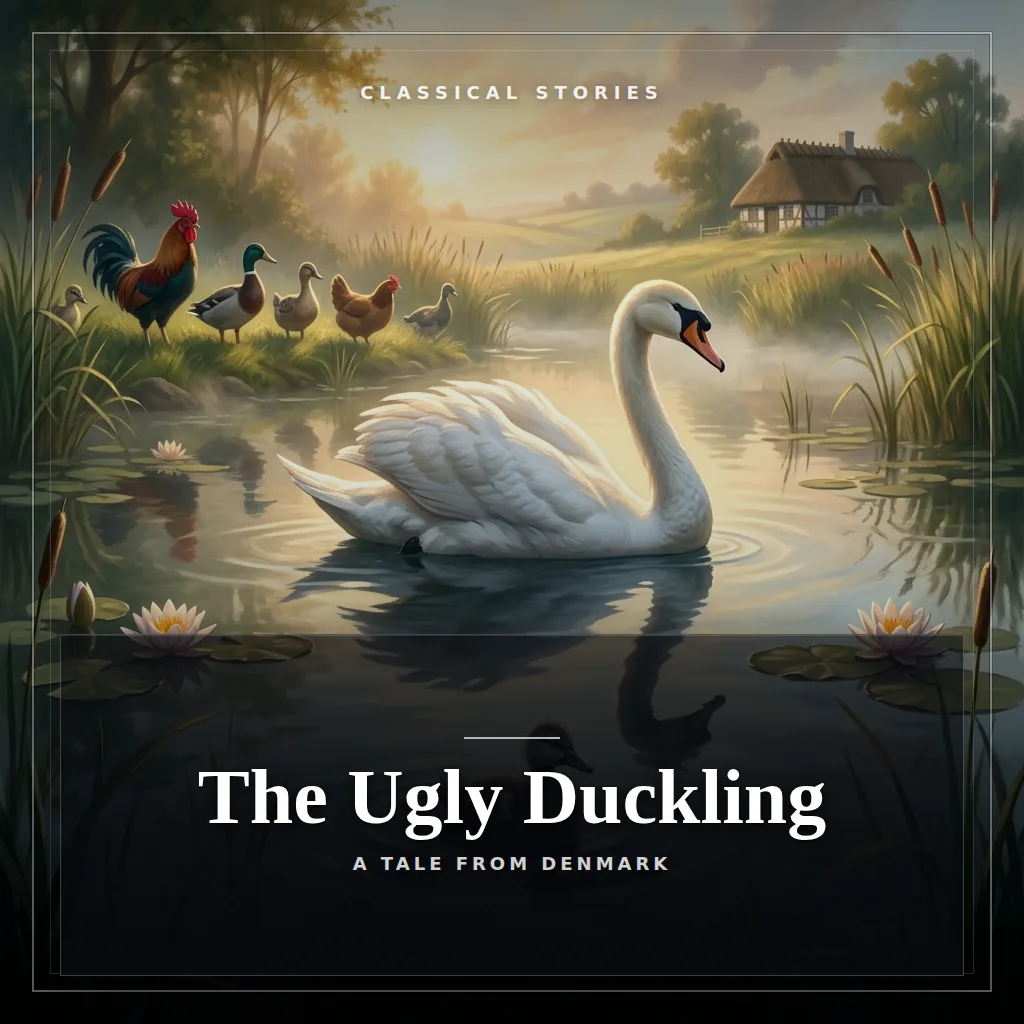
In a farmyard, a duck's eggs hatch — all but one, larger than the rest, which finally opens to reveal a big, grey, ungainly chick. Because he looks different, he is pecked and mocked by the ducks, chased by the hens, scorned by the farmyard, until he runs away. Alone, he wanders through a hard world and a bitter winter — turned out by wild geese, frightened by hunters, nearly frozen, taken in and then driven off again — always the odd one, always alone, believing himself simply too ugly to belong anywhere. Then spring arrives, and he sees a flock of beautiful swans and, longing, approaches them ready to be rejected once more — and bends to the water, and finds in his own reflection not an ugly duckling but a swan.
Why it's worth a listen
A large grey bird hatches among ducklings and is mocked for being different by everyone he meets, through a long, cold, lonely winter — until spring comes and he sees his own reflection among a family of swans and understands at last what he was all along. Andersen's tender, hopeful story about not fitting in, and about becoming who you always were.
What listeners will learn
Subjects: world stories, literature, cultural literacy.
- character
- setting
- conflict
- choice
- consequence
- theme
- retelling
- ugly
- duckling
- classical
Questions for after listening
- Retell the central conflict in order.
- Name one important choice and what happened because of it.
- How did the setting or tradition shape the story?
A question to keep
When you don't fit in anywhere, is something wrong with you — or are you simply in the wrong place?
Chapters
- Introduction
- The Last Egg in the Nest
- The Hard Ways of the Yard
- Into the Great Wild Marsh
- The Cottage and the Cold
- The Luminous Strangers
- A Question to Keep
Read a transcript preview
Number 76. The ugly duckling. The summer in Denmark that year was a golden, lazy thing. If you walked along the countryside, you would find yourself waiting through fields of yellow corn and green oats, while down in the meadows, the hay was gathered in great fragrant stacks that smelled of sun-warmed earth and sweet dried clover. It is here, in this quiet corner of Northern Europe, that our story begins. It is a story that has been told in many ways, by many voices, since a kind-hearted Danish writer named Hans Christian Anderson first set it down on paper in the winter of 1843. He knew what it was like to feel out of place, and so he wrote a tale for anyone who has ever looked around and wondered if they belonged to a different world altogether. Near a grand old country house with deep canals surrounding its stone walls, there grew a veritable forest of burdock leaves. These leaves were so tall that a small child could stand upright beneath them without touching the green canopy above. It was a wild, secret, shadowed place, and deep within this jungle of stems and giant leaves, a mother duck had built her nest. She had been sitting on her eggs for what felt like an eternity. Sitting on a nest is a lonely business for a duck. Her friends preferred swimming in the cool canals to sitting under the hot leaves chatting with her. So she was left alone with her thoughts and the silent, patient warmth of her own feathery body. But at last, the shells began to crack. Peep, peep, went one tiny voice, then another. Peep, peep. The little yellow heads poked out into the green light of the burdock forest. They looked about them in absolute wonder, their dark, bead-like eyes taking in the vastness of the leaves. "How large the world is," said the little ones, stretching their necks. Their mother smiled, rustling her wings. "Do you think this is the whole world? Oh no, it stretches far beyond the garden, right into the parson's field. Though, I have never been so far myself. Are you all here?" She stood up, her webbed feet shifting carefully. "No, they were not all here. The largest egg of all still lay in the center of the nest, smooth and stubborn. Oh dear," sighed the mother duck, settling herself back down. "How much longer must this go on?" An old duck, who was highly respected in the neighborhood for her wisdom and her very grand manners, came waddling down the path to pay a visit. She stopped under the burdock leaves and peered into the nest. "Well, how are we getting on?" the old duck asked, her voice raspy and slow. "This one egg is taking a terribly long time," the mother duck replied, nudging the large grayish shell with her bill. "It simply will not break. But look at the others. Are they not the prettiest ducklings you have ever seen? They look exactly like their father, the scamp. He hasn't come to visit me once." The old duck waddled closer and squinted at the unhatched egg. "Let me see it." "Ah, yes, that is a turkey's egg. You mark my words. I was cheated that way once myself, and let me tell you, it was nothing but trouble. Turkeys are afraid of the water. I couldn't get the creature into the canal no matter how much I quacked and scolded. Leave it where it is. Go and teach your other children how to swim." The mother duck looked at the large egg. It looked cold and lonely sitting there, while its siblings huddled together, warm and fluffy. "I think I've sat on it for this long," the mother said softly. "I can sit on it a little longer. A few more days won't hurt." "Please yourself," said the old duck, turning her tail. "But don't say I didn't warn you." And with a stiff shake of her feathers, she waddled away. At last, the great egg cracked. "Peep," said the newcomer. But it was not a bright, sharp peep. It was a low, hollow sound.…
Editorial review
Quality reviewed · 96/100 on . Certificate EL-77E0-4156 is bound to the exact narrated script.
The review checks factual care, audience fit, teaching quality, structure, tone and source honesty. Read the editorial standards.
Published 2026-07-11 · Updated