- Who is it for?
- Ages 8–14
- How long is it?
- 42 min
- What does it include?
- Synced read-along and a quiz
- What does it cost?
- Free — no sign-up required
About this audiobook
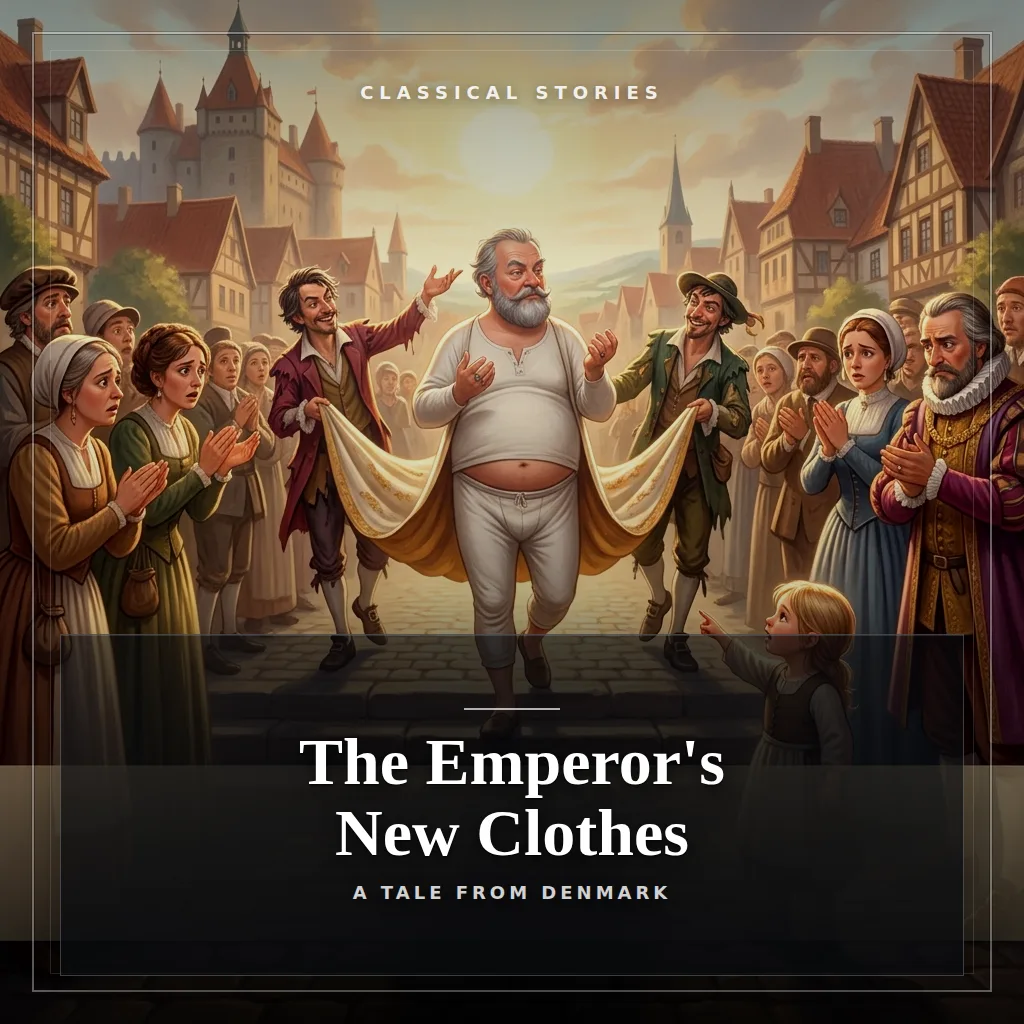
A vain emperor who cares only for fine clothes is visited by two swindlers posing as weavers, who claim to make cloth of a magical property: it is invisible to anyone who is stupid or unfit for their post. They 'weave' at empty looms, and no one — not the emperor, not his ministers, not the emperor himself — dares admit to seeing nothing, for fear of being thought a fool. The swindlers 'dress' the emperor in the nonexistent finery, and he parades through the city in a grand procession, everyone praising clothes that aren't there, all of them trapped by the same fear. Then a small child in the crowd, too young to have learned to pretend, cries out that the emperor has nothing on at all — and the truth, once spoken, spreads through the whole crowd.
Why it's worth a listen
Two swindlers promise a vain emperor a magical suit of clothes so fine that only the wise and worthy can see it — which means no one dares admit they see nothing at all, not the ministers, not the crowd, not the emperor parading down the street in his underclothes. Until one small child, who hasn't learned to pretend, says the six words that pop the whole bubble. The wisest, funniest little story about honesty ever told.
What listeners will learn
Subjects: world stories, literature, cultural literacy.
- character
- setting
- conflict
- choice
- consequence
- theme
- retelling
- emperor
- clothes
- classical
Questions for after listening
- Retell the central conflict in order.
- Name one important choice and what happened because of it.
- How did the setting or tradition shape the story?
A question to keep
Why is it so hard to say the obvious truth when everyone around you is pretending?
Chapters
- The Sovereign of Silks and Satins
- The Magic of the Loom
- The Court of Whispers
- The Emperor’s Eyes
- The Fitting and the Procession
- A Question to Keep
Read a transcript preview
[ 00:00] There was once an emperor who loved nothing in the world so much as beautiful new clothes. [ 00:09] While other rulers spent their mornings reviewing their armies, visiting their universities, or deciding the laws of the land, this emperor spent his hours in a room lined with mirrors, draped in silks of every color under the sun. [ 00:27] He did not care for the theater, he did not care for rides in the forest, and he only cared for his soldiers if their uniforms happened to be of a particularly splendid shade of crimson or gold. [ 00:41] This story comes to us from the cold, windswept shores of Denmark, written down nearly two centuries ago, in the year 1837, by a man named Hans Christian Anderson. [ 00:55] He was a writer who looked at the grand, serious world of grownups and saw the funny, fragile truths underneath. [ 01:04] Like many great tales, this one has been told in a thousand different ways across the generations, but the heart of it remains as bright and sharp as a needle. [ 01:14] It is a story about the maps we draw in our minds, the things we pretend to see, and the quiet power of a single honest voice. [ 01:24] In the grand capital of the emperor's kingdom, life was bustling, merry, and full of travelers. [ 01:31] But no matter who arrived at the city gates, the talk of the town always returned to the palace and the ruler who lived within it. [ 01:39] Most kings had a council chamber where they spent their days. [ 01:43] In this empire, if a foreign ambassador arrived and asked to see the ruler, the servants would not say, the king is in council. [ 01:50] Instead, they would bow politely and whisper, the emperor is in his wardrobe. [ 01:57] He had a different coat for every single hour of the day. [ 02:02] There was the morning coat of pale blue linen, stitched with silver threads that mimicked the morning dew. [ 02:10] There was the midday coat of deep forest green, heavy with emerald buttons that caught the light like sunbeams filtering through leaves. [ 02:20] There was the afternoon coat of plum-colored velvet, and the evening coat of midnight silk, so dark and rich it seemed to swallow the light of the candles. [ 02:32] The emperor's wardrobe was not merely a room. [ 02:36] It was a vast, labyrinthine hall of cedar chests, brass hangers, and velvet-lined drawers. [ 02:44] A small army of tailors, button makers, weavers, and starchers worked day and night, just to ensure that the emperor never had to wear the same outfit twice in a single month. [ 02:58] The emperor's obsession was a great boon to the city's merchants, but it was also a source of constant anxiety for his ministers. [ 03:06] The treasury was always nearly empty, drained by the constant demand for rare dyes from the east, soft furs from the north, and delicate lace from the south. [ 03:18] Yet, no one dared to suggest that the emperor might spend a little less on his collars and a little more on the city's crumbling bridges. [ 03:27] To do so would be to risk his displeasure, and a displeased emperor was a very uncomfortable thing indeed. [ 03:35] One sunny afternoon, two men arrived at the city gates. [ 03:41] They carried no heavy chests of fabric, no looms, and no shears. [ 03:47] They had only two small dusty bags and a great deal of confidence. [ 03:54] They were swindlers, rogues who made their living not by the honest sweat of their brows, but by understanding the secret fears and vanities of other people. [ 04:06] They had heard of the emperor who lived for fashion, and they had devised a plan so brilliant, so daring, and so utterly preposterous that it could only succeed in a court built on pretense. [ 04:23] They put it about the city that they were weavers, but not ordinary weavers. [ 04:29] They claimed to be master craftsmen from a distant,…
Editorial review
Quality reviewed · 98/100 on . Certificate EL-CAAE-FAB4 is bound to the exact narrated script.
The review checks factual care, audience fit, teaching quality, structure, tone and source honesty. Read the editorial standards.
Published 2026-07-11 · Updated