- Who is it for?
- Ages 8–14
- How long is it?
- 42 min
- What does it include?
- Synced read-along and a quiz
- What does it cost?
- Free — no sign-up required
About this audiobook
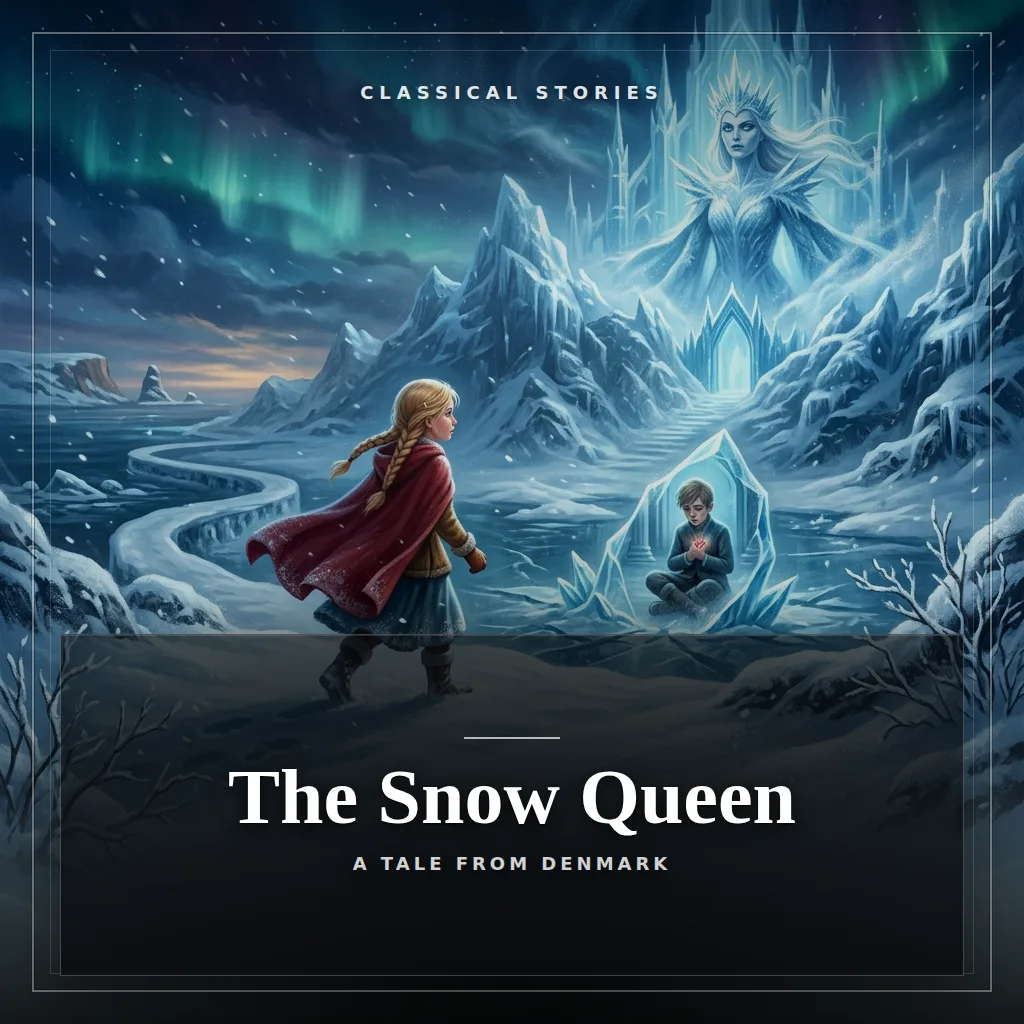
Kai and Gerda are as good as brother and sister, raised across a rooftop from each other with a rose garden between the window boxes. Then the goblin mirror — made to show everything good as shriveled and everything bad as grand — shatters in the sky, and two splinters find Kai. The boy who loved roses now loves only snowflakes, 'because they are perfect'; and one white winter day he ties his sled to a great white sledge, and is gone. Everyone says he is dead. Gerda does not believe everyone. She puts on her red shoes and starts walking north.
Why it's worth a listen
A goblin mirror shatters across the world, and one sliver lands in a boy's eye and one in his heart — turning everything he loves ugly and everything cold beautiful. Then the Snow Queen's sledge carries him north. What follows is one of the great rescue journeys: a girl with no magic at all, walking through seasons, palaces, and robber camps, armed with nothing but refusing to give up.
What listeners will learn
Subjects: world stories, literature, cultural literacy.
- character
- setting
- conflict
- choice
- consequence
- theme
- retelling
- snow
- queen
- classical
Questions for after listening
- Retell the central conflict in order.
- Name one important choice and what happened because of it.
- How did the setting or tradition shape the story?
A question to keep
What can ordinary, stubborn love do against cleverness without kindness?
Chapters
- The Glass in the Eye and the Heart
- The Great White Sledge
- The River and the Flowered Garden
- Gold Coaches and Wild Robbers
- The Lapland Woman and the Finland Woman
- The Ice Palace and the Return Home
Read a transcript preview
There are mirrors that tell the truth, mirrors that lie, and then there was the mirror made by the greatest goblin of them all. He was one of the worst kind of goblins, the devil himself, some said, and he was terribly pleased with his invention. This mirror had a peculiar malicious power. Everything good and beautiful reflected in it, shriveled up to almost nothing. While everything worthless and ugly stood out and became even worse than it was. The loveliest landscapes looked like boiled spinach in this glass, and the kindest people looked like monsters standing on their heads. If a good thought passed through a person's mind, the mirror showed a grin, and the goblin laughed at his cleverness. He and his pupils went everywhere with this mirror, showing it to everyone, until there wasn't a country or a person left that had not been distorted by it. Finally, the goblins decided they wanted to fly up to heaven itself. They wanted to hold the mirror up to the angels and mock the light of the sun. The higher they flew, the more the mirror grinned and shook with wicked laughter. It shook so hard that they could scarcely hold it. They flew higher and higher, closer to the stars, until the mirror trembled so violently that it slipped from their hands and fell down, down, down to the earth, where it broke into hundreds of millions, billions of pieces. And that was much worse than before. For the pieces were, some of them, smaller than a single grain of sand. They flew about in the air, and if a tiny splinter of this glass got into a person's eye, it stayed there. From that moment on, that person saw everything distorted, seeing only the flaws, the mistakes, and the ugliness in the world, because every little fragment kept the power of the whole mirror. Even worse, some of these splinters were large enough to be made into window panes, through which one could no longer see friends clearly. And some pieces were made into spectacles, and when people put them on to see better and judge fairly, everything went wrong. A few splinters were so sharp that they found their way deep into people's chests, directly into their hearts. And when that happened, the heart became like a lump of ice, cold, heavy, and unfeeling. In Denmark, a beautiful land of low hills, ancient beach forests and cold gray seas, they tell a story about this mirror. It is a story that has been told in many ways over the last 200 years, but its heart remains as true as a wooden floor under your feet. In a large, crowded town in this northern land, there lived two children who were not brother and sister, but who loved each other just as much. Their names were Kai and Gerda. Their parents lived in two attic rooms that faced each other across the narrow gutter of the roof. Where the two roofs came close together, there was a wooden window box on each side, filled with kitchen herbs and beautiful blooming roses. In the summer, the children could step out of their windows onto the roof, sit on their little wooden stools under the roses, and play together for hours. In the winter, when the snow fell and the window panes were covered in frost, they could not do this. They had to warm copper coins on the stove and press them against the frozen glass to make round, clear peepholes. Through these holes, Kai would look from his side and Gerda from hers, waving across the white falling snow. Those are the white bees swarming, Kai's old grandmother told them one winter evening as they sat by the warm stove. Do they have a queen bee too? asked Kai, for he knew that real bees always had one. Yes, they do, said the grandmother. She flies where the swarm is thickest. She is the largest of them all, and she never stays still on the earth. She always flies back up into the black cloud. Many a winter night, she flies through the streets of the town…
Editorial review
Quality reviewed · 92/100 on . Certificate EL-E0ED-4752 is bound to the exact narrated script.
The review checks factual care, audience fit, teaching quality, structure, tone and source honesty. Read the editorial standards.
Published 2026-07-10 · Updated