- Who is it for?
- Ages 8–14
- How long is it?
- 44 min
- What does it include?
- Synced read-along and a quiz
- What does it cost?
- Free — no sign-up required
About this audiobook
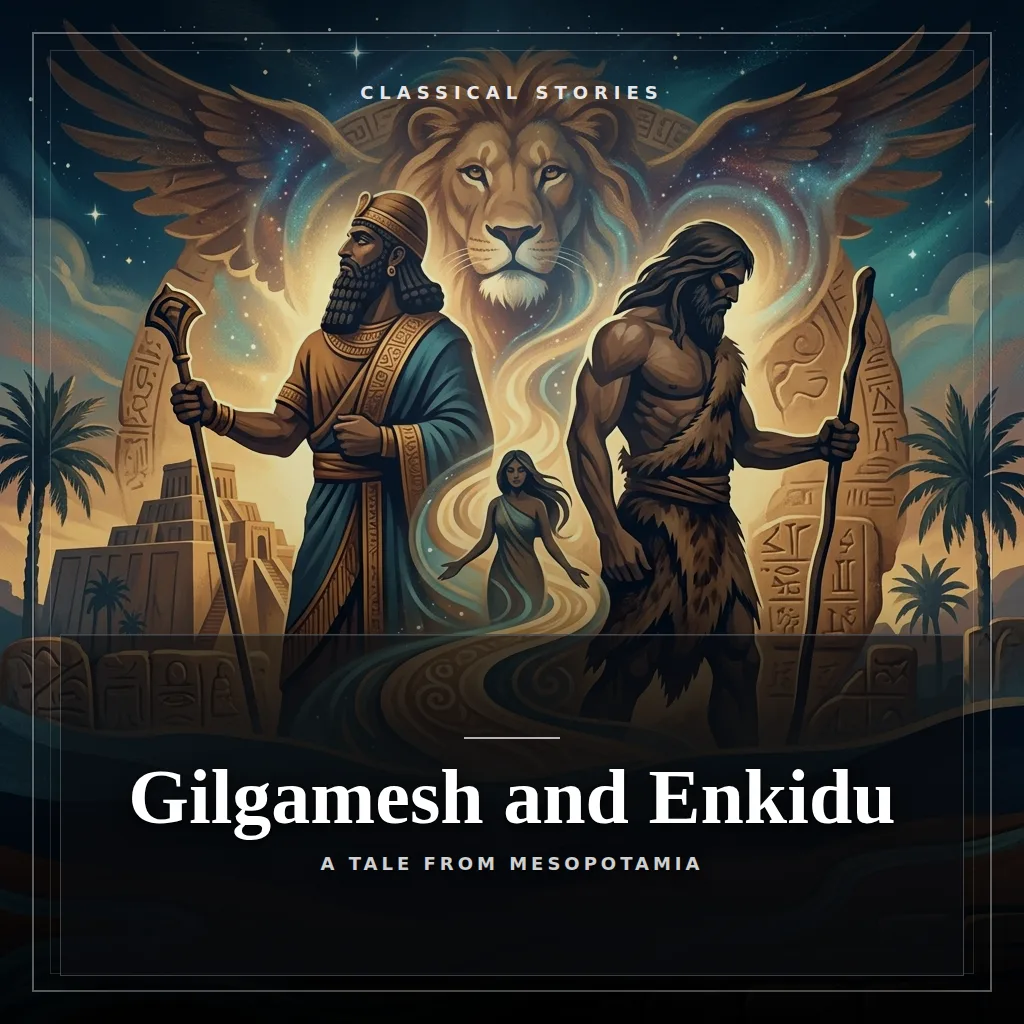
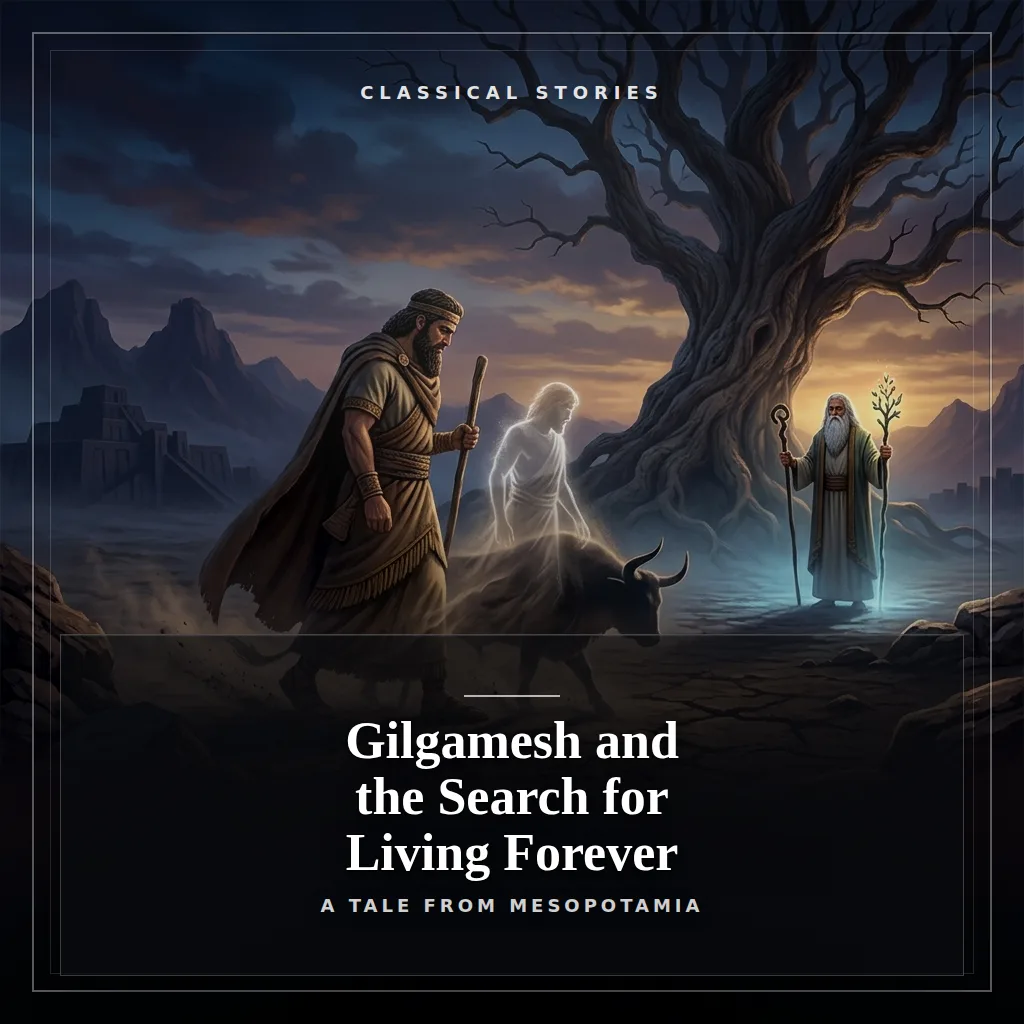
Gilgamesh, king of Uruk, is shattered by the death of his friend Enkidu and terrified that the same fate waits for him. Refusing to accept it, he journeys to the ends of the earth to find Utnapishtim, the one man granted immortality after surviving a great flood. The road is brutal — scorpion-guarded mountains, the sun's dark tunnel, the ferry across the waters of death. When he finally arrives, Utnapishtim tells him the hard truth: death is the lot of humankind. He offers Gilgamesh one chance at a plant of youth from the sea-bottom — which a serpent snatches away the moment the king sets it down. Gilgamesh goes home empty-handed, and wiser: the walls he built, the life he has, are the only immortality a person gets.
Why it's worth a listen
After losing his dearest friend, the king of Uruk cannot accept that he too must die — so he sets out to find the one man who ever escaped death and learn his secret. He crosses mountains, the waters of death, and a garden of jewels, only to discover the answer is smaller, stranger, and truer than he hoped. The sequel to the world's oldest story, and its wisest chapter.
What listeners will learn
Subjects: world stories, literature, cultural literacy.
- character
- setting
- conflict
- choice
- consequence
- theme
- retelling
- gilgamesh
- search
- living
Questions for after listening
- Retell the central conflict in order.
- Name one important choice and what happened because of it.
- How did the setting or tradition shape the story?
A question to keep
If you cannot live forever, how should you live at all?
Chapters
- The King in the Wild
- The Sun's Dark Path
- The House at the Edge of the World
- The Silent Shore
- Bread and the Deep Waters
- A Question to Keep
Read a transcript preview
To understand the weight of a king's tears, you must first understand the size of his kingdom. Long ago, in the land of Mesopotamia, the fertile cradle of earth between the great Tigris and Euphrates rivers, where writing first began as small wedge-shaped marks pressed into wet clay, there stood a city called Uruk. It was a marvel of the ancient world. Its walls were made of burnt brick, baked so hard they gleamed like copper in the desert sun. It had vast orchards of date palms, busy marketplaces smelling of coriander and cedarwood, and grand temples that reached toward the blue sky. And ruling over Uruk was Gilgamesh. He was a king like no other. The old songs say he was two-thirds divine and only one-third human, built like a mountain bull, with eyes that saw to the ends of the earth. He was a builder of walls, a conqueror of monsters, and a man who believed there was nothing in this world he could not master. But Gilgamesh had a secret heavy truth inside him. That one-third of him which was human meant that like all humans, he was mortal. He was made of clay, and to clay he would one day return. For a long time, Gilgamesh did not think about this. He was too busy being glorious. But then, the unthinkable happened. Gilgamesh had a friend named Enkidu. Enkidu had been born in the wild, raised among the gazelles and the lions, running free until he came to Uruk. When Gilgamesh and Enkidu met, they fought like two crashing thunderstorms. But when the dust cleared, they embraced. They became closer than brothers. They shared everything, triumphs, dangers, feasts, and quiet nights under the stars. They thought that together, they were invincible. But the gods are jealous of human joy. A sudden, quiet sickness fell upon Enkidu. The wild man who could outrun the wind withered away in a palace bed. Gilgamesh sat beside him, holding his hand, watching the strength drain from his fingers. And then, Enkidu died. For seven days and seven nights, Gilgamesh sat by his friend's silent body. He would not let anyone bury him, hoping against hope that Enkidu was only sleeping, that those bright eyes would open and laugh once more. He wept until his throat was raw. He tore off his fine royal robes of purple wool and gold thread. He flung his crown into the dust. When they finally laid Enkidu in the earth, a terrible coldness settled in Gilgamesh's chest. It was not just grief, it was fear. "When I die, will I be like him?" Gilgamesh whispered to the empty air of his bed chamber. "Shall I lie down in the dirt and never rise again? Fear has entered my belly. I look at my own hands, and I see the dust waiting for them." The great king of Uruk could no longer bear the sight of his palace. The laughter in the streets sounded like mockery. The high walls felt like a prison. He left his throne, his people, and his city behind. He did not take a horse or a chariot. He dressed himself in the shaggy skins of wild beasts, let his hair and beard grow long and matted, and walked out into the wilderness. He wandered through the trackless deserts and the howling wastes, living on wild berries and whatever game he could hunt with his bow. He looked like a madman, a ghost haunting the edges of the living world. He was searching for something that no king's army could conquer, and no treasury could buy. He was searching for Utnapishtim. A long, long time ago, before the great cities were built, the gods had sent a monstrous flood to wash away all of humanity. But one man, Utnapishtim, had survived. Because of his wisdom and his faithfulness, the gods had granted him and his wife a unique gift. They were taken to live at the edge of the world, beyond the waters of death, to live forever. "I will find him," Gilgamesh swore, his voice cracking in the dry desert wind. "I will cross the world, I will climb the mountains,…
Editorial review
Quality reviewed · 98/100 on . Certificate EL-1317-C5F8 is bound to the exact narrated script.
The review checks factual care, audience fit, teaching quality, structure, tone and source honesty. Read the editorial standards.
Published 2026-07-11 · Updated