- Who is it for?
- Ages 8–14
- How long is it?
- 40 min
- What does it include?
- Synced read-along and a quiz
- What does it cost?
- Free — no sign-up required
About this audiobook
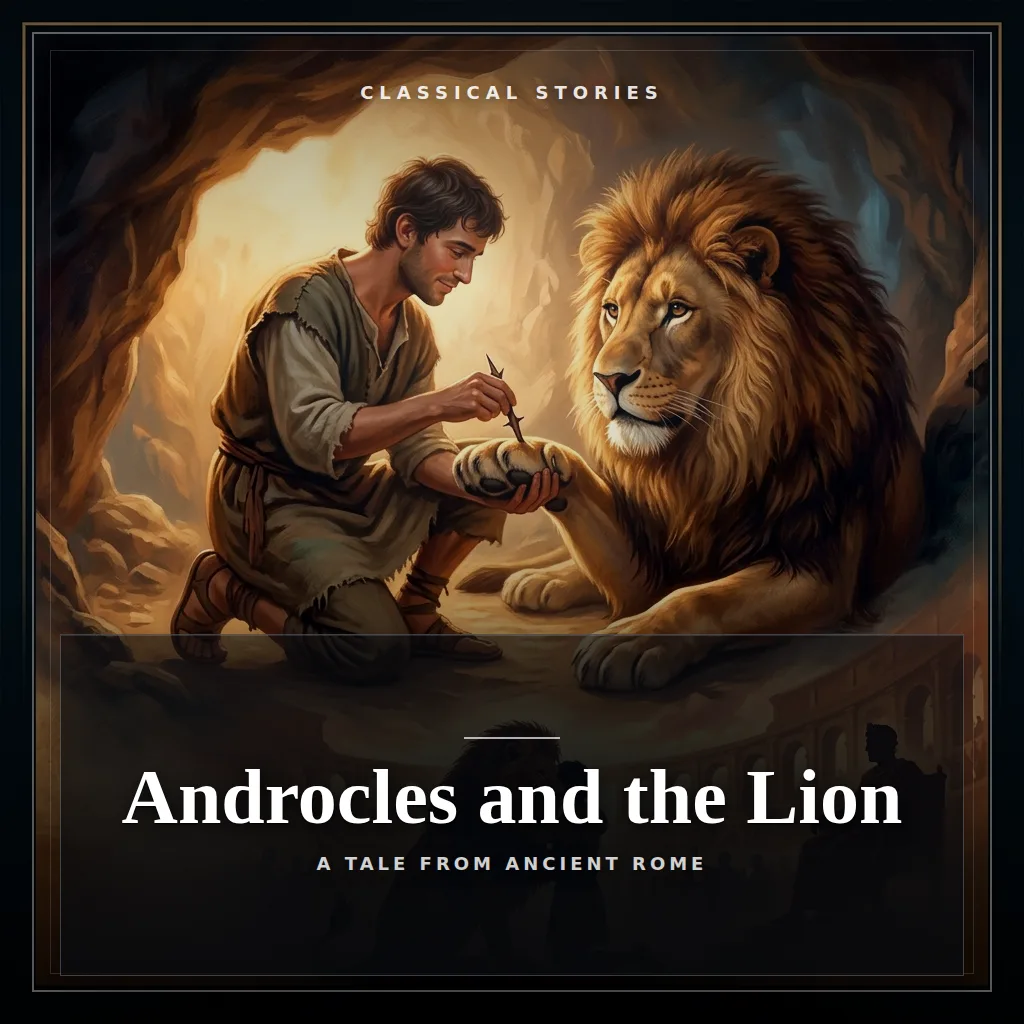
Androcles, a runaway slave, takes shelter in a cave in the wilderness — which turns out to be a lion's den. But the lion comes home limping, whimpering, and holds up a paw swollen around a great thorn. Instead of fleeing, Androcles gently draws the thorn out, and for a time the two live in the cave as unlikely companions. Later Androcles is captured and condemned to be thrown to a wild lion in the arena for the crowd's entertainment. The lion is loosed, races across the sand toward him — and stops, and nuzzles him, for it is the very lion he once healed. Even the emperor, astonished, sets them both free.
Why it's worth a listen
An escaped slave hiding in a cave meets a limping lion and, instead of running, pulls a thorn from its swollen paw. Months later, condemned to face a starving lion before a roaring crowd, he looks up at the beast bounding toward him — and recognizes an old friend. One of the oldest and warmest 'kindness returns' stories in the world.
What listeners will learn
Subjects: world stories, literature, cultural literacy.
- character
- setting
- conflict
- choice
- consequence
- theme
- retelling
- androcles
- lion
- classical
Questions for after listening
- Retell the central conflict in order.
- Name one important choice and what happened because of it.
- How did the setting or tradition shape the story?
A question to keep
Does a kindness ever really disappear — or does it wait to come back around?
Chapters
- The Flight and the Sanctuary
- The Guest with the Great Paw
- Life in the Shadows
- The Shadow of the Arena
- The Meeting on the Golden Sand
- The Emperor’s Question
- A Question to Keep
Read a transcript preview
The dry earth of the Roman countryside does not hide a runaway's footprints easily. When the wind blows from the south, carrying the hot, dusty breath of the sea, it sweeps across the olive groves and the rocky hills, whispering secrets to anyone who cares to listen. On this particular afternoon, the wind seemed to whisper of danger, of clinking iron, and of the heavy, rhythmic tread of soldiers marching along the paved stone roads. Androcles did not look back. He could not. His breath came in ragged, burning gasps that felt like hot sand in his throat. His feet, bare and cut by the sharp flint of the hills, left small dark spots of red on the gray stones behind him. He was running from a master whose heart was as cold and unyielding as the marble pillars of his great villa. In the vast and powerful world of ancient Rome, a culture of grand temples, roaring stadiums, and laws written in stone, to be an enslaved man who dared to run away was to invite the swiftest and most terrible wrath of the empire. This story, which has traveled down through the centuries to us, was first set down in parchment by a Roman writer named Aulus Gellius, and later woven into the wise and gentle fables of Aesop. It is a tale that has been told in many ways, by many voices, in many languages, but at its heart, it remains as bright and true as a polished coin. It is a story about the unseen threads that bind the smallest of us to the greatest, and how a single act of mercy can ripple outward through the world, waiting for its moment to return. As the sun began to sink toward the horizon, painting the sky in bruises of purple and deep gold, Androcles realized he could run no further. His legs trembled like dry reeds in a storm. The open scrubland of the North African province offered no places to hide, only low bushes and sunbaked boulders. If he stayed in the open, the searchers with their keen-nosed hounds would find him before the first stars appeared. Then, he saw it. High up on the side of a rugged limestone hill, a dark cleft yawned in the rock. It was a cave, its mouth half hidden by wild, tangled briers and dry, rattling vines. With the last ounce of his strength, Androcles scrambled up the loose scree, his hands scraping against the rough rock. He parted the thorny branches, heedless of the scratches they left on his arms, and tumbled into the cool, musty darkness of the cavern. Inside, the air was remarkably different. It was cool, thick with the scent of dry earth, ancient dust, and something else, something heavy, musky, and wild that made the hairs on the back of his neck stand up. But Androcles was too exhausted to care. The darkness felt like a heavy woolen blanket. He crawled into the deepest corner of the cave, where the shadows were thickest, pressed his back against the cold stone wall, and let his eyelids fall shut. For a few sweet hours, he was neither a slave nor a fugitive. He was simply a tired soul, asleep in the quiet heart of the earth. But sleep, no matter how deep, must always yield to the morning. It was not the light that woke Androcles, for the cave remained dim and gray. It was a sound. A low, vibrating rumble that shook the very dust on the stone floor beneath him. Androcles opened his eyes, his heart instantly leaping into his throat. His breath hitched. Silhouetted against the bright, arched opening of the cave was a shape so massive, it seemed to block out the sun. It was a lion. It was not a young, sleek beast, but a great, battle-scarred monarch of the wilderness. Its mane was a tangled, dark halo of dusty gold, and its shoulders were as broad as a draft ox's. The dry, metallic scent of wild beast filled the small cave, suffocating in its intensity. Androcles pressed himself so hard against the stone wall, he felt as if he…
Editorial review
Quality reviewed · 96/100 on . Certificate EL-2DC0-9ACC is bound to the exact narrated script.
The review checks factual care, audience fit, teaching quality, structure, tone and source honesty. Read the editorial standards.
Published 2026-07-11 · Updated