- Who is it for?
- Ages 8–14
- How long is it?
- 42 min
- What does it include?
- Synced read-along and a quiz
- What does it cost?
- Free — no sign-up required
About this audiobook
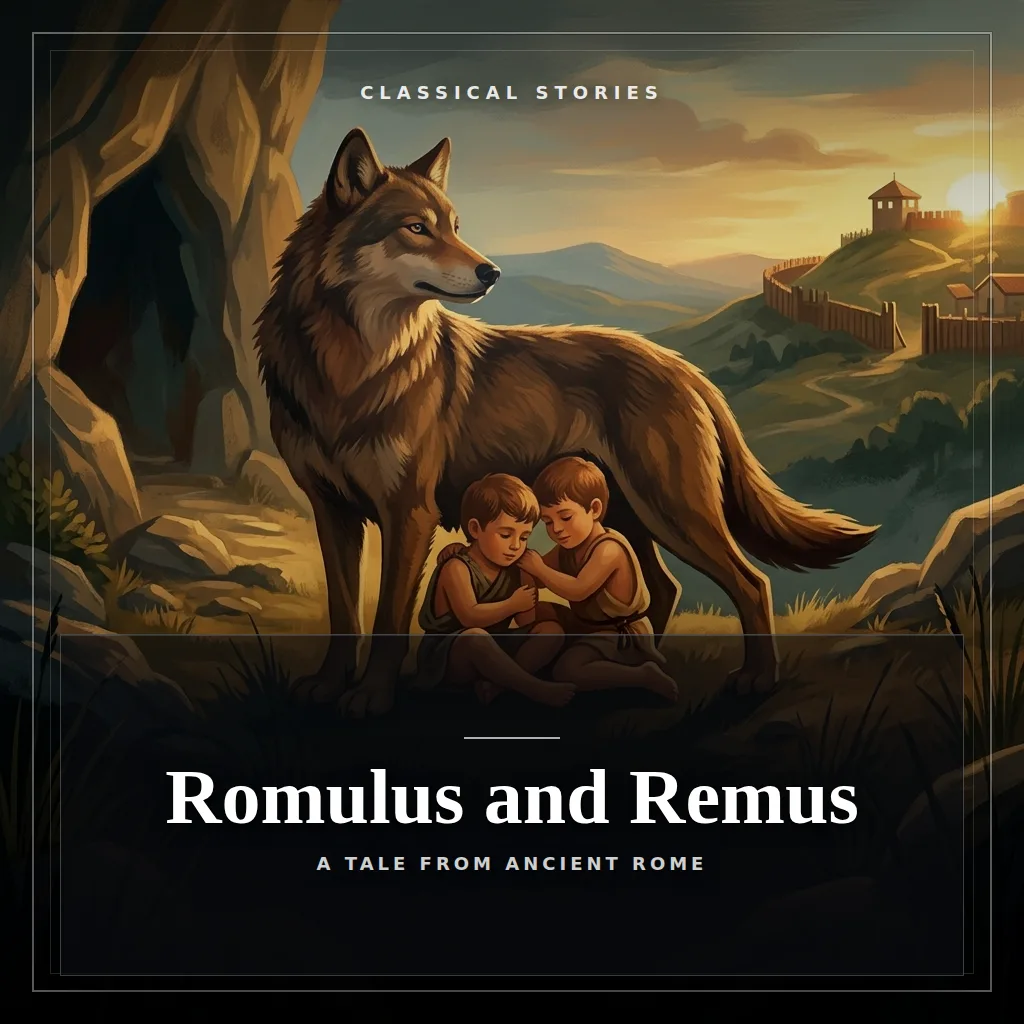
Twin brothers Romulus and Remus, royal babies condemned to die, are set adrift on the River Tiber and washed ashore, where a she-wolf finds and nurses them and a shepherd raises them. Grown into bold young men, they decide to found a city on the hills where they were saved. But they cannot agree on which hill, or whose name it will bear, and they look to the flight of birds for a sign. The signs are disputed, tempers flare, a boundary is mocked and crossed — and the founding of Rome is marked from its first day by a brothers' quarrel that ends only one way.
Why it's worth a listen
Two baby brothers are set adrift on a river to die, saved and suckled by a she-wolf, and grow up to found the greatest city of the ancient world — before a single terrible quarrel between them decides whose name it will carry. Rome's own story about itself, wolves and all.
What listeners will learn
Subjects: world stories, literature, cultural literacy.
- character
- setting
- conflict
- choice
- consequence
- theme
- retelling
- romulus
- remus
- classical
Questions for after listening
- Retell the central conflict in order.
- Name one important choice and what happened because of it.
- How did the setting or tradition shape the story?
A question to keep
When two people want to build the same dream, what happens if neither will give way?
Chapters
- Introduction
- The River’s Cradle
- The Mother in the Cave
- The Secret of the Hills
- The Language of Birds
- The Line in the Earth
- A Question to Keep
Read a transcript preview
Number 41. Romulus and Remus. Long before the great stone temples of Rome rose to touch the Italian sky, before the paved roads stretched like veins to the ends of the earth, and before the thunder of marching legions shook the hills, there was only the wild land. There was the rushing water of the river Tiber, the whisperings of the oak trees, and the quiet, watchful presence of the seven hills. This is a story from the heart of ancient Rome, a culture of builders, soldiers, and dreamers, whose language, laws, and stories still echo through our world today. Like many of the oldest tales, it has been told in dozens of ways by hundreds of voices over the course of more than 2,000 years. Yet, at its heart, it remains a story about two brothers, a shared dream, and the heavy price of pride. Our story begins in a time of shadows and stolen crowns, in an ancient city called Alba Longa, which nestled in the hills not far from where Rome would one day stand. The rightful king of this city was a kind and gentle man named Numitor. He ruled with justice, and the people loved him. But Numitor had a brother named Amulius, whose heart was cold, sharp, and hollowed out by jealousy. Amulius did not want to serve. He wanted to rule. With a band of armed men and a heart cleared of mercy, Amulius marched into the palace, dragged his brother Numitor from the throne, and banished him to a life of quiet exile in the countryside. Amulius crowned himself king, but like all tyrants who steal what is not theirs, he lived in constant, shivering fear. He feared the people, he feared the gods, and most of all, he feared that one day a descendant of Numitor would grow strong enough to take back the crown. To make sure this could never happen, Amulius kept a watchful, cruel eye on Numitor's family. When Numitor's daughter, a beautiful and gentle young woman named Rhea Silvia, gave birth to twin boys, the king's fear turned into a roaring panic. These were no ordinary babies. They were healthy, loud, and robust, with eyes that seemed to look straight through the shadows of the palace. Rumors whispered through the stone corridors that their father was none other than Mars, the fierce God of War himself. King Amulius knew that if these boys grew to manhood, his stolen reign would end in ruin. He could not allow them to live. Yet, even a tyrant feared the anger of the gods if he spilled royal blood with his own hands. So Amulius chose a colder, quieter way. He summoned a trusted servant, a man whose loyalty was bound by fear, and handed him a heavy wooden cradle containing the two sleeping infants. "Take them to the river Tiber," Amulius ordered, his voice like dry leaves scraping on stone. "Throw them into the deepest part of the current. Let the river do what I cannot. Let the water wash away my worries forever." The servant took the cradle and hurried out of the palace, his boots clicking against the cold marble floor. He walked through the gates of Alba Longa and down into the valley where the Tiber ran wild. It was the season of rains, and the river was not its usual gentle, golden brown self. It had swollen into a roaring monster, bursting its banks and flooding the low-lying plains. The water swirled with mud, uprooted trees and debris, rushing forward with a deafening growl. The servant stood at the edge of the flood waters. He looked down at the twin babies. They had woken up, but they were not crying. Instead, they looked up at him with wide, bright eyes, reaching their tiny hands toward the gray sky. The servant's heart failed him. He was a servant of a cruel king, but he was not a monster. He could not bear to throw these innocent children into the middle of that raging, freezing torrent. Instead, he walked as far into the shallows as he dared, until the muddy water lapped at his knees. He placed the…
Editorial review
Quality reviewed · 98/100 on . Certificate EL-B713-12A7 is bound to the exact narrated script.
The review checks factual care, audience fit, teaching quality, structure, tone and source honesty. Read the editorial standards.
Published 2026-07-11 · Updated