- Who is it for?
- Ages 8–14
- How long is it?
- 43 min
- What does it include?
- Synced read-along and a quiz
- What does it cost?
- Free — no sign-up required
About this audiobook
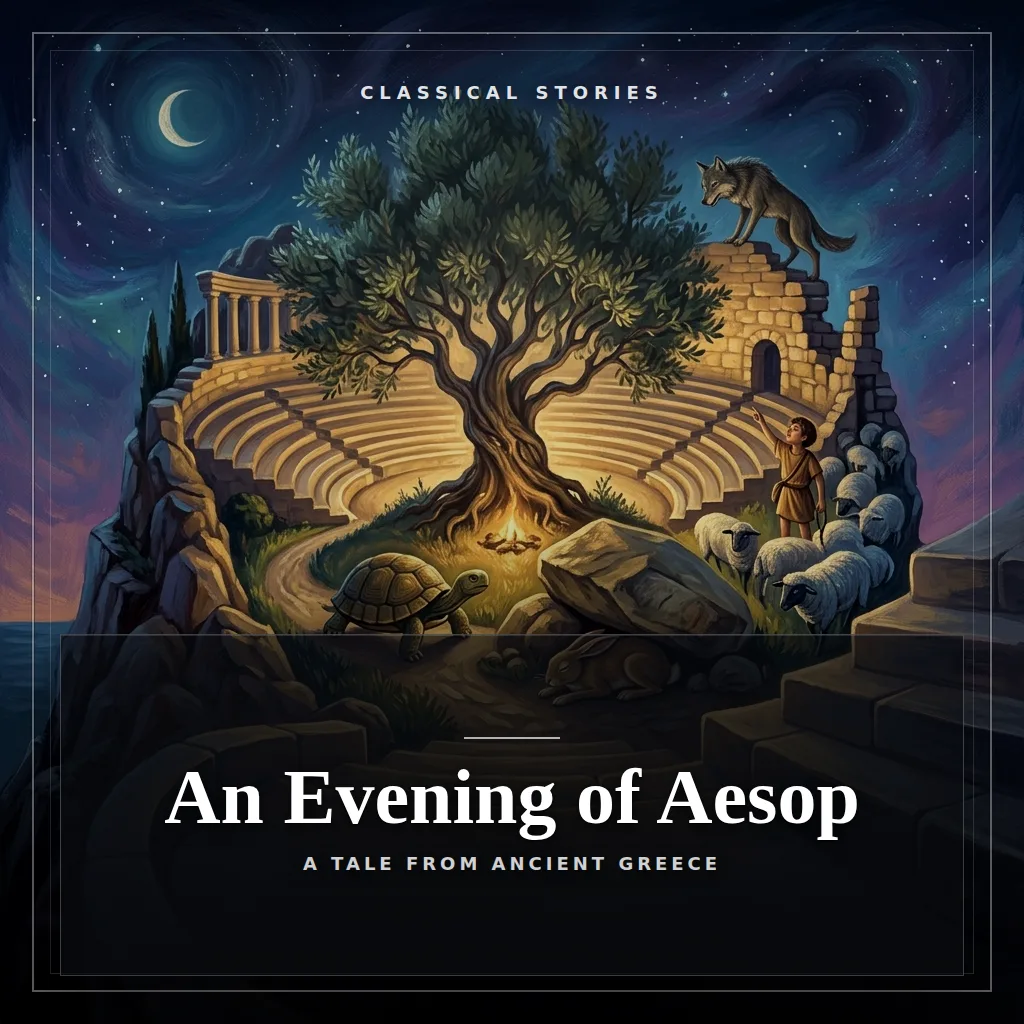
For the finale of the series, the narrator gathers the listener close for an evening of Aesop — the ancient Greek storyteller whose fables are the tiniest and most enduring stories in the world. One after another, the great small tales unfold: the slow tortoise who beats the boastful hare by never stopping; the shepherd boy who cries 'wolf!' for fun until no one believes his true alarm; the ant who works through summer while the grasshopper sings, and the hungry winter that follows; the fox who decides the grapes he cannot reach were sour anyway; the mighty lion spared by a tiny mouse who later gnaws him free of a hunter's net. Each is over in a minute and each carries a truth that has outlived empires. And as the fire burns low on the hundredth story, the narrator turns to the listener with the last question of all — not about any single fable, but about the whole long journey of a hundred tales, and why we have been telling them.
Why it's worth a listen
The hundredth and final episode gathers the tiny, perfect stories that may be the most-told of all: the tortoise who beats the hare, the boy who cried wolf, the ant and the grasshopper, the fox and the grapes, the lion and the mouse, and more — the fables of Aesop, so short a child can hold them and so wise a whole life can't wear them out. A warm fireside finale for a series about why humans tell stories at all, ending where storytelling is simplest and oldest.
What listeners will learn
Subjects: world stories, literature, cultural literacy.
- character
- setting
- conflict
- choice
- consequence
- theme
- retelling
- evening
- aesop
- classical
Questions for after listening
- Retell the central conflict in order.
- Name one important choice and what happened because of it.
- How did the setting or tradition shape the story?
A question to keep
After a hundred stories from all the world, what is the smallest story that still holds the most?
Chapters
- The Last Fire of the Hundred Nights
- The Dust and the Speed
- The Empty Hills
- The Song and the Seed
- A Garland of Quick Shadows
- The Great and the Small
- A Question to Keep
Read a transcript preview
The wood in the hearth has burned down to a deep, pulsing crimson. The kind of heat that does not roar or crackle, but whispers secrets into the quiet corners of the room. Outside, a gentle wind is turning the pages of the trees. But inside, we have reached the warmest, stillest part of the evening. If you look closely at the embers, you can see tiny landscapes rising and falling in the ash, mountains of gold, valleys of gray, and paths that wind away into the shadows. This is our hundredth evening together. We have traveled across frozen tundras, dived into the deepest oceans where dragons sleep, walked through palaces of jade, and run across planes of gold. We have met heroes with hearts of iron, and tricksters with pockets full of wind. But tonight, for our final journey, we do not need to travel far, nor do we need a map of great empires. We are going to look at the smallest stories ever told. Our destination is the sun-drenched rocky hills of ancient Greece, a land of silver-green olive groves, deep blue seas, and dusty roads where people walked in simple sandals, talking of philosophy, stars, and the sea. The ancient Greeks loved grand stories. They sang of 10-year wars, of gods who threw lightning from the clouds, and of heroes who sailed into the underworld. But they also loved another kind of story, one that did not require a choir or a golden harp. They loved the fables of a storyteller named Aesop. According to the old accounts, Aesop was not a king, a general, or a wealthy merchant. He was a quiet observer of the world. He spent his days watching the things that most people walked right past, a beetle rolling a ball of dirt, a dog looking at its reflection in a stream, a crow trying to reach the water at the bottom of a pitcher. He realized that the grandest truths about human beings, our bravery, our foolishness, our kindness, and our pride, did not need giant heroes to explain them. They could be explained by a mouse, a donkey, or a handful of grapes. Because these stories were spoken aloud on dusty Greek roads thousands of years before they were ever written down in books, they have been told in a thousand different ways. Every teller adds a little bit of their own warmth to the fire. And tonight, this is our telling. What is a fable? It is a story stripped of all its heavy armor, left with only its bones and its heart. It is a story that takes only a minute to tell, but a lifetime to forget. As we watch the embers glow, let us step onto that ancient Greek road and watch the animals walk, talk, and show us exactly who we are. If you had been standing on the edge of the great meadow on a warm, dusty afternoon in ancient Greece, you would have heard a sound like a tiny drum beat. Thump. Thump. Thump. It was the sound of the tortoise moving through the dry grass. He was a creature made of patience. His shell was heavy and gray, patterned like the dry earth itself, and his neck was long and wrinkled, ending in a face that looked as though it had seen the beginning of the world, and was in no particular hurry to see the end of it. Every step he took was a decision. He lifted one clawed foot, moved it forward three inches, set it down, balanced his weight, and then lifted the next. Behind him, there was a sudden, violent gust of wind and a cloud of dry leaves. "Out of the way, slow coach, out of the way!" This was the hare. He was a creature made of springs and nervous energy. His long ears twitched to the left, then to the right, catching the sound of every falling acorn. His hind legs were long and powerful, coiled like metal wires ready to snap. He did not walk. He leaped. He bounded. He zigzagged across the meadow just because he could. He stopped in front of the…
Published 2026-07-11 · Updated