- Who is it for?
- Ages 8–14
- How long is it?
- 36 min
- What does it include?
- Synced read-along and a quiz
- What does it cost?
- Free — no sign-up required
About this audiobook
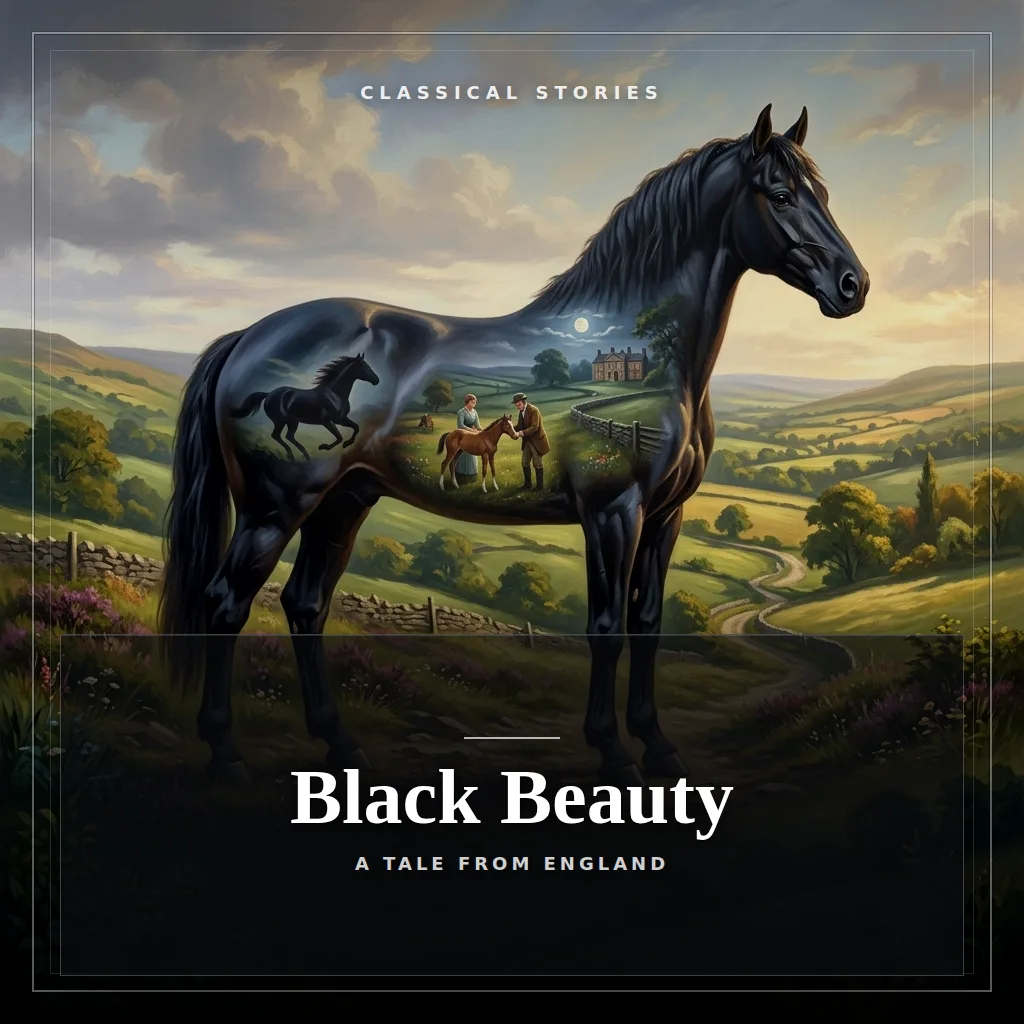
Black Beauty, a handsome, gentle horse, tells the story of his own life. Born in a pleasant meadow and well broken-in by a kind master, he passes, as horses do, from owner to owner and fortune to fortune — some who treat him with care and respect, and some whose thoughtlessness or cruelty (the tight bearing-rein that hurts his neck, a drunken groom, an overworked cab-horse's grind) bring him low. Along the way he befriends other horses like the spirited, ill-fated Ginger, and learns what a difference a kind word or a cruel hand makes to a creature that cannot speak for itself. Worn down by hard years, Beauty at last finds his way, through luck and the recognition of an old friend, to a peaceful home and gentle owners for the rest of his days — his told-from-the-inside life a quiet plea for kindness to all who serve us and cannot ask for it.
Why it's worth a listen
The whole story is told by a horse — Black Beauty himself — narrating his own life from a happy foalhood through many owners kind and cruel, so that we see the human world entirely from the other end of the reins. Anna Sewell's gentle, groundbreaking classic taught generations of readers to be kind to animals simply by letting one tell its own story.
What listeners will learn
Subjects: world stories, literature, cultural literacy.
- character
- setting
- conflict
- choice
- consequence
- theme
- retelling
- black
- beauty
- classical
Questions for after listening
- Retell the central conflict in order.
- Name one important choice and what happened because of it.
- How did the setting or tradition shape the story?
A question to keep
How should we treat those who can't speak for themselves — and what would they say if they could?
Chapters
- The Meadow and the Bit
- The Stables at Birtwick Park
- The Tightening Rein
- The Streets of London
- The Fair and the Final Turn
- A Question to Keep
Read a transcript preview
The first place I can well remember was a large, pleasant meadow, with a pond of clear water in it. Some shady trees leaned over it, and rushes and water lilies grew at the deep end. Over the hedge on one side, we looked into a plowed field, and on the other, we looked over a gate at our master's house, which stood by the roadside. At the top of the meadow was a grove of fur trees, and at the bottom, a running brook overhung by a steep bank. This story comes to us from England, a green and rainy island of rolling hills, ancient stone walls, and bustling cobblestone cities. It was a time, not so very long ago, when the world was powered not by engines of steel and steam, but by the strength of beating hearts. By the millions of horses who carried people to work, hauled heavy coal from the docks, and plowed the rich earth. While there are many ways to tell of this vanished time, this is the story of one black horse who lived it, and who learned, through joy and through sorrow, what it means to live at the mercy of human hands. While I was young, I lived upon my mother's milk, as I could not eat grass. In the daytime, I ran by her side, and at night, I lay down close by her. When it was hot, we stood under the shade of the trees, quite near the pond. And when it was cold, we had a warm, cozy shed near the grove. There were six young colts in the meadow besides me. They were older than I was and had great fun. We used to gallop all together round and round the meadow as hard as we could go. Sometimes, we had rather rough play, for they would frequently bite and kick as well as gallop. One day, when there was a good deal of kicking, my mother winnied to me to come to her, and then she said, "I wish you to pay attention to what I am going to say to you. The colts who live here are very good colts, but they are cart horse colts, and of course, they have not learned manners. You have been well bred and well born. Your father has a great name in these parts, and your grandfather won the cup two years at the New Market races. Your grandmother had the sweetest temper of any horse I ever knew, and I think you have never seen me kick or bite. I hope you will grow up gentle and good, and never learn bad ways. Do your work with a good will, lift your feet up well when you trot, and never bite or kick, even in play. I have never forgotten my mother's advice. She was a wise old horse, and our master, Farmer Gray, thought a great deal of her. Her name was Duchess, but he often called her pet. Our master was a good, kind man. He gave us good food, good lodging, and kind words. He spoke as gently to us as he did to his little children. We were all quite fond of him, and my mother loved him dearly. When she saw him at the gate, she would nay with joy and trot up to him. He would pat her and stroke her and say, "Well, old girl, and how is your little darky?" I was a dull black, so he called me darky. Then he would give me a piece of bread, which was very good, and sometimes he would give my mother a carrot. All the horses would come to him, but I think we were his favorites. But as I grew older, the time came for me to be broken in. To a young horse, this is a strange and frightening time. It means learning to wear a saddle and bridle, and to carry a human being on your back, going just the way they want you to go, even when you would rather run free. It means having a cold piece of iron, as thick as a man's…
Editorial review
Quality reviewed · 96/100 on . Certificate EL-1199-BFA9 is bound to the exact narrated script.
The review checks factual care, audience fit, teaching quality, structure, tone and source honesty. Read the editorial standards.
Published 2026-07-11 · Updated