- Who is it for?
- Ages 8–14
- How long is it?
- 44 min
- What does it include?
- Synced read-along and a quiz
- What does it cost?
- Free — no sign-up required
About this audiobook
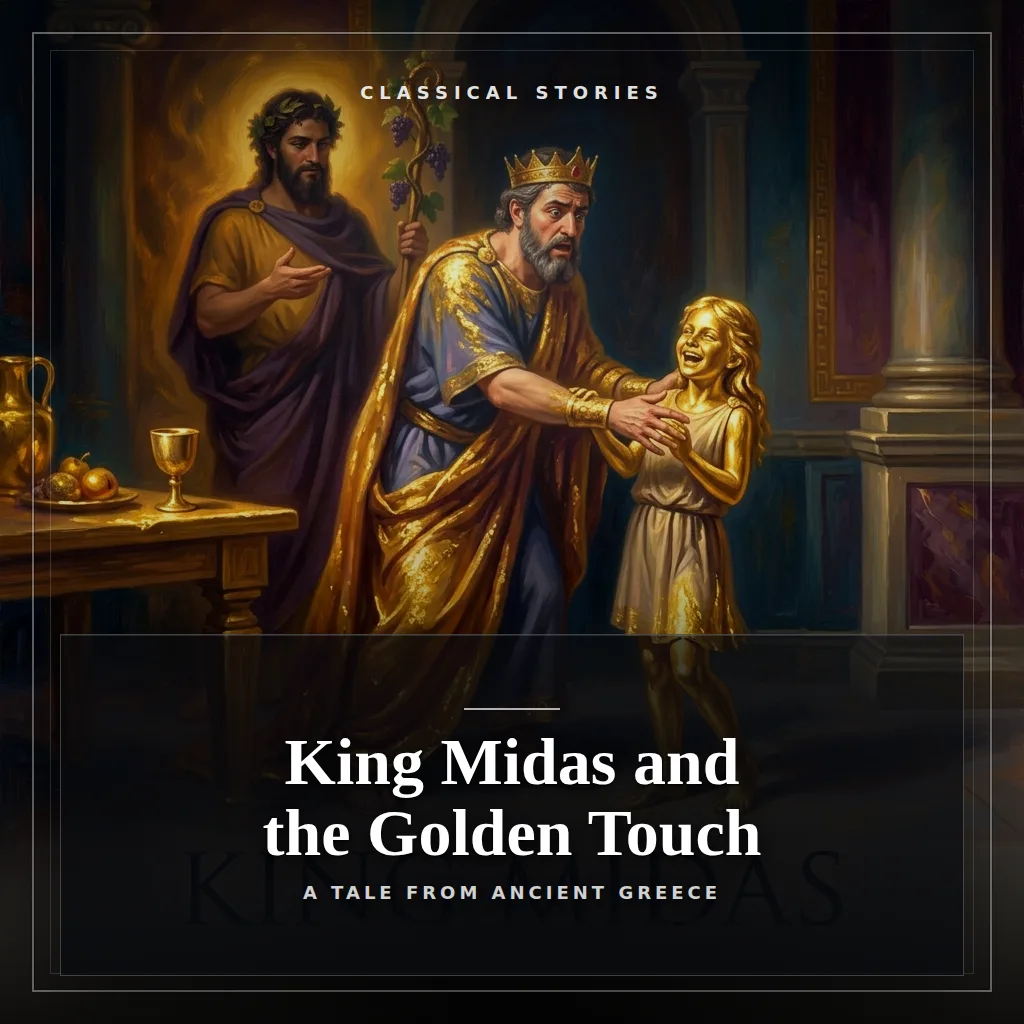
King Midas does a kindness to an old companion of the wine-god Dionysus, and the god grants him any wish he wants. Midas, who loves gold above all things, asks that everything he touches turn to gold. At first it is wonderful — twigs, stones, and roses stiffen into treasure at his fingertips. Then he tries to eat, and his bread and wine turn to metal in his mouth. And when his beloved daughter runs to comfort him, she too becomes a cold golden statue. Now the richest man in the world would give every ounce of it back.
Why it's worth a listen
A king is granted the one wish greedy hearts always make — that everything he touches turn to gold — and learns before the day is out that a golden rose has no scent, a golden feast cannot be eaten, and a golden daughter cannot laugh. The most famous 'be careful what you wish for' story ever told, and still the sharpest.
What listeners will learn
Subjects: world stories, literature, cultural literacy.
- character
- setting
- conflict
- choice
- consequence
- theme
- retelling
- king
- midas
- golden
Questions for after listening
- Retell the central conflict in order.
- Name one important choice and what happened because of it.
- How did the setting or tradition shape the story?
A question to keep
When you finally get exactly what you wished for, how do you know if it was worth wishing?
Chapters
- The King Who Counted in the Dark
- A God’s Sad Gift
- The Bright Morning of the World
- The Bitter Feast
- The Silent Princess
- The River of Wash-Away
- A Question to Keep
Read a transcript preview
[ 00:00] Deep beneath the stone floors of a great palace, where the air was always cool and smelled of damp earth and old iron, a key turned in a lock. It was a heavy bronze key, worn smooth by the touch of a single man's thumb, and the sound it made as it slid into the keyhole was a low, heavy click that echoed down the dark corridor. [ 00:30] This was the treasury of Frigia, and the man holding the key was King Midas. To the people who lived in the sunlit valleys outside the palace walls, Midas was a ruler of great fortune. His kingdom was rich, his soldiers were brave, and his palace was surrounded by gardens that were famous across the ancient world. [ 00:56] But to Midas, the world outside was only a distraction. The only place he felt truly at peace was here, in the dark, with the door locked tight behind him. [ 01:11] This story comes to us from the sun-drenched hills of ancient Greece, a land where people believed the gods walked among the olive groves, and the rivers held spirits of their own. Like all the best stories, it has been told and retold for thousands of years, traveling from the lips of Greek travelers to the parchment of Roman poets like Ovid, changing slightly with each voice, but keeping its true heart always the same. [ 01:43] And in every telling, Midas begins in the dark, counting. [ 01:49] On this particular morning, the king stepped into his vault and pulled a heavy wooden chest from the shadows into the single beam of sunlight that filtered down through a narrow grate in the ceiling. He lifted the lid. Inside lay thousands of gold coins, stamped with the faces of forgotten kings and the symbols of distant empires. [ 02:17] Midas did not want to spend them. He did not want to buy ships or build temples or feed his people with them. He simply wanted to see them. He plunged his hands into the chest, lifting a double handful of the heavy yellow metal and letting it spill back down through his fingers. The sound was like dry autumn leaves scraping across stone, but to Midas, it was the sweetest music in the world. [ 02:50] "Beautiful," he whispered, his voice a dry rustle in the vault. "Perfect. If only the whole world could be like this." [ 03:01] Outside the vault, the world was indeed very different. It was soft and green and constantly changing. Midas had a daughter, a girl whose name has been lost to the centuries, but whose laughter was said to sound like water dancing over river stones. She loved the palace gardens, where she spent her days tending to the roses that grew in thick, wild hedges. [ 03:28] These were no ordinary roses. They were the famous Frigian roses, 60-petaled and sweet-scented, filling the mountain air with a perfume so rich, it could make a traveler light-headed with joy. [ 03:43] Every afternoon, the princess would bring a basket of these roses into the palace, hoping to draw her father out into the sunshine. She would find him sitting on his throne, his eyes fixed on the gold trim of his footstool, his mind far away in his locked vaults. [ 04:04] "Look, Father," she would say, holding up a bloom that was the color of a summer dawn, still wet with dew. "The roses are twice as sweet today. Come walk with me in the garden. The wind is coming down from the mountains, and the air is perfect." [ 04:23] Midas would look at the flower, and though he loved his daughter, a little sigh of disappointment would escape his lips. "It is very pretty, my child," he would say, his voice gentle but tired. "But see how the petals are already beginning to curl at the edges? By tomorrow, they will turn brown and fall into the dust. It is a pity that something so beautiful must rot. If only it were made of gold, it would never wither. It would be perfect forever." [ 05:00] The princess…
Editorial review
Quality reviewed · 96/100 on . Certificate EL-621A-C5B7 is bound to the exact narrated script.
The review checks factual care, audience fit, teaching quality, structure, tone and source honesty. Read the editorial standards.
Published 2026-07-11 · Updated