- Who is it for?
- Ages 8–14
- How long is it?
- 34 min
- What does it include?
- Synced read-along and a quiz
- What does it cost?
- Free — no sign-up required
About this audiobook
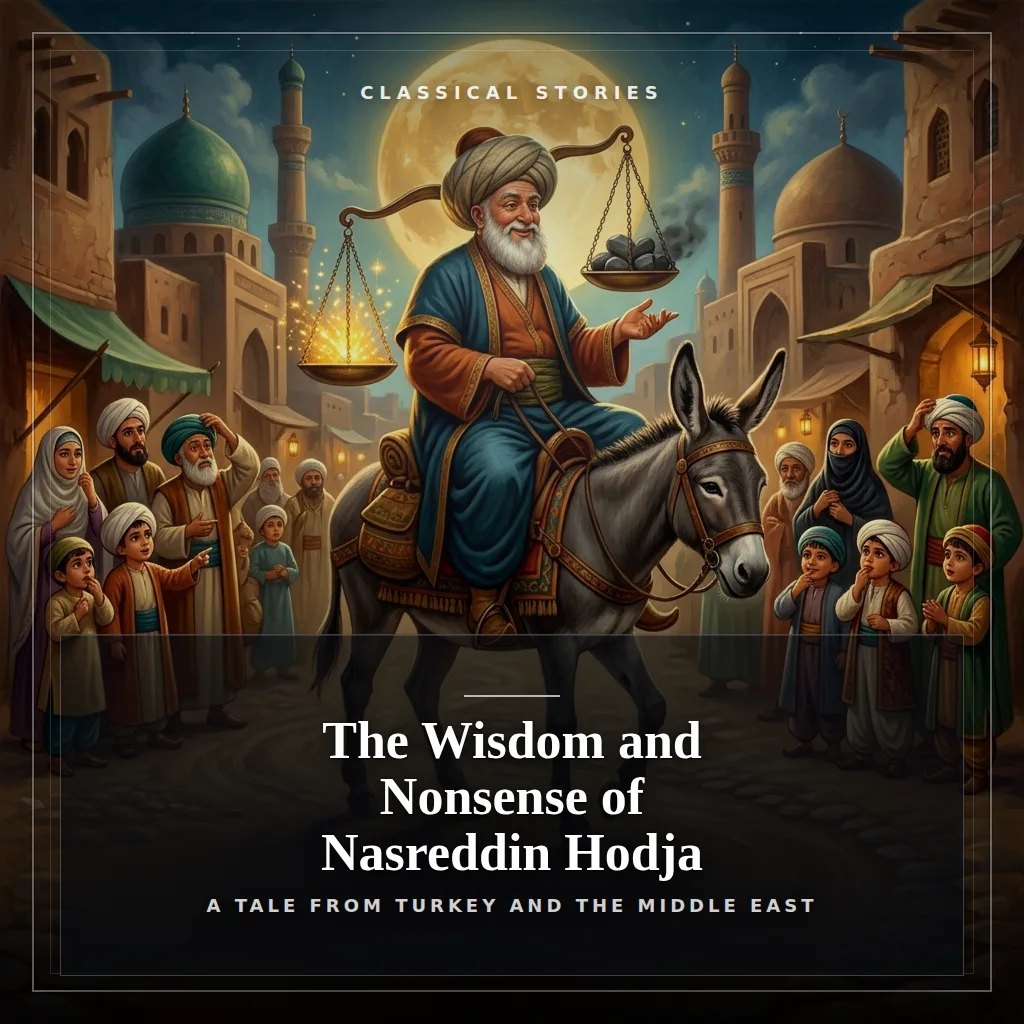
Nasreddin Hodja is the most beloved comic figure of the Turkish and Middle Eastern world — a village teacher and judge who seems like a bumbling fool but keeps turning out to be the wisest person in the room. This episode strings together his best short tales: why he rides his donkey facing backward, the time he searched for a lost ring under a streetlamp instead of where he dropped it, the day he was asked to give a sermon and out-clevered a whole mosque, the smell of soup 'paid for' with the jingle of coins, and more — each a joke that lands, and then quietly teaches.
Why it's worth a listen
Riding his little donkey backward, arguing that he is right to, the beloved trickster-sage Nasreddin Hodja has made people across half the world laugh for eight hundred years — and every time you finish laughing, you notice he had a point. A garland of the funniest, wisest short tales about the fool who is never quite as foolish as he seems.
What listeners will learn
Subjects: world stories, literature, cultural literacy.
- character
- setting
- conflict
- choice
- consequence
- theme
- retelling
- wisdom
- nonsense
- nasreddin
Questions for after listening
- Retell the central conflict in order.
- Name one important choice and what happened because of it.
- How did the setting or tradition shape the story?
A question to keep
Is the person who looks foolish sometimes the one who understands best?
Chapters
- The Man on the Backward Donkey
- Searching Where the Light Is
- The Secret of the Pulpit
- The Price of a Smell and the Sound of Silver
- The Pot That Gave Birth and Died
- A Handful of Nonsense
- A Question to Keep
Read a transcript preview
If you were to stand in the dusty, sun-drenched square of a certain village in Turkey some 700 years ago, you might have witnessed a sight that made even the local stray dogs stop and stare. Down the main street, past the baskets of dried figs and the stacks of woven carpets, came a small gray donkey. Its long ears twitched to keep off the flies, and its hooves made a steady clack, clack, clack against the cobblestones. This was a perfectly ordinary donkey. The man sitting on its back, however, was not ordinary at all. He was a stout man with a white beard that looked like a puff of summer cloud, wearing a massive, slightly lopsided turban that seemed to have a mind of its own. But it was not his beard or his turban that made the spice merchants drop their scales in astonishment. It was the fact that the man was riding his donkey completely backward. His face was turned toward the donkey's tail, and his back was pressed against the animal's neck. He looked perfectly comfortable, humming a little tune to himself as he trotted along, watching the road they had already traveled. A crowd of children immediately began to run alongside him, giggling and pointing. "Look at the Hoja!" one of them cried. "He doesn't know which way his donkey is going." The man did not look embarrassed. He merely smiled down at the children, his eyes wrinkling at the corners with a warm, quiet amusement. This was Nasreddin Hoja. In his village, and indeed across the entire Middle East and Central Asia, the word Hoja meant a teacher, a scholar, or a judge. He was a man people were supposed to look up to for wisdom. Yet here he was, looking like a complete and utter blockhead. Soon, the adults of the village joined the children. They stood outside their tea houses, holding their small glass cups, shaking their heads in disbelief. Finally, a village elder, a man who prided himself on his great dignity and serious mind, stepped into the middle of the street and held up his hand to stop the donkey. "Nasreddin," the elder said, clearing his throat and trying to sound patient. "We all know you are a learned man. You have studied the law and you teach our children. But surely, even a child knows how to ride a beast of burden. You are facing the wrong way." The donkey stopped. Nasreddin Hoja looked down at the elder from his backward perch. He did not look angry or foolish. Indeed, his expression was as serious as if he were explaining a complex point of law in a grand court. "My dear friend," Nasreddin said, his voice rich and calm. "You see things from only one narrow perspective. Let us look at the logic of the situation. If I were to sit on this donkey facing forward, my back would be turned to all of you who are walking behind me. That would be very rude, wouldn't it? A teacher should never turn his back on his neighbors." The elder blinked. "Well, yes, I suppose that is true. But if you ride like this, your back is turned to the direction you are going." "Ah," Nasreddin said, raising a finger. "But if I sat forward and you walked behind me, then your faces would be looking at my back. That would be disrespectful to you. And if you walked in front of me, then your backs would be turned to me, which would be disrespectful to me." The crowd in the street fell silent. Several people began to scratch their heads, trying to follow the twists and turns of this explanation. "So you see," Nasreddin continued cheerfully, "this is the only possible solution. By sitting backward, I can look you in the eye as we travel together, and my donkey can look where we are going. No one is ignored. No one is disrespectful, and we all move forward together, even if some of us are looking backward." With a gentle tap of his heels against the donkey's flanks, Nasreddin urged the animal onward. The donkey trotted off, and…
Editorial review
Quality reviewed · 93/100 on . Certificate EL-E676-A7C6 is bound to the exact narrated script.
The review checks factual care, audience fit, teaching quality, structure, tone and source honesty. Read the editorial standards.
Published 2026-07-11 · Updated