- Who is it for?
- Ages 8–14
- How long is it?
- 41 min
- What does it include?
- Synced read-along and a quiz
- What does it cost?
- Free — no sign-up required
About this audiobook
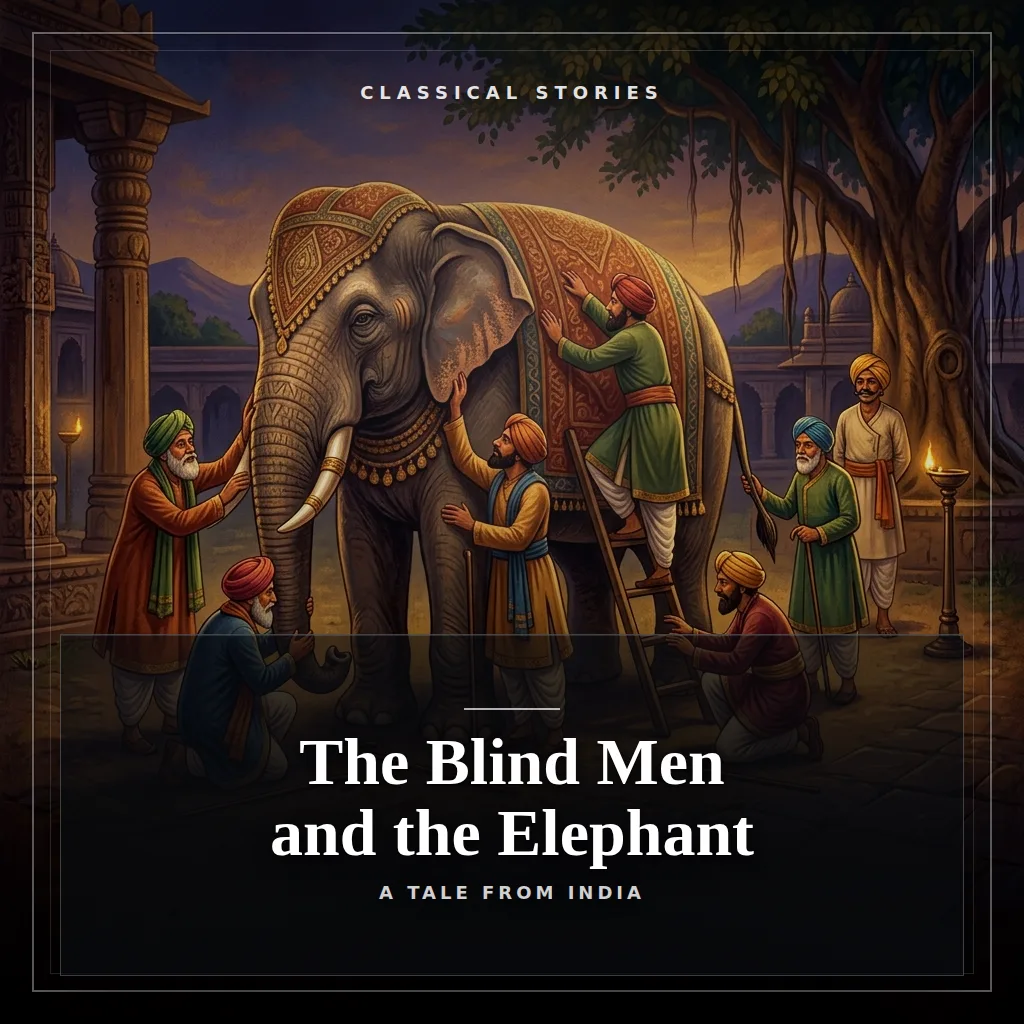
In an old Indian town, six curious men who cannot see hear that a strange great beast called an elephant has arrived, and go together to learn what it is. Each reaches out and touches a different part. The one who feels the broad side says an elephant is like a wall; the one at the tusk says a spear; the trunk, a snake; the ear, a fan; the leg, a tree; the tail, a rope. Each is completely certain, and each is describing something real — and because each knows only his own piece, they argue louder and louder, no one able to see that every one of them is partly right and no one is right alone.
Why it's worth a listen
Six wise men who have never met an elephant each touch a different part — the trunk, the ear, a leg, the tail — and each declares, with total confidence, exactly what an elephant is. They are all correct, and all wrong, and they fall to arguing. A tiny, ancient story that has never stopped being useful about how people can each hold a piece of the truth and still miss it whole.
What listeners will learn
Subjects: world stories, literature, cultural literacy.
- character
- setting
- conflict
- choice
- consequence
- theme
- retelling
- blind
- elephant
- classical
Questions for after listening
- Retell the central conflict in order.
- Name one important choice and what happened because of it.
- How did the setting or tradition shape the story?
A question to keep
When everyone is partly right, how does anyone see the whole truth?
Chapters
- The Dust of the Grand Road
- The Approach to the River
- Six Hands Upon the Great Unknown
- Six Truths in the Shade
- The Storm of Certainty
- The Whole of the Beast
- A Question to Keep
Read a transcript preview
In the old, sun-drenched valley of the Ganges River, where the earth was baked to the color of warm copper, and the ancient neem trees cast long, filigreed shadows across the dry soil. There lived six men who were known throughout their province as seekers of truth. This story comes to us from the vast and beautiful land of India, a place of deep rivers, high mountains, and crowded, colorful marketplaces. For thousands of years, philosophers, teachers, and ordinary families have shared this tale to understand the complicated workings of the human mind. It is a parable cherished across several of India's great spiritual traditions, by the Buddhists, the Hindus, and the Jains, each telling it in their own way to illustrate the mysteries of how we understand our world. In every telling, the heart of the story remains the same, reminding us of the limits of our own eyes and the vastness of the world around us. The six men of our story lived in a quiet, prosperous town named Shergati, nestled near the edge of a great forest. They were men of great dignity, intelligence, and curiosity. They spent their days in the shade of a wide-roofed veranda, discussing the movements of the stars, the laws of the seasons, and the poetry written by the sages of old. They were highly respected by the townsfolk, who often came to them to settle disputes about land, boundaries, or the value of a crop. There was only one thing about these six men that made them different from the other scholars of the province. All of them had been blind since the day they were born. To these men, however, the absence of sight was not a dark room. It was simply a different way of listening to the world. They knew the coming of spring by the sweet, heavy scent of mango blossoms drifting from the orchards. They knew the approach of a storm by the sudden, cool drop in the air pressure and the metallic smell of ozone in the wind. They could tell who was walking down the street by the rhythm of their footsteps and the unique creak of their leather sandals. Their fingers were so sensitive that they could read the texture of a leaf and tell you if the tree had received enough water in the winter. Because they were so clever, they were also very confident. They had studied the world through touch, sound, and smell for so many years that they rarely doubted their own conclusions. If Dharma, the eldest of the six, said that a piece of cloth was woven from cotton grown in the south, the others trusted him because his fingers had never lied to him. One warm afternoon, as the six friends sat on their cool stone veranda, sipping tea infused with ginger and cardamom, a young boy from the market came running up the dusty path. He was breathing heavily, his bare feet kicking up small clouds of red dust. "Sirs, sirs!" the boy cried, leaning against the wooden post of the veranda to catch his breath. "You must come to the edge of the town, near the river bank. A traveler has just arrived from the northern kingdoms, and he has brought with him a wondrous creature. It is an animal unlike any other in the valley. They call it an elephant." The six wise men paused. Dharma set his clay teacup down on the stone floor with a soft click. "An elephant?" said Raman, the second wise man, who was known for his sharp intellect and love of precise measurements. "I have heard of such beasts in the ancient poems. They are said to be the mounts of kings and the companions of gods in battle. But the poems speak of them in metaphors. One poet calls them clouds with legs, and another calls them living mountains. What does that mean in truth?" "It is a beast of immense power," the boy said, his eyes wide, though the men could not see them. "It is standing now under the shade of the great banyan tree by the river. The whole town is gathering to look…
Published 2026-07-11 · Updated