- Who is it for?
- Ages 8–14
- How long is it?
- 45 min
- What does it include?
- Synced read-along and a quiz
- What does it cost?
- Free — no sign-up required
About this audiobook
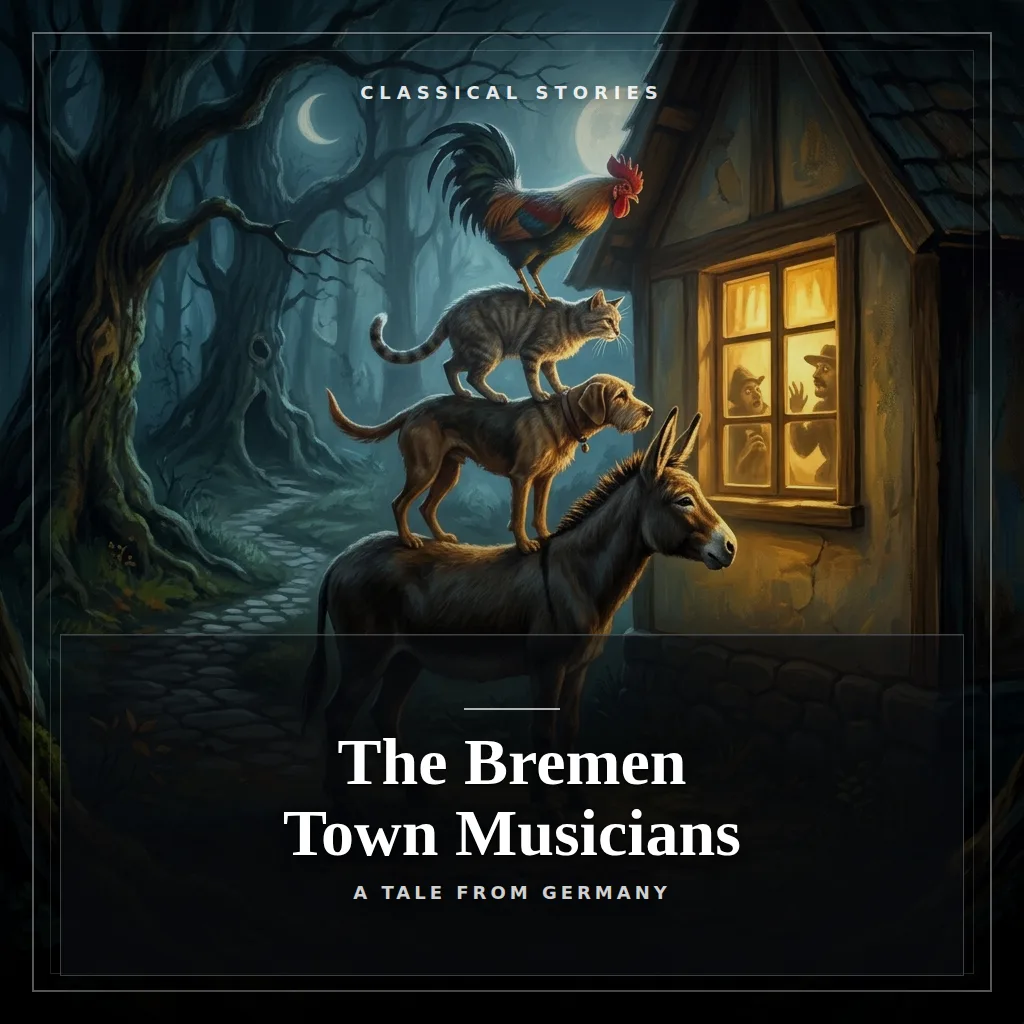
An old donkey, no longer strong enough to carry sacks, runs away before his master can be rid of him, deciding to go to Bremen and become a musician. Along the road he meets a worn-out hunting dog, an old cat past mousing, and a rooster about to become Sunday dinner — and invites each to join him; they'll all make music in Bremen. Night falls before they arrive, and they spy a lighted house in the woods full of feasting robbers. Hungry and homeless, the four animals devise a plan: they stack up — dog on donkey, cat on dog, rooster on top — and let loose all their 'music' at once through the window. The unearthly racket and the shadowy monster-shape send the robbers fleeing into the night, and the four friends take the warm house for themselves.
Why it's worth a listen
A donkey, a dog, a cat, and a rooster — each cast off as too old to work — set out together to become musicians in Bremen, and never get there. Instead, one dark night, they stack themselves into a tower of animals in a window and scare a band of robbers clean out of a cozy house. A warm, funny fairy tale about friendship, second chances, and being far more than the world thinks you are.
What listeners will learn
Subjects: world stories, literature, cultural literacy.
- character
- setting
- conflict
- choice
- consequence
- theme
- retelling
- bremen
- town
- musicians
Questions for after listening
- Retell the central conflict in order.
- Name one important choice and what happened because of it.
- How did the setting or tradition shape the story?
A question to keep
When the world says you're too old to be useful, what can you still do — especially together?
Chapters
- The Road Out of the Pasture
- The Gathering of the Outcasts
- The Long Road to Nowhere
- A Warm Light in the Deep Woods
- The Grand Tower of Harmony
- The Concert of the Outcasts
- The Night Visitor and the New Home
- A Question to Keep
Read a transcript preview
If you travel deep into the heart of Western Germany, past the rolling hills where the grapes grow fat on the vine, and into the ancient whispering forests of Westphalia, you will find yourself in a landscape where stories seem to grow right out of the mossy earth. Over 200 years ago, two brothers named Jacob and Wilhelm Grimm wandered through these very towns and villages. They sat by hearth fires, listening to the tales that grandmothers and travelers told to keep the winter cold at bay. Like all great folk tales, this story has been told in a thousand different ways, by a thousand different voices, but the heart of it remains as true today as it was when the trees of the forest were only saplings. It is a story about what happens when the world decides you are no longer useful, and the quiet, marvelous discovery that you might just be getting started. Our story begins in a quiet pasture at the edge of a great forest, where an old donkey stood with his head bowed toward the grass. For 30 long years, this donkey had carried heavy sacks of grain from the fields to his master's mill. He had walked the same dusty path so many times that his hooves knew every stone, every dip, and every puddle without him ever having to look down. His coat, which had once been the color of dark polished slate, was now silvered with age, especially around his muzzle and eyes. His ears, which used to twitch at the slightest rustle of a field mouse, now leaned forward with a heavy, quiet wisdom. He was tired. His knees made a dry clicking sound when the damp autumn air rolled in from the hills, and his back, once straight and strong, had curved into the gentle shape of a crescent moon. But the donkey's mind was still as sharp as a fresh thistle. One evening, as he stood near the open window of the farmhouse stable, he heard his master talking to a neighbor. The farmer's voice was cold, like water drawn from a winter well. "The gray donkey is finished," the farmer said, his boots scraping against the wooden floorboards. "He can barely carry a single sack of flour to the mill without his leg shaking. He is eating grass that my young horses need, and he is no longer worth his keep. Tomorrow, I will sell his hide to the knacker." The donkey did not blink. He did not cry out. But inside his chest, his heart gave a great heavy thud. The knacker was the man who took old animals and turned them into leather and glue. After 30 years of faithful service, after carrying thousands of sacks of grain through rain, snow, and scorching summer heat, this was to be his reward? The donkey looked out at the road that stretched away from the farm, winding its way through the hills toward the great city of Bremen. He had heard the merchants talk of Bremen when they came to the mill. They said it was a city of music, of color, and of freedom. It was a place where the streets were wide, and the people gathered in the squares to listen to musicians play the loot, the flute, and the drums. The donkey lifted his head. His ears stood straight up. "No," he said softly to himself, his voice a low, gravelly rumble. "I may not be strong enough to carry sacks of grain, but I still have breath in my lungs. I still have a voice. I will go to Bremen, and I will become a town musician." Without waiting for the morning, and without saying goodbye to the master who had forgotten his kindness, the donkey slipped his halter over his ears. He pushed open the creaking wooden gate of the pasture with his nose and stepped out onto the highway. The gravel was cool beneath his hooves, and the night air smelled of pine needles and damp earth. He did not run. His knees were too stiff for that. But he walked with a steady, purposeful trot, his head held high. He…
Editorial review
Quality reviewed · 96/100 on . Certificate EL-CAA7-6414 is bound to the exact narrated script.
The review checks factual care, audience fit, teaching quality, structure, tone and source honesty. Read the editorial standards.
Published 2026-07-11 · Updated