
- Who is it for?
- Ages 7–13
- How long is it?
- 40 min
- What does it include?
- Synced read-along and a quiz
- What does it cost?
- Free — no sign-up required
About this audiobook
A Seven-Day Family Field Guide To Dali is an audio travel companion designed for families exploring the Dali region of Yunnan. This wrap-up field guide helps listeners spot and remember key cultural and geographical highlights during a seven-day adventure. The guide covers local Bai culture, traditional festivals, and regional identity. Listeners will learn about the local language and traditions that shape this unique area. Designed as a practical itinerary, the guide provides families with a clear framework to understand the geography and cultural heritage of Dali together.
Why it's worth a listen
This audio guide makes exploring Yunnan engaging for the whole family by bringing the rich traditions and language of the Bai people to life. Listen to discover what unique local festivals and cultural details you can spot on your own seven-day adventure.
What listeners will learn
Subjects: culture, language, geography.
- Bai culture
- language
- festivals
- local identity
- tradition
- seven
- family
- field
- dali
- wrap
Questions for after listening
- What is one thing that makes Dali or Yunnan distinctive?
- Name one place, custom, or natural feature from the episode.
- Plan one question you would ask if you visited this place.
Chapters
- Reading The Place Before The Map
- The Living Pages of the Field Notebook
- Cartography of the Senses
- The Architecture of Time
- Listening to the Wind and the Tongue
- The Ethical Lens
- The Art of the Curious Question
- Guardians of the Mountain and Lake
- Synthesizing the Landscape
- The Journey Beyond the Return
Read a transcript preview
A Seven-Day Family Field Guide To Dali Day 7 of a seven-part Dali, Yunnan family learning journey. ## 1. Reading The Place Before The Map Today in Dali, we stand at the crossroads of deep time, cultural memory, and the physical earth. As we begin this final, reflective day of our journey, we are not merely visitors passing through a landscape; we are active observers, field researchers, and chroniclers of a world that has been shaped over millions of years by tectonic forces and thousands of years by human footsteps. To understand Dali, we must first learn to read the place before we ever look at a map. We must understand that the geography beneath our feet is a living, breathing document, and our family is here to decipher its chapters together. Dali, a region nestled in the northwestern fold of Yunnan Province in southwestern China, is a name that translates to great order or great administration, but its landscape is one of dramatic, poetic wildness. Yunnan itself means south of the clouds, a name that perfectly captures the shifting, ethereal atmosphere of this high-altitude plateau. When we look to the west, we see the towering, jagged spine of the Cangshan range, nineteen peaks of green and granite that rise over four thousand meters into the sky, their summits often shrouded in the very clouds that give the province its name. To the east lies Erhai, a vast, shimmering, ear-shaped alpine lake that cradles the valley, acting as a giant mirror for the sky and the mountains. This dramatic topography is not an accident of nature; it is the result of an ancient and colossal geological event. Millions of years ago, the Indian tectonic plate collided with the Eurasian plate, a slow-motion crash that pushed up the Himalayas and crumpled the land of southwestern China into steep, parallel ridges and deep river valleys. This collision created a unique biogeographic convergence zone, a place where plants and animals from temperate, tropical, and alpine worlds meet and mingle. Because of this steep elevation gradient, where one can travel from subtropical valley floors to frozen alpine peaks in a single day, northwestern Yunnan has become one of the richest biodiversity regions on Earth, a sanctuary for rare flora and fauna that survived the ice ages in these sheltered mountain folds. For centuries, this unique geography also shaped human history. The valley of Dali, protected by the mountains on one side and the lake on the other, became a natural cradle for civilization. It was the heartland of the Bai people, the indigenous ethnic group of this region, whose name means white, reflecting their historical reverence for the color white as a symbol of purity, dignity, and good fortune. Here, the Bai built a sophisticated agricultural society, nourished by the eighteen streams that cascade down from the snows of Cangshan to empty into Erhai. As we look out across the valley, we are also looking at the territory of two great ancient empires: the Nanzhao Kingdom, which ruled from the eighth to the tenth centuries, and its successor, the Dali Kingdom, which flourished from the tenth to the thirteenth centuries. These kingdoms were not isolated mountain fiefdoms; they were powerful, independent states that controlled the trade routes between China, Tibet, Southeast Asia, and India. This network of trails, known as the Tea Horse Road, was a lifeline of commerce and cultural exchange. Along these narrow paths, caravans of hardy ponies carried bricks of dark, fermented tea from the forests of southern Yunnan to the high plateaus of Tibet, returning with strong Tibetan horses, medicinal herbs, and sacred Buddhist texts. To begin our field course today, let us practice our first act of observation. Stand together as a family and look toward the mountains, then turn slowly toward the lake. Notice the space between them. This narrow strip of fertile land is where history happened. In your mind, strip away the modern concrete roads and the power lines. Imagine this valley as it was a thousand years ago: a green mosaic of wet rice paddies, winding dirt paths trodden by pack mules, and low, white-walled villages nestled at the foot of the green slopes. By…
Editorial review
Quality reviewed · 93/100 on . Certificate EL-76E3-32E5 is bound to the exact narrated script.
The review checks factual care, audience fit, teaching quality, structure, tone and source honesty. Read the editorial standards.
Published 2026-07-05 · Updated
Related audiobooks
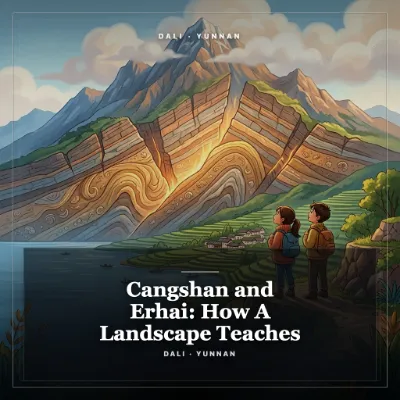 Cangshan and Erhai: How A Landscape TeachesDali & Yunnan · 33 min · Free
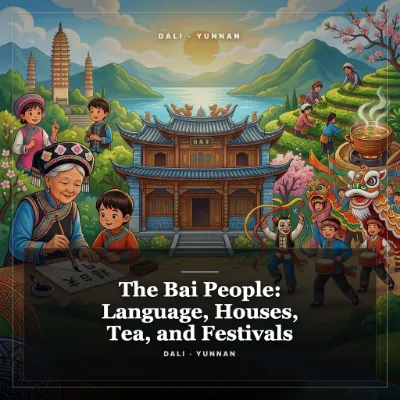 The Bai People: Language, Houses, Tea, and FestivalsDali & Yunnan · 35 min · Free
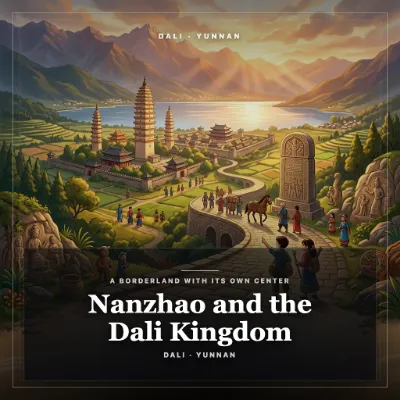 Nanzhao and the Dali Kingdom: A Borderland With Its Own CenterDali & Yunnan · 33 min · Free
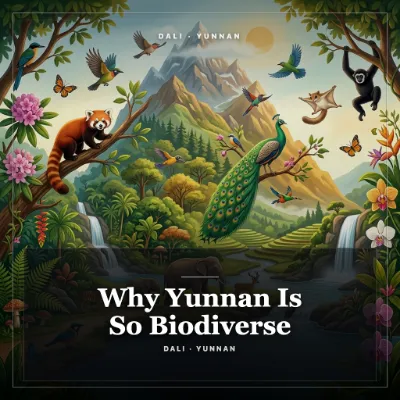 Why Yunnan Is So BiodiverseDali & Yunnan · 39 min · Free