
- Who is it for?
- Ages 7–13
- How long is it?
- 39 min
- What does it include?
- Synced read-along and a quiz
- What does it cost?
- Free — no sign-up required
About this audiobook
This educational audiobook explores why Yunnan, and specifically the Dali region, is one of the most biodiverse places on Earth. Listeners will learn about the unique geography, ecology, and biology of this remarkable area. The guide covers essential scientific concepts, including ecosystems, habitats, species, and how mountains shape the local environment. Designed as a family field guide, it introduces science and travel concepts in an accessible format. It explains the factors that allow so many different species to thrive together in Yunnan's diverse habitats, making it a valuable resource for young scientists.
Why it's worth a listen
This family-friendly guide turns complex ecological concepts into an engaging audio journey through one of the planet's most vibrant regions. Discover how mountains and unique ecosystems support an incredible variety of life, and find out what makes Yunnan a true wonder of the natural world.
What listeners will learn
Subjects: biology, ecology, geography.
- biodiversity
- habitat
- species
- mountains
- ecosystem
- yunnan
- biodiverse
- most
- places
- earth
Questions for after listening
- What is one thing that makes Dali or Yunnan distinctive?
- Name one place, custom, or natural feature from the episode.
- Plan one question you would ask if you visited this place.
Chapters
- Reading The Place Before The Map
- The Great Collision and the Birth of the Hengduan
- Three Rivers, Three Gorges, One Parallel World
- The Altitude Elevator: Life Zones in a Single Mountain
- Refugia: How the Ice Age Spared Yunnan
- The Kingdom of Plants: Rhododendrons and the Green Canopy
- Feathers and Fur: The Animal Kingdom of the Gorges
- The Human Thread: The Tea Horse Road and the Bai People
- The Micro-Climates of Dali: From Lake to Peak
- The Field Notebook: Becoming Yunnan Naturalists
Read a transcript preview
Why Yunnan Is So Biodiverse Day 4 of a seven-part Dali, Yunnan family learning journey. ## 1. Reading The Place Before The Map Today in Dali, if you stand on the cobblestone streets of the old town and look toward the west, your eyes will inevitably climb a colossal, green-and-gray wall of stone. This is Cangshan, the Azure Mountains, a dramatic granite range that rises like a frozen wave more than four thousand meters above sea level. If you turn your back to those peaks and look east, the land drops away into a vast, shimmering sheet of blue water. This is Erhai, the Ear-shaped Lake, a massive alpine basin that has sustained human and animal life for millennia. To understand Yunnan, the southwestern Chinese province whose name translates beautifully as "South of the Clouds," you must first learn to read this dramatic contrast between the vertical mountain and the horizontal water. Dali, which refers both to this historic valley and the wider Dali Bai Autonomous Prefecture, is not just a scenic destination. It is a gateway to one of the most ecologically complex and biologically diverse landscapes on our planet. For a family traveling through this region, the sheer abundance of life can feel overwhelming. You might notice a flash of iridescent blue as a sunbird darts through a courtyard garden, or wonder at the thick, mossy forests that drape the high ridges of Cangshan in a perpetual emerald shroud. You might see wild azaleas clinging to bare rock faces, or spot strange, delicate ferns growing in the mortar of ancient stone walls. This is not an accident of nature, nor is it merely a pleasant garden. It is the result of a profound geological and climatic puzzle. Yunnan occupies just over four percent of China’s total land area, yet it is home to more than half of the country’s plant and animal species. It is a place where tropical rainforests, temperate woodlands, and alpine tundras are packed so closely together that you can travel through all of them in a single day’s walk. To begin our investigation into why this region is so extraordinarily biodiverse, we have to look beyond the modern maps and tourist brochures. We have to train our eyes to see the landscape as a living, breathing canvas of geological forces, wind patterns, and evolutionary history. When we look at Cangshan, we are not just looking at a mountain range; we are looking at a giant ecological escalator. When we look at Erhai, we are not just looking at a lake; we are looking at a giant thermal regulator that softens the climate of the entire valley. Together, they form a micro-world, a miniature laboratory where we can observe the same natural laws that shaped the entire province of Yunnan. As we journey through this episode, we will explore the deep history of this land. We will discover how the slow, unstoppable collision of continents pushed these mountains into the sky, how giant rivers carved paths through the stone, and how ice ages that devastated life in other parts of the world actually helped preserve and multiply the species of Yunnan. We will learn to look at a single leaf, a passing cloud, or a mountain stream as a clue to a grand story that began tens of millions of years ago. By the time we finish our exploration today, you will not just see Dali as a beautiful place to visit, but as a living testament to the creative power of our planet’s geography. Let us begin our field study right where we are. Take a moment to look around you, wherever you are sitting or walking in Dali. Notice the air. Is it cool, damp, or warm? Can you hear the sound of water running through the stone channels along the streets? Can you see the clouds catching on the high peaks of Cangshan? This water and these clouds are the lifeblood of Yunnan's biodiversity. They are the actors in a great ecological drama that we are about to untangle, layer by layer, from the depths of the river gorges to the highest, snow-dusted summits. ## 2. The Great Collision and the Birth…
Editorial review
Quality reviewed · 98/100 on . Certificate EL-6EBF-A69A is bound to the exact narrated script.
The review checks factual care, audience fit, teaching quality, structure, tone and source honesty. Read the editorial standards.
Published 2026-07-05 · Updated
Related audiobooks
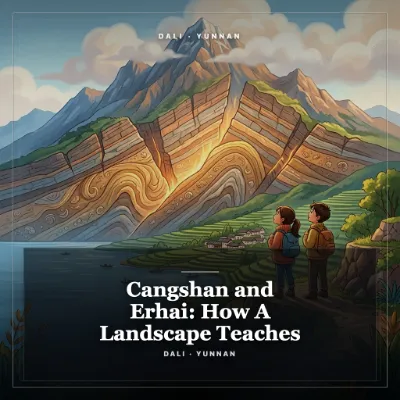 Cangshan and Erhai: How A Landscape TeachesDali & Yunnan · 33 min · Free
 The Bai People: Language, Houses, Tea, and FestivalsDali & Yunnan · 35 min · Free
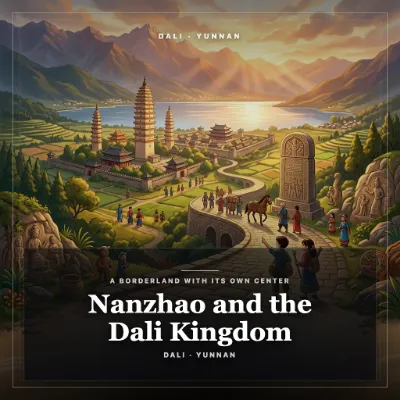 Nanzhao and the Dali Kingdom: A Borderland With Its Own CenterDali & Yunnan · 33 min · Free
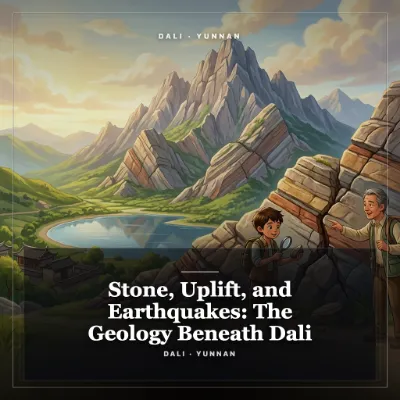 Stone, Uplift, and Earthquakes: The Geology Beneath DaliDali & Yunnan · 34 min · Free