
- Who is it for?
- Ages 7–13
- How long is it?
- 33 min
- What does it include?
- Synced read-along and a quiz
- What does it cost?
- Free — no sign-up required
About this audiobook
This family field guide explores the geography and geology of Yunnan, focusing on the great Cangshan mountains and the shimmering Erhai lake at the heart of Dali. Listeners will learn about earth science through the region's landscape formation, examining how mountains, rocks, faults, and lakes shape the environment. By studying these natural features, the audiobook explains how a landscape teaches us about the physical history of our planet. It serves as an educational introduction to earth science and geography, designed specifically for curious kids and families interested in travel and the natural world.
Why it's worth a listen
This engaging audio guide brings earth science to life by turning the scenic wonders of Yunnan into an outdoor classroom for the whole family. Listen to discover how giant tectonic faults and shifting rocks created the majestic peaks and waters we see today.
What listeners will learn
Subjects: history, geography, culture.
- Nanzhao
- Dali Kingdom
- regional history
- trade routes
- local rule
- cangshan
- erhai
- landscape
- teaches
- exploring
Questions for after listening
- What is one thing that makes Dali or Yunnan distinctive?
- Name one place, custom, or natural feature from the episode.
- Plan one question you would ask if you visited this place.
Chapters
- Reading The Place Before The Map
- The Great Collision and the Rise of Cangshan
- Erhai, The Jewel of the Fault Line
- The Monsoon and the Rain Shadow
- The Gift of the Silt: Alluvial Fans and Soil
- Where the Houses Grow: Settlement and the Bai People
- The Three Rivers and the Great Convergence
- Echoes of Kingdoms and Trade
- The Living Water: Lake Ecology and Change
- The Family Field Journal: Reading Dali Together
Read a transcript preview
Cangshan and Erhai: How A Landscape Teaches Day 1 of a seven-part Dali, Yunnan family learning journey. ## 1. Reading The Place Before The Map Today in Dali, we are stepping into a natural classroom where the blackboard is made of ancient metamorphic rock and the ink is the deep blue water of a highland lake. Before we consult our phones, open our guidebooks, or look at a digital map, we must learn to read the landscape with our own eyes. To do this, we must first understand where we are standing on the surface of our planet. We are in the Dali Bai Autonomous Prefecture, a historic region in northwestern Yunnan Province in southwestern China. The name Yunnan translates beautifully as South of the Clouds, a hint at the high-altitude mists and dramatic topography that define this corner of the world. Dali itself is a place of deep historical resonance, named after the ancient Dali Kingdom that once ruled this basin, and it is the homeland of the Bai ethnic group, a people whose culture, architecture, and daily lives have been shaped by the mountains and water for thousands of years. If you look out of any window in the Dali basin, or stand in an open field, your eyes will immediately be drawn to two massive, contrasting features that dominate the entire world here. To your west rises a colossal, green-and-gray wall of mountains that seems to prop up the sky. This is Cangshan, the Cang Mountains, a range that acts as a giant shield against the weather of the west. To your east lies a vast, shimmering sheet of water that stretches as far as the eye can see. This is Erhai, or Erhai Lake, a high-altitude freshwater body whose name literally means Ear Sea, so called by the local people because its shape resembles a human ear, and because to those living far inland, its vastness felt as immense as an ocean. Between this mountain wall and this highland lake lies a narrow, gently sloping shelf of land. This is the Dali plain. It is here, on this sliver of green, fertile soil, that cities have been built, crops have been harvested, and trade routes have run for millennia. As a family of explorers, your first task is to realize that this landscape is not a static backdrop. It is an active, dynamic system where the mountains, the water, the wind, and the soil are constantly interacting. Every village you pass, every field of green crops, every ancient temple, and even the direction the houses face is a direct response to the geography of this basin. To read this place, we must train our eyes to look for the connections. We must ask ourselves why the mountains are so steep, why the lake is where it is, how the water travels from the peaks to the shore, and how human beings found a way to live in harmony between the giant and the deep. Before you begin your explorations of any specific site, path, or shoreline, remember that the natural world is constantly shifting. Trails can be affected by weather, lake protection rules can change to safeguard the environment, and local access guidelines are updated regularly. Always make sure to check local conditions, safety notices, and administrative rules with local guides or authorities before setting out on any hike up the mountain or boat trip on the water. Now, let us begin our journey by looking deep into the earth, back to a time when giant tectonic plates collided to forge the dramatic landscape we see today. ## 2. The Great Collision and the Rise of Cangshan To understand why the mountain wall of Cangshan rises so abruptly from the valley floor, we have to travel back in geological time about fifty million years. At that moment in Earth's history, the Indian tectonic plate, carrying what is now the Indian subcontinent, was drifting northward across the ancient ocean. It crashed directly into the massive Eurasian plate. This was not a soft collision; it was a slow-motion, colossal impact that crumpled the crust of the earth, folding, lifting, and fracturing rocks on a scale never seen before.…
Editorial review
Quality reviewed · 96/100 on . Certificate EL-9F89-D295 is bound to the exact narrated script.
The review checks factual care, audience fit, teaching quality, structure, tone and source honesty. Read the editorial standards.
Published 2026-07-05 · Updated
Related audiobooks
 The Bai People: Language, Houses, Tea, and FestivalsDali & Yunnan · 35 min · Free
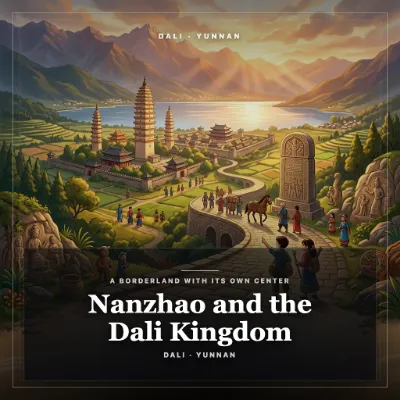 Nanzhao and the Dali Kingdom: A Borderland With Its Own CenterDali & Yunnan · 33 min · Free
 Why Yunnan Is So BiodiverseDali & Yunnan · 39 min · Free
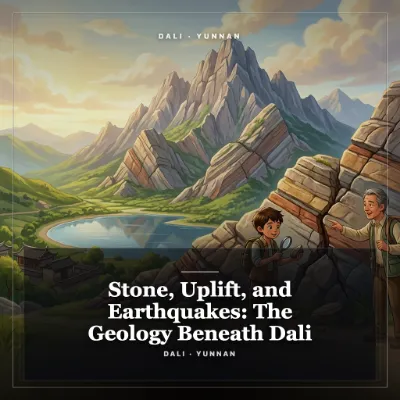 Stone, Uplift, and Earthquakes: The Geology Beneath DaliDali & Yunnan · 34 min · Free