
- Who is it for?
- Ages 7–13
- How long is it?
- 33 min
- What does it include?
- Synced read-along and a quiz
- What does it cost?
- Free — no sign-up required
About this audiobook
Water, Farms, and Food Around Erhai is an audio guide that explores the geography, agriculture, and culture of the Erhai Lake region in Dali, Yunnan. Designed for families, this guide covers the clever farming methods used around the lake, focusing on how people grow rice and raise fish. Listeners will learn about local water systems, irrigation, and foodways that shape the local economy. The guide connects water, farms, and food to show how people interact with their environment in Yunnan, providing a clear look at regional agriculture and culture.
Why it's worth a listen
This family-friendly guide offers a clear and engaging look at how communities work alongside nature to produce food. Discover how the relationship between water, rice, and fish sustains both the local economy and traditional ways of life.
What listeners will learn
Subjects: culture, language, geography.
- Bai culture
- language
- festivals
- local identity
- tradition
- water
- farms
- food
- around
- erhai
Questions for after listening
- What is one thing that makes Dali or Yunnan distinctive?
- Name one place, custom, or natural feature from the episode.
- Plan one question you would ask if you visited this place.
Chapters
- The Living Basin of Erhai
- The Mountain's Cold Breath
- The Chemistry of a Lake
- The Green Fringe
- Fields of Abundance
- The Forest's Underground Web
- The Craft of the Milk Fan
- The Market as an Ecosystem
- The Three Parallel Rivers and the Wider Web
- Reading the Table, Reading the Land
Read a transcript preview
Water, Farms, and Food Around Erhai Day 6 of a seven-part Dali, Yunnan family learning journey. ## 1. The Living Basin of Erhai Today in Dali, we are stepping into a landscape where water is not just a feature of the scenery, but the very lifeblood that has shaped human history, culture, and survival for thousands of years. To understand this place, we must look at it not as a collection of separate tourist destinations, but as a single, breathing, interconnected ecological basin. We are standing in the Dali Bai Autonomous Prefecture, a region in northwestern Yunnan Province in southwestern China. The name Yunnan translates beautifully as "south of the clouds," a fitting description for a high-altitude province characterized by dramatic mountain ranges and fast-shifting weather. The word Dali itself is rich with historical meaning, closely tied to the ancient Dali Kingdom, which ruled this region from the tenth to the thirteenth centuries, and the Nanzhao Kingdom, which preceded it from the eighth to the ninth centuries. At the heart of this basin lies Erhai, a magnificent body of water whose name means "ear-shaped sea" in the local language, reflecting its long, curved shape. It is not a sea, of course, but a high-altitude freshwater lake sitting at nearly two thousand meters above sea level. To the west of the lake rises the mighty Cangshan range, a wall of nineteen green peaks that soar to over four thousand meters, their summits often wrapped in a crown of white clouds. To the east of the lake lie drier, gentler hills. The flat, fertile plain sandwiched between the steep slopes of Cangshan and the blue waters of Erhai is where human life has flourished for millennia. This is the homeland of the Bai people, an ethnic group with a distinct culture, language, and architectural style, who have lived in harmony with this unique environment since ancient times. For centuries, this basin was a vital crossroads on the Tea Horse Road, an ancient network of trade routes that wound through the mountains of Yunnan, Sichuan, and Tibet. Caravans laden with tea, salt, silk, and horses traveled these rugged paths, and Dali served as a wealthy, bustling oasis where different cultures met, traded, and shared ideas. Today, the legacy of this trade and the deep roots of Bai culture are still visible in the stone-paved streets, the elegant whitewashed homes with their painted murals, and the traditional farming practices that still define the landscape. As we begin our exploration of this living basin, let us start with a simple family field prompt. Wherever you are standing right now—whether in the quiet courtyard of a guesthouse, on a stone path in Dali Old Town, or near the edge of a farm field—close your eyes for a moment and just listen. Can you hear the sound of moving water? In Dali, water is almost always nearby, trickling through narrow stone channels along the streets, rushing down from the mountains in deep ravines, or gently lapping against the lake shore. Try to trace that sound in your mind. Where do you think that water was yesterday, and where do you think it will be tomorrow? By learning to listen to the water, we begin to read the story of Dali. ## 2. The Mountain's Cold Breath To understand why the water in Dali flows the way it does, we must look up at the towering peaks of Cangshan. These mountains are not just a beautiful backdrop; they are a massive geological engine that drives the entire water cycle of the basin. The story of Cangshan begins about fifty million years ago, with one of the most violent geological events in Earth's history: the collision of the Indian tectonic plate with the Eurasian tectonic plate. As the Indian subcontinent crashed northward into Asia, the land buckled, folded, and crumpled upward, creating the Himalayas, the Tibetan Plateau, and the rugged mountain ranges of western Yunnan. This tectonic collision created a steep elevation gradient in Dali, where the land rises abruptly from the lake shore at two thousand meters to the mountain peaks at over four thousand meters. This dramatic rise in altitude creates distinct microclimates. As warm, moisture-laden winds…
Editorial review
Quality reviewed · 96/100 on . Certificate EL-9415-B377 is bound to the exact narrated script.
The review checks factual care, audience fit, teaching quality, structure, tone and source honesty. Read the editorial standards.
Published 2026-07-05 · Updated
Related audiobooks
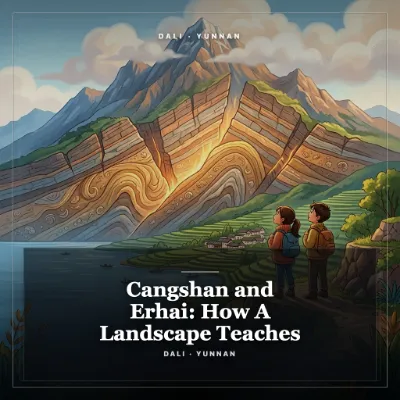 Cangshan and Erhai: How A Landscape TeachesDali & Yunnan · 33 min · Free
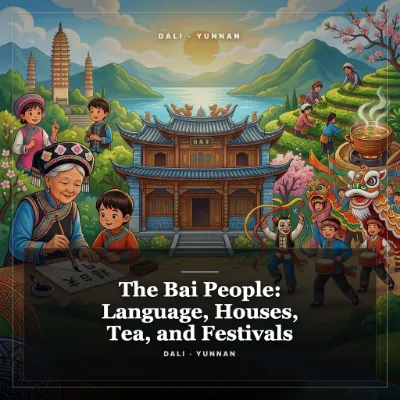 The Bai People: Language, Houses, Tea, and FestivalsDali & Yunnan · 35 min · Free
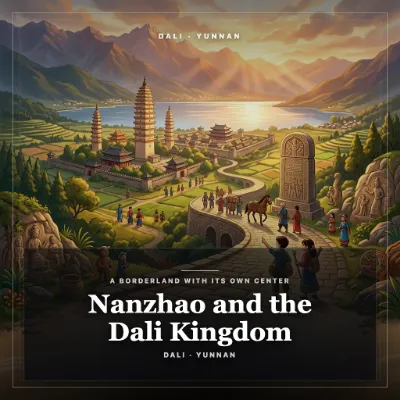 Nanzhao and the Dali Kingdom: A Borderland With Its Own CenterDali & Yunnan · 33 min · Free
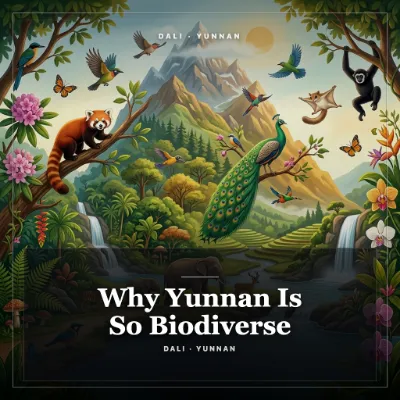 Why Yunnan Is So BiodiverseDali & Yunnan · 39 min · Free