
- Who is it for?
- Ages 7–13
- How long is it?
- 34 min
- What does it include?
- Synced read-along and a quiz
- What does it cost?
- Free — no sign-up required
About this audiobook
This audiobook explores the earth science, geography, and geology of Dali, Yunnan. Listeners will learn about the landscape formation of this region, focusing on how its mountains, lake, and famous marble were made. The guide covers key geological concepts, including rocks, stone, and faults beneath the earth's surface. It explains the natural forces of uplift and earthquakes that continue to shape the local environment. Designed as a family field guide, it offers a clear look at the geological processes that created the unique natural features of Dali.
Why it's worth a listen
This family field guide brings earth science to life by connecting geological forces to the visible wonders of Dali's mountains, lakes, and famous marble. Listeners will discover how underground faults and sudden earthquakes shape the landscape, turning a geography lesson into an active exploration of the ground beneath their feet.
What listeners will learn
Subjects: earth science, geography, geology.
- mountains
- rocks
- faults
- lakes
- landscape formation
- stone
- uplift
- earthquakes
- geology
- beneath
Questions for after listening
- What is one thing that makes Dali or Yunnan distinctive?
- Name one place, custom, or natural feature from the episode.
- Plan one question you would ask if you visited this place.
Chapters
- Reading The Place Before The Map
- The Great Collision of Continents
- The Hengduan Mountains and the Three Parallel Rivers
- Cangshan and Erhai: The Fault Line and the Lake
- The Anatomy of Stone: Metamorphism and Marble
- Earthquakes: The Earth Breathing and Adjusting
- The Architecture of Resilience: The Three Pagodas
- Erosion, Sediment, and the Shaping of the Plains
- Reading the Landscape: A Family Field Guide
- The Living Earth: A New Way of Seeing
Read a transcript preview
Stone, Uplift, and Earthquakes: The Geology Beneath Dali Day 5 of a seven-part Dali, Yunnan family learning journey. ## 1. Reading The Place Before The Map Today in Dali, we are standing on the edge of a great continental puzzle, a place where the bones of the Earth are not buried deep beneath soil and forest, but are thrust high into the sky for everyone to see. When you first arrive in this part of southwestern China, your eyes are immediately drawn to a striking contrast. To your left, a massive, green-and-gray wall of stone rises almost vertically into the clouds. This is Cangshan, the Azure Mountain, a range whose peaks reach over four thousand meters into the heavens. To your right lies a vast, shimmering sheet of blue water. This is Erhai, the Ear-shaped Sea, a high-altitude freshwater lake that stretches north to south like a long, curved mirror. Between this towering wall of rock and this deep basin of water lies a narrow, fertile strip of green land. This is the Dali plain, where generations of the Bai people, an indigenous ethnic group known for their distinctive white-walled architecture and deep connection to this landscape, have farmed, built cities, and lived for thousands of years. To understand Dali, we must learn to read this landscape not just as a beautiful postcard, but as a living document written in the language of geology. The shape of the land here is not accidental. It is the direct result of colossal forces operating over millions of years, forces that are still active beneath our feet at this very moment. When we look at Cangshan, we are looking at the crust of the Earth being pushed upward toward the sky. When we look at Erhai, we are looking at a deep tear in the Earth's crust that has filled with water. The flat land where we walk, where the ancient towns are built, and where the crops grow, is the meeting place of these two extremes, created by the debris washed down from the heights into the depths. As a family traveling through this region, you have a unique opportunity to become landscape detectives. Over the next thirty minutes, we are going to peel back the layers of soil, vegetation, and human history to explore the extraordinary geological story of Dali and the wider province of Yunnan, a name that translates beautifully as "South of the Clouds." We will discover how two giant tectonic plates collided to create the highest mountains on Earth, how this collision bent and folded the land of Yunnan like a giant accordion, and how the rocks beneath our feet have shaped everything from the biodiversity of the forests to the architecture of the ancient temples. By the time we finish our journey today, you will look at the mountains, the lake, and even the stones in the walls of the houses with entirely new eyes. You will see that the Earth is not a static, finished stage, but a dynamic, changing canvas that is still being painted every single day. Let us begin by orienting ourselves. Stand for a moment and look toward the mountains of Cangshan. Feel the scale of them. They do not roll gently into the distance like the hills of many other parts of the world. Instead, they rise like a sudden, dramatic barrier. Why is this transition so sharp? Why is there a flat plain right next to a giant mountain wall? To answer this, we have to travel back in time, long before human beings walked these valleys, long before the Nanzhao Kingdom or the Dali Kingdom ruled this land, and even before the ancestors of the Tea Horse Road traders began leading their caravans through these mountain passes. We must travel back fifty million years, to a time when the map of the world looked completely different. ## 2. The Great Collision of Continents Imagine the planet Earth as a giant puzzle, but instead of cardboard pieces, the puzzle is made of massive slabs of solid rock called tectonic plates. These plates are not resting on a solid foundation; they float on a hot, semi-liquid layer of the Earth's mantle…
Editorial review
Quality reviewed · 96/100 on . Certificate EL-3147-4AC0 is bound to the exact narrated script.
The review checks factual care, audience fit, teaching quality, structure, tone and source honesty. Read the editorial standards.
Published 2026-07-05 · Updated
Related audiobooks
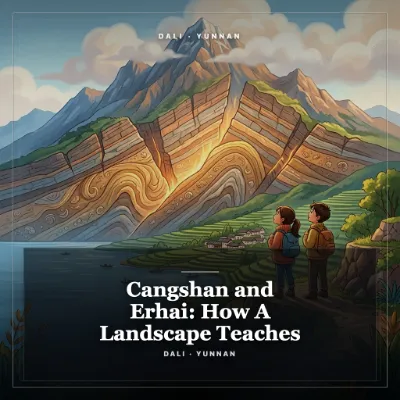 Cangshan and Erhai: How A Landscape TeachesDali & Yunnan · 33 min · Free
 The Bai People: Language, Houses, Tea, and FestivalsDali & Yunnan · 35 min · Free
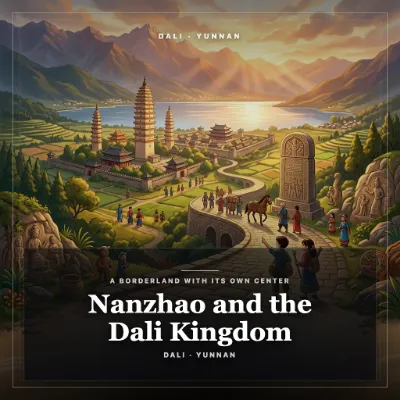 Nanzhao and the Dali Kingdom: A Borderland With Its Own CenterDali & Yunnan · 33 min · Free
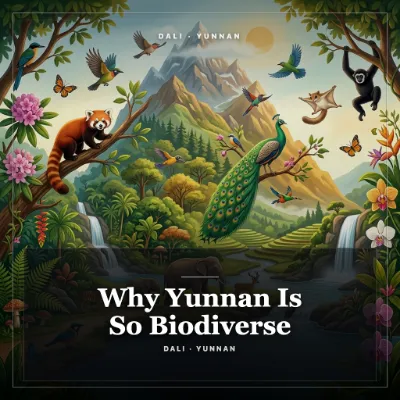 Why Yunnan Is So BiodiverseDali & Yunnan · 39 min · Free