- Who is it for?
- Ages 8–14
- How long is it?
- 36 min
- What does it include?
- Synced read-along and a quiz
- What does it cost?
- Free — no sign-up required
About this audiobook
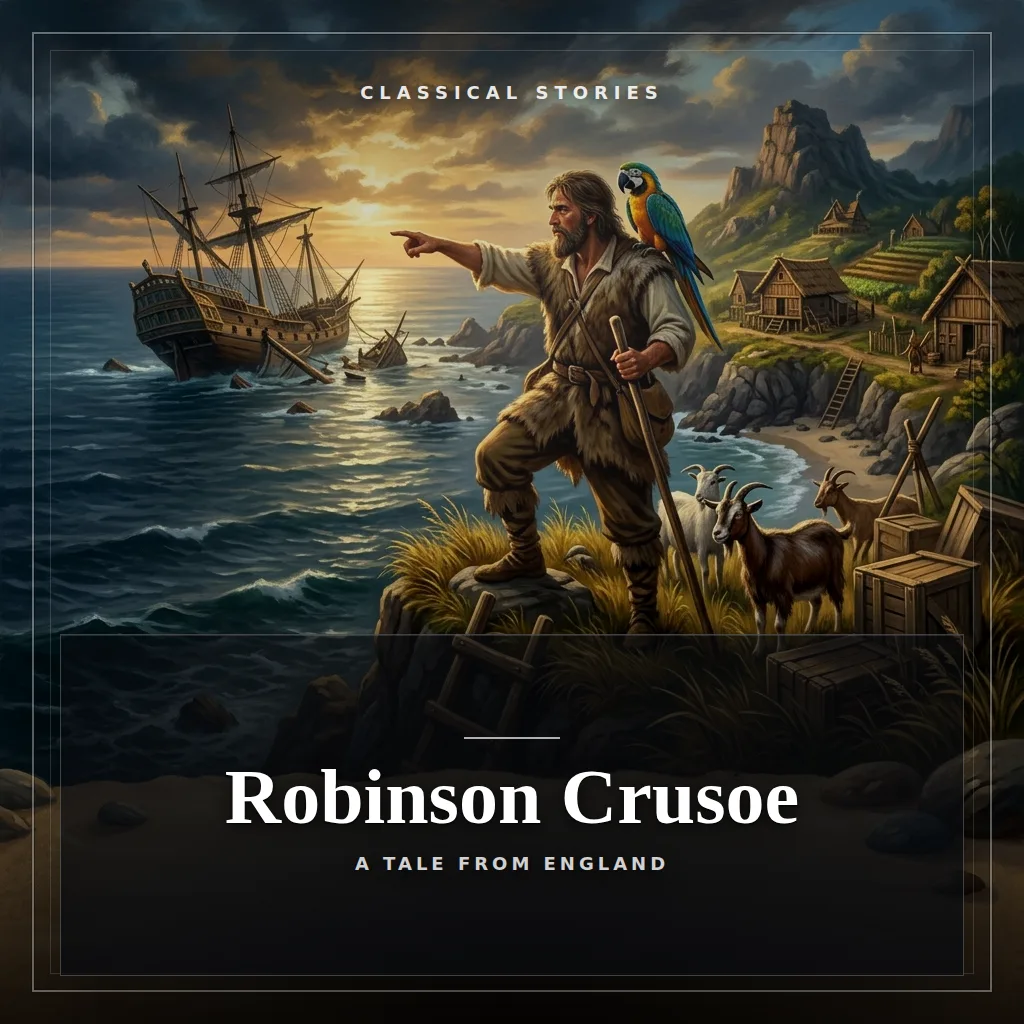
Robinson Crusoe, shipwrecked and the only survivor, washes onto a deserted tropical island. Salvaging tools, seed, and supplies from the broken ship before it sinks, he sets about staying alive: he builds a shelter, learns to grow grain and raise goats, makes pottery and bread, tames a parrot, and marks the days on a wooden post so as not to lose track of time. Year by year, through patience and endless invention, he turns a bare island into a home — and turns his loneliness into a kind of hard-won peace. Then one day, walking the shore he thought was his alone, he finds a single human footprint in the sand, and everything he thought he knew about his island changes in an instant.
Why it's worth a listen
One man survives a shipwreck onto an empty island and must build an entire life from scratch — shelter, food, a calendar, a home — with only what he can salvage and invent. From one of the first English novels, the gripping story of survival, loneliness, ingenuity, and the day a single footprint in the sand changes everything.
What listeners will learn
Subjects: world stories, literature, cultural literacy.
- character
- setting
- conflict
- choice
- consequence
- theme
- retelling
- robinson
- crusoe
- classical
Questions for after listening
- Retell the central conflict in order.
- Name one important choice and what happened because of it.
- How did the setting or tradition shape the story?
A question to keep
Alone with nothing, what does a person actually need — and what can patience and ingenuity build?
Chapters
- The Shore of the World
- What the Sea Left Behind
- The Castle of Clay and Wood
- The Wooden Calendar
- The King of the Island
- A Question to Keep
Read a transcript preview
The sea does not care about a man's plans, nor does the wind ask permission before it blows. On a wild black night in the late autumn of 1659, a great merchant ship was torn to pieces by a storm so violent that the oldest sailors on board had never seen its equal. Out of all the crew who fought the waves that night, only one man was thrown alive onto the shore. His name was Robinson Crusoe. This story comes to us from England, written down more than 300 years ago by an author named Daniel Defoe. It is celebrated as one of the very first English novels, a tale of adventure so vivid and true to life that people have been telling and retelling it across the centuries, wondering what they would do if they found themselves in Crusoe's place. It is a story not just of survival, but of how a human being, when stripped of everything, can rebuild a world from nothing but patience and the earth beneath his feet. On that first terrible night, however, Crusoe did not feel like a builder. He felt like a ghost. When the giant wave had finally flung him onto the shore, he had gasped for breath, spitting out sand and bitter salt water, and scrambled on his hands and knees up the sloping beach, away from the roaring surf. When he looked back, he saw nothing but the white foam of the breakers. The ship was a dark, broken shape wedged far out on a reef of rocks, and his companions, the brave men he had worked with, laughed with and sailed with, were gone. The sea had swallowed them all. Crusoe was wet, cold, and utterly alone. He had no dry clothes to change into, nothing to eat, and no weapon to defend himself against wild beasts or hostile forces that might be lurking in the dark. In his pockets, he found only a knife, a pipe, and a little tobacco in a tin. As the darkness deepened and the wind continued to howl through the unfamiliar trees, terror seized him. He did not know what kind of land he had been cast upon. Was it an island? Was it a continent? Were there wild beasts that would hunt him in the dark? Unable to sleep on the open ground, he found a large, bushy tree with thick spreading branches. He climbed up into its limbs, wedged himself safely between two great boughs so that he would not fall if he drifted off, and fell into a deep, exhausted sleep. The rain fell all through the night, dripping through the leaves, but Crusoe slept the heavy sleep of a man who had escaped death by the narrowest of margins. When he woke the next morning, the storm had passed. The sun was shining brightly, and the sea, which had been so furious the night before, was now a calm, glittering sheet of blue. Crusoe climbed down from his tree and looked out at the water. The storm had lifted the wrecked ship off the sandbar where it had first struck and carried it closer to the shore, wedging it against a flat shelf of rock. It was still mostly intact, though its masts were broken and its side was stove in. Crusoe realized that the ship was a treasure house. If he did not go out to it quickly, the next storm would break it into splinters and wash everything away. He had to act, and he had to act alone. He stripped off his heavy, wet clothes and swam out to the wreck. The water was warm, but the currents were strong, and by the time he reached the side of the ship, he was gasping for breath. He found a chain hanging over the side and hauled himself up onto the deck. The ship was silent, save for the creaking of its timbers and the gentle lapping of the water in the hold below. The silence was heavy, a reminder of the friends he had lost. But Crusoe could not afford to grieve yet. He had to survive. He went to the ship's stores. To…
Editorial review
Quality reviewed · 98/100 on . Certificate EL-28BD-D3FB is bound to the exact narrated script.
The review checks factual care, audience fit, teaching quality, structure, tone and source honesty. Read the editorial standards.
Published 2026-07-11 · Updated