- Who is it for?
- Ages 8–14
- How long is it?
- 1h 18m
- What does it include?
- Synced read-along and a quiz
- What does it cost?
- Free — no sign-up required
About this audiobook
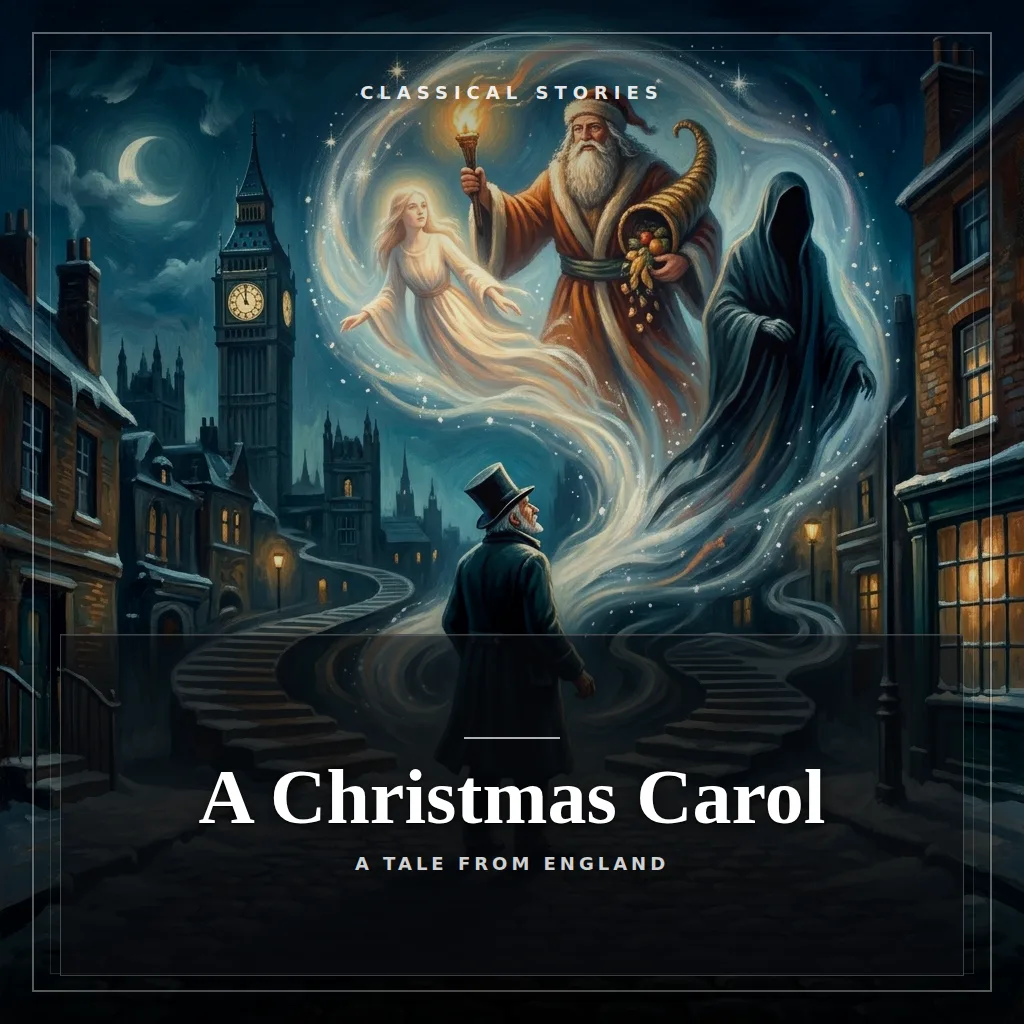
Ebenezer Scrooge is a bitter, tight-fisted old man who despises Christmas, underpays his clerk Bob Cratchit, and turns away everyone's warmth. On Christmas Eve he is visited by the ghost of his old partner Jacob Marley, wound in the chains he forged in life, who warns Scrooge that he faces the same fate unless he changes, and that three spirits will come. The Ghost of Christmas Past shows him the boy he was and the love he let slip; the Ghost of Christmas Present shows him the joy of others he scorns and the fragile, gentle Tiny Tim; the silent Ghost of Christmas Yet to Come shows him a lonely, unmourned death — his own. Waking on Christmas morning to find he still has time, Scrooge is transformed: he becomes generous, joyful, a second father to Tiny Tim, and proof that it is never too late to change.
Why it's worth a listen
A cold, miserly old man who hates Christmas and everyone in it is visited on Christmas Eve by the ghost of his dead partner and then by three spirits — of Christmas Past, Present, and Yet to Come — who walk him through his own life, warmth he refused, and the lonely end he is heading toward. Dickens' beloved ghost story about second chances, and the possibility that anyone, at any age, can choose to change.
What listeners will learn
Subjects: world stories, literature, cultural literacy.
- character
- setting
- conflict
- choice
- consequence
- theme
- retelling
- christmas
- carol
- classical
Questions for after listening
- Retell the central conflict in order.
- Name one important choice and what happened because of it.
- How did the setting or tradition shape the story?
A question to keep
Can a person truly change — and is it ever too late to become kind?
Chapters
- The Man of Cold and Iron
- The Chain of Jacob Marley
- The Light of Yesterday
- The Feast of the Present
- The Shadow of What May Be
- The Joy of Morning
Read a transcript preview
Once upon a time, on a dark, freezing Christmas Eve in London, England, the fog was so thick that the street lamps looked like ghostly fingers poking through the gray air. It was a cold that bit your nose, froze your breath into white clouds, and made people hurry home to their blazing fires. But there was one man in London who did not care about the cold, because he carried a winter of his own deep inside his chest. His name was Ebenezer Scrooge. This famous story comes to us from the rich storytelling tradition of Victorian England, a place of cobblestone streets, coal fires, and grand snowy winters. It is a tale that has been told and retold for nearly 200 years, because it asks a question that belongs to every human being, no matter where or when they live. Can a person truly change their heart, or is it ever too late to become kind? To understand Scrooge, you must understand that he was a man made of sharp edges and locked doors. He was a clutching, covetous, squeezing, grasping old sinner. No one ever stopped him in the street to say, "My dear Scrooge, how are you?" No beggars implored him to bestow a single penny, no children asked him what time it was. Even the blind men's dogs seemed to know him, tugging their owners into doorways when they saw him coming, as if to say, "No light at all is better than an evil eye, dark master." Scrooge liked it that way. He liked to edge his way along the crowded paths of life, warning all human sympathy to keep its distance. On this particular Christmas Eve, Scrooge sat in his counting house. The door of his office was open, so that he might keep his eye upon his clerk, a poor, gentle man named Bob Cratchit. Bob sat in a dismal little cell beyond, copying letters. Scrooge had a very small fire in his grate, but Bob's fire was so tiny that it looked like a single dying coal. Bob could not add more coal to it, because Scrooge kept the coal box in his own room, and if the clerk entered with the shovel, Scrooge would surely threaten to fire him. So Bob wrapped himself in his long white comforter and tried to warm his hands at the candle. Suddenly, the door burst open, and a voice full of warmth and youth cried out, "A Merry Christmas, uncle! God save you!" It was Scrooge's nephew, Fred. He had walked through the fog so quickly that he was all in a glow. His face was ruddy, his eyes sparkled, and his breath smoked in the air. "Bah!" said Scrooge. "Humbug!" "Christmas a humbug, uncle?" said Fred, laughing. "You don't mean that, I am sure." "I do," said Scrooge. "Merry Christmas! What right have you to be merry? What reason have you to be merry? You're poor enough." "Come then," returned the nephew gaily. "What right have you to be dismal? What reason have you to be morose? You're rich enough." Scrooge had no better answer ready on the spur of the moment, so he said, "Bah!" again, and followed it up with, "Humbug!" Fred did not lose his temper. He pleaded with his uncle to come to his house for Christmas dinner the next day. He spoke of Christmas as a kind, forgiving, charitable, pleasant time, the only time in the long calendar of the year, when men and women seem by one consent to open their shut-up hearts freely, and to think of people below them as if they really were fellow passengers to the grave, and not another race of creatures bound on other journeys. But Scrooge only growled that Fred could keep Christmas in his own way, and let Scrooge keep it in his. "Keep it?" repeated Fred. "But you don't keep it." "Let me leave it alone then," said Scrooge. "Much good may it do you." After Fred left, still wishing his uncle a Merry Christmas with a cheerful heart, two portly gentlemen entered the office. They took off their hats and presented papers, explaining that they were collecting…
Published 2026-07-11 · Updated