- Who is it for?
- Ages 8–14
- How long is it?
- 42 min
- What does it include?
- Synced read-along and a quiz
- What does it cost?
- Free — no sign-up required
About this audiobook
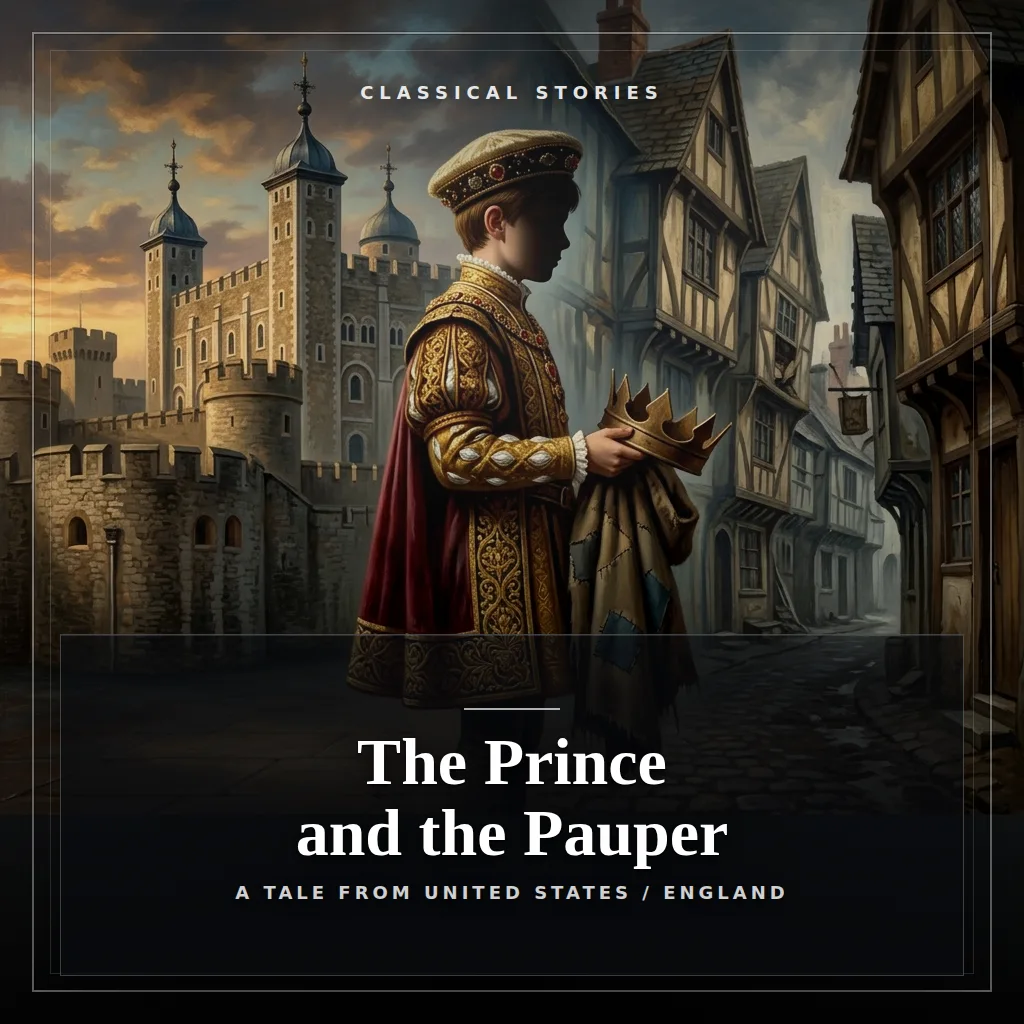
In old London, two boys born on the same day look astonishingly alike: Tom Canty, a beggar boy raised in poverty and cruelty, and Edward, Prince of Wales, heir to the throne. When chance brings them face to face in the palace, they swap clothes to marvel at the resemblance — and are instantly mistaken for each other. The prince, thrown out as a ragged impostor, is plunged into the harsh streets, workhouses, and unjust laws his own crown upholds, learning what his subjects truly suffer. Tom, trapped in the palace as everyone insists he is the prince gone strange in the head, blunders through courtly life and, judging cases, brings unexpected common-sense mercy to royal justice. As the old king dies and a coronation looms, the two boys race to set right who is who — the true prince now a wiser king-to-be for having lived as the lowest of his people.
Why it's worth a listen
Two boys who look exactly alike — one a prince in a palace, one a pauper in the gutters of London — meet by chance and, for a lark, trade clothes, only to be mistaken for each other and swept into each other's lives. The prince learns hard lessons about how his poorest subjects really live, and the pauper stumbles through royal riddles, in Twain's warm, funny, sharp story about privilege, justice, and walking in someone else's shoes.
What listeners will learn
Subjects: world stories, literature, cultural literacy.
- character
- setting
- conflict
- choice
- consequence
- theme
- retelling
- prince
- pauper
- classical
Questions for after listening
- Retell the central conflict in order.
- Name one important choice and what happened because of it.
- How did the setting or tradition shape the story?
A question to keep
How differently would you understand the world if you had to live someone else's life for a while?
Chapters
- Two Boys, Two Worlds
- Cast Out into the Cold
- The Prince Who Forgot Himself
- The Knight of the Ragged Kingdom
- The Race to Westminster
- A Question to Keep
Read a transcript preview
In the ancient, crowded city of London, on a chilly autumn day, nearly 500 years ago, two baby boys were born, who looked so much alike, they might have been carved from the very same block of marble. But while one was welcomed with the ringing of church bells, the firing of cannons, and the cheering of an entire kingdom, the other arrived in a dark, drafty room, where nobody wanted him at all. This story comes to us from the literary tradition of the United States, written by the great American author Mark Twain in the late 19th century. Yet, like a ship crossing the wide Atlantic, it carries us back in time to the foggy, cobblestone streets of Old England, during the reign of the Tudor kings. It is a story that has been told in many ways over the years, but at its heart, it remains a tale of two lives turned upside down by a single daring choice. The first boy was named Edward Tudor, the Prince of Wales. He lived in Westminster Palace, surrounded by walls of thick stone, tapestries of rich crimson silk, and more servants than he could count. When he woke in the morning, one servant handed him his shirt, another buckled his shoes, and a third poured his water. He was never allowed to run down the long corridors, never allowed to get dirty, and never allowed to play with other children. He was a prisoner of his own high birth, watched constantly by guards and tutors who reminded him every hour of the heavy crown he would one day wear. The second boy was named Tom Canty. He lived in a wretched, smelling alleyway called Awful Court, not far from the muddy banks of the River Thames. Tom's home was a single, decaying room on the third floor of a house that seemed to lean sideways with age. He slept on a pile of dirty straw in the corner, sharing the floor with his mother, his twin sisters, Nan and Bet, and his father, John Canty. John Canty was a thief and a bully, a man with a voice like gravel and a hand that was always ready to strike. He expected Tom to go out into the streets every day to beg for pennies, and if Tom came home empty-handed, he was beaten and sent to bed without even a crust of moldy bread. Yet, despite the hunger and the bruises, Tom was not entirely unhappy. In the very same tenement house, lived an old defrocked priest named Father Andrew. Father Andrew was a kind soul, who had saved a few precious books from the ruins of his old church. In the quiet hours of the evening, when the rest of London was asleep, the old priest taught Tom how to read and write. He taught him a little Latin too, and told him magnificent sweeping stories of brave knights, golden castles, and noble princes who ruled with justice and mercy. These stories became Tom's escape. When the rain poured through the holes in the roof, and his stomach growled with hunger, Tom would close his eyes and pretend he was a prince. He practiced speaking with a slow, courtly dignity. He walked with his head held high, pretending his ragged coat was a velvet robe. Soon, the other children of Awful Court began to notice. They called him Prince Tom in jest, but they also began to bring their arguments to him, marveling at how fairly he settled their disputes. Still, Tom's greatest wish was to see a real prince, just once with his own eyes. One cold winter morning, Tom wandered far from his usual haunts, his bare feet blue with the frost. He found himself outside the grand gates of Westminster Palace. Peering through the gilded iron bars, he saw a sight that made his breath catch in his throat. There, on the manicured lawns, stood a boy of his own age. The boy wore a doublet of shimmering red satin, slashed with gold thread, a small sword in a jeweled scabbard at his hip, and a cap of blue velvet, adorned with a curling white…
Published 2026-07-11 · Updated