- Who is it for?
- Ages 8–14
- How long is it?
- 40 min
- What does it include?
- Synced read-along and a quiz
- What does it cost?
- Free — no sign-up required
About this audiobook
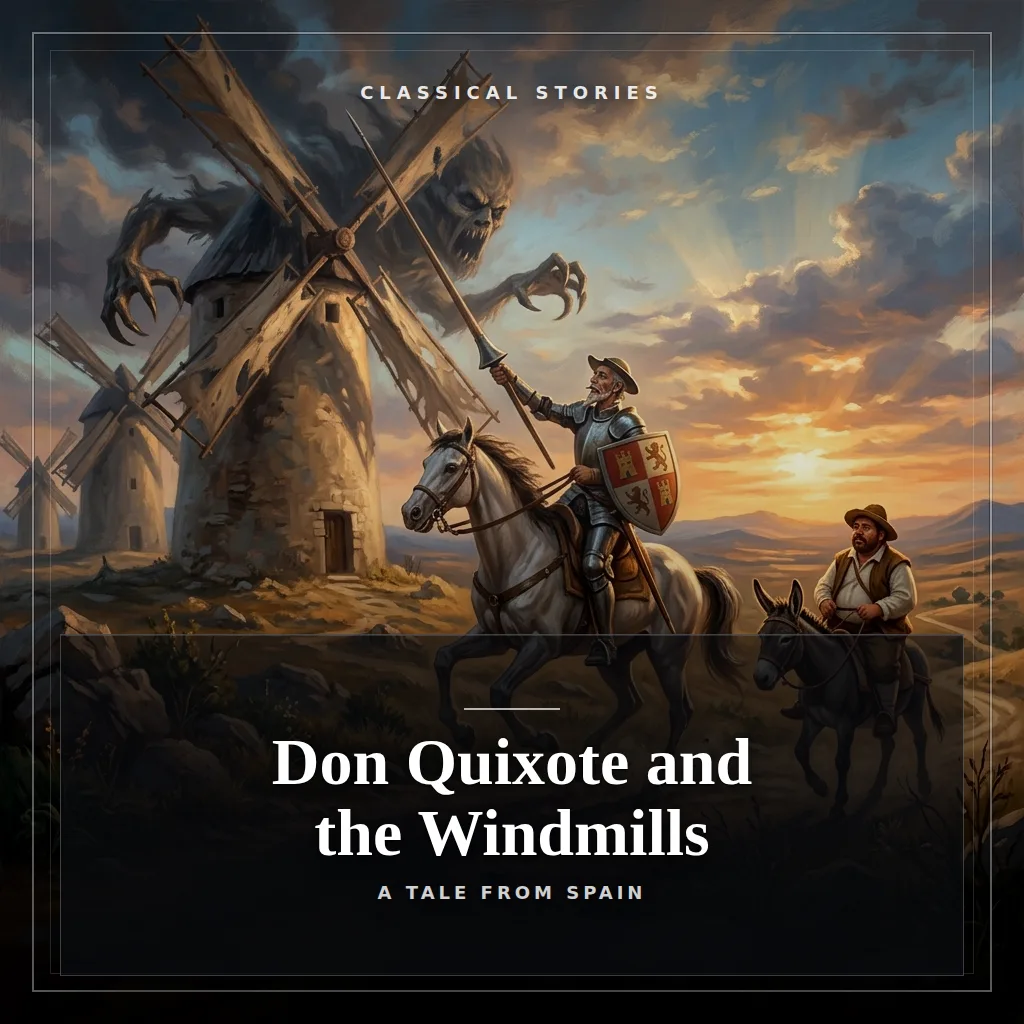
Alonso Quixano, an elderly gentleman, reads so many books of chivalry that his wits turn, and he resolves to revive knighthood — becoming 'Don Quixote,' donning his great-grandfather's rusty armor, renaming his skinny old horse Rocinante, and choosing a farm-girl he's never met as his noble lady, Dulcinea. He persuades a good-natured neighbor, Sancho Panza, to be his squire with promises of an island to govern, and the mismatched pair ride out. Everywhere, Don Quixote sees the world of his books: a roadside inn is a castle, flocks of sheep are armies, and, most famously, a row of windmills on the plain are monstrous giants he must charge — lance lowered, in earnest, while practical Sancho shouts that they are only windmills. He is knocked flat, and gets up undeterred, because in his world he fought giants, and that is a braver thing to be.
Why it's worth a listen
An old gentleman reads so many tales of knights that he decides to become one himself — dressing in rusty armor, renaming his bony horse, and riding out with a puzzled farmer as his squire to right wrongs and fight monsters that everyone else can plainly see are windmills. From one of the first and greatest novels ever written, the funny, touching story of the man who chose to live in a braver, more magical world than the one that was actually there.
What listeners will learn
Subjects: world stories, literature, cultural literacy.
- character
- setting
- conflict
- choice
- consequence
- theme
- retelling
- quixote
- windmills
- classical
Questions for after listening
- Retell the central conflict in order.
- Name one important choice and what happened because of it.
- How did the setting or tradition shape the story?
A question to keep
Is it foolish to see the world as more magical and heroic than it is — or is there something noble in it?
Chapters
- The Library of Dreams
- The Making of a Knight
- A Squire for the Journey
- Castles and Innkeepers
- The Giants of La Mancha
- A Question to Keep
Read a transcript preview
In a dusty, sun-drenched corner of Spain, in a region called La Mancha, where the wind sweeps across flat plains of clay and dry grass, there once lived a gentleman who forgot who he was because he loved stories too much. This was a land of wide open skies, of ancient olive trees twisted by the heat, and of quiet villages where the passage of time was marked only by the rising and setting of the golden Spanish sun. In one of these villages, in a house that smelled of old paper, dried lavender, and tallow candles, lived Alonso Quixano. He was an elderly gentleman, nearing 50 years of age, with a complexion as dry as the plains outside, a lean body, and a face that seemed carved from weathered oak. He lived a quiet, unremarkable life, with a housekeeper who had passed her 40th year, a niece who had not yet reached her 20th, and a single field hand who could saddle his horse as easily as he could handle a pruning knife. For many years, Alonso Quixano lived as his neighbors did. He rose early, took long walks, and ate simple meals, mostly mutton, salad, and the occasional fried egg on Saturdays. But as the years began to press upon his shoulders, he found a quiet door out of his ordinary life. That door was his library. On the wooden shelves of his study, sat dozens of thick, leather-bound volumes. These were not books of history or agriculture, nor were they guides to managing his modest estate. They were books of chivalry. They were grand, sprawling, breathless tales of knights errant from ages long past. Within those pages, brave men in gleaming armor rode through enchanted forests, fought multi-headed dragons, rescued captured princesses from towering castles, and matched wits with powerful dark wizards. At first, Alonso read only in the quiet evenings, after his daily chores were finished. But slowly, the stories began to take hold of him. A single hour of reading in the evening became two hours. Two hours became four. Soon, he was waking before the rooster crowed to open a book, and he did not close it until the oil in his lamp had burned dry, and the cold gray light of dawn crept through his window shutters. He read through the heat of the afternoon, when the rest of Spain was asleep during the siesta. He read while he ate, barely tasting his food. He read while he walked, stumbling over his own rug. He spent so much time reading, and so little time sleeping, that his brain began to dry up. To a mind exhausted by sleeplessness and filled to the brim with magic, the boundary between what was real and what was written began to melt away. He did not see the ink on the page. He saw the glint of steel. He did not hear the rustle of paper. He heard the clarion call of trumpets. He became absolutely, unshakably convinced that every word in those giant books was literal truth. He believed that the legendary knight Amadis of Gaul had truly lived, that the wizard Merlin still watched over the world from a hidden cave, and that the grand heroic age of knighthood was not a collection of old legends, but a real historical golden age that had somehow been lost to the dust of time. He looked out of his window at the world around him, and he found it terribly gray. Where were the heroes? Where were the champions who stood up for the weak, who fought for justice, who rode into the wild unknown with nothing but a shield and a brave heart? The world, he decided, had grown cold and selfish. People cared only for their crops, their coins, and their comfortable beds. The age of knights had ended. And because it had ended, the world had lost its magic. As the hot wind of La Mancha rattled his window pane, a wild, magnificent idea took root in Alonso Quixano's dry brain. It was an idea so bold, so strange, and so wonderfully foolish that it would change his life forever, and eventually, the lives…
Published 2026-07-11 · Updated