- Who is it for?
- Ages 8–14
- How long is it?
- 45 min
- What does it include?
- Synced read-along and a quiz
- What does it cost?
- Free — no sign-up required
About this audiobook
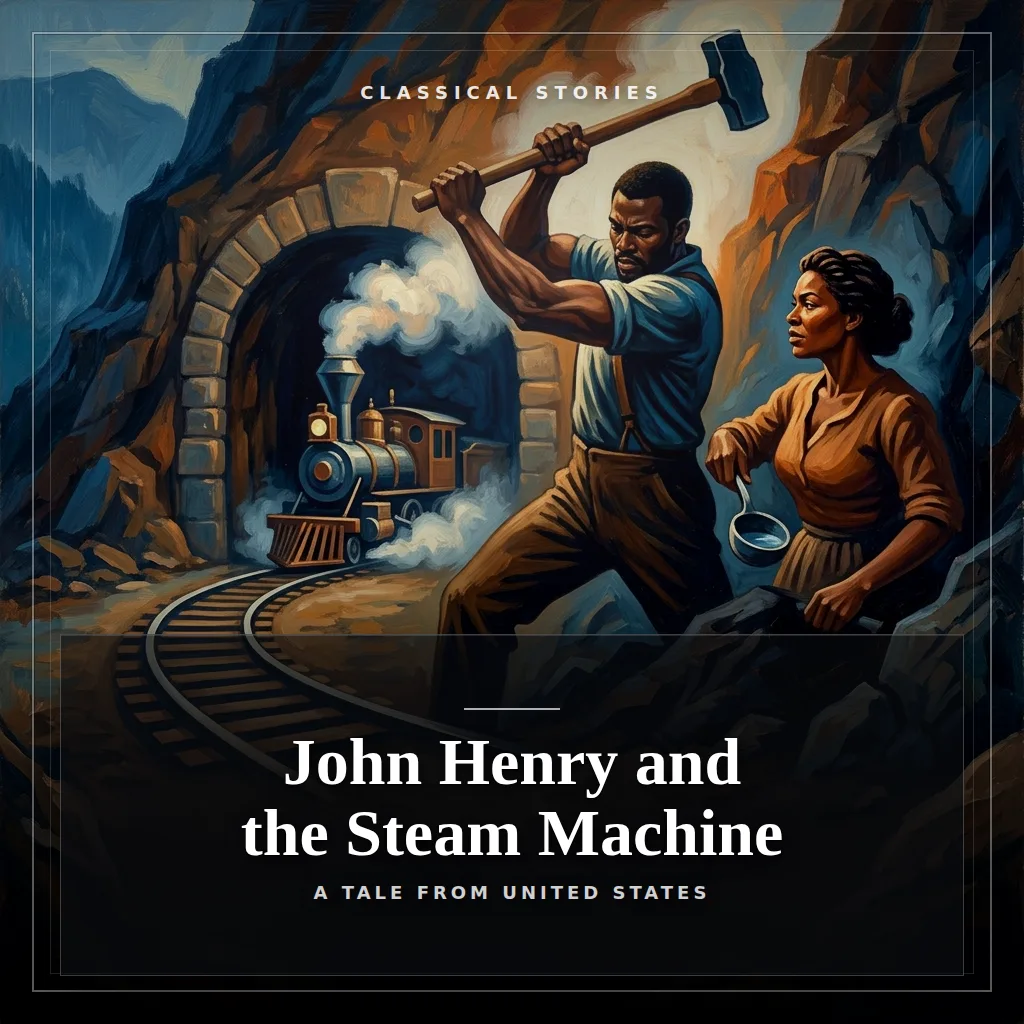
John Henry is the mightiest steel-driver on the railroad — a man who swings a great hammer to drive steel drills into rock so the tunnels can be blasted through the mountains. When a salesman brings a new steam-powered drill and claims it can out-work any man, John Henry will not accept that a machine can replace him. A contest is set: John Henry against the steam drill, boring through the mountain. To the astonishment of everyone, the man out-drills the machine — hammering with impossible strength and heart, he breaks through first. But the effort is too much; he falls at the moment of victory, his hammer in his hand, having proved his point at the ultimate cost.
Why it's worth a listen
The steel-driving man John Henry, born with a hammer in his hand, races a steam-powered drilling machine through a mountain to prove that a person still matters — and beats it, and it costs him everything. One of America's greatest folk ballads, a thundering, bittersweet story about work, dignity, and the machines that changed the world.
What listeners will learn
Subjects: world stories, literature, cultural literacy.
- character
- setting
- conflict
- choice
- consequence
- theme
- retelling
- john
- henry
- steam
Questions for after listening
- Retell the central conflict in order.
- Name one important choice and what happened because of it.
- How did the setting or tradition shape the story?
A question to keep
What are we really proving when we refuse to be replaced — and what is it worth?
Chapters
- The Hammer and the Heart
- The Mountain and the Steel
- The Iron Monster Arrives
- The Bet at the Red Mountain
- The Race Against the Steam
- A Question to Keep
Read a transcript preview
Some people say John Henry was born with a hammer in his hand. And when he first swung it, the earth shook from the blue peaks of Virginia all the way to the Atlantic Ocean. They say that on the night he was born, the sky turned the color of a bruised plum, and the thunder didn't just rumble, it struck the hills with a sharp metallic ring, like a giant blacksmith working an anvil in the clouds. His mother looked at the newborn boy, saw the strength in his tiny shoulders, and knew right then that her son was not made for a quiet, ordinary life. Of course, that is the legend. The grand song we sing when the night is dark and we want to feel giant-sized ourselves. But the truth of John Henry is even larger than the myth, and it belongs to a specific time, a specific place, and a proud people. This is a story from the United States, born out of the African-American folk tradition during the great railroad era of the late 19th century. It was a time of immense change. The Civil War had ended, slavery was abolished, and thousands of newly freed black men were looking for a way to build lives of dignity, strength, and independence. Many of them found their calling on the railroad. They were the men who carved paths through the wilderness, laid down the heavy pine ties, and spiked the iron rails that connected a massive, fractured country from coast to coast. It was brutal, exhausting work, but it was also a place where a man could prove his worth by the sweat of his brow and the power of his arm. And in those days, among all the thousands of workers stretching across the American continent, there was no name spoken with more respect, more awe, or more love than the name of John Henry. Now, you have to understand what a steel driver was, because we don't have jobs like that anymore. In those days, before we had the heavy machinery we see on construction sites today, tunnels were made by hand. It was a two-man job of terrifying precision. First, there was the shaker or the turner. The shaker's job was to stand against the dark, cold rock face of the mountain, holding a long, heavy steel drill, essentially a massive chisel against the stone. Then came the driver. The driver's job was to swing a 9-lb sledgehammer with all his might, striking the end of that steel drill. Clang. The moment the hammer struck, the shaker would twist the steel drill a quarter turn to clear out the rock dust, and then hold it steady again. Clang. Another strike. Clang. Another. They did this over and over, hour after hour, driving that steel rod deep into the mountain's heart. Once the hole was deep enough, the blasting crew would fill it with gunpowder, light the fuse, and blow a chunk of the mountain away. Then the workers would clear the rubble, and the steel drivers would step up to the new rock face to start all over again. It was a dance of life and death. If the driver's aim was off by even a fraction of an inch, or if he swung a second too early, he wouldn't hit the steel. He would hit his partner. It required absolute trust, perfect rhythm, and a heart that didn't know the meaning of fear. John Henry was the undisputed king of the steel drivers. When he swung his hammer, it didn't just make a noise. It sang. He used a hammer with a handle made of supple hickory wood, greased so it wouldn't slip in his hands, and he swung it in a full, magnificent circle, starting from his ankles, rising up through his hips, and coming down with the force of a falling star. But John Henry didn't just work in silence. He was a singing man. In the African-American railroad tradition, singing was as important as the hammer itself. The men sang work songs or lining tracks to keep their movements synchronized. If everyone struck at the exact same beat, the…
Editorial review
Quality reviewed · 98/100 on . Certificate EL-16B9-A136 is bound to the exact narrated script.
The review checks factual care, audience fit, teaching quality, structure, tone and source honesty. Read the editorial standards.
Published 2026-07-11 · Updated