- Who is it for?
- Ages 8–14
- How long is it?
- 32 min
- What does it include?
- Synced read-along and a quiz
- What does it cost?
- Free — no sign-up required
About this audiobook
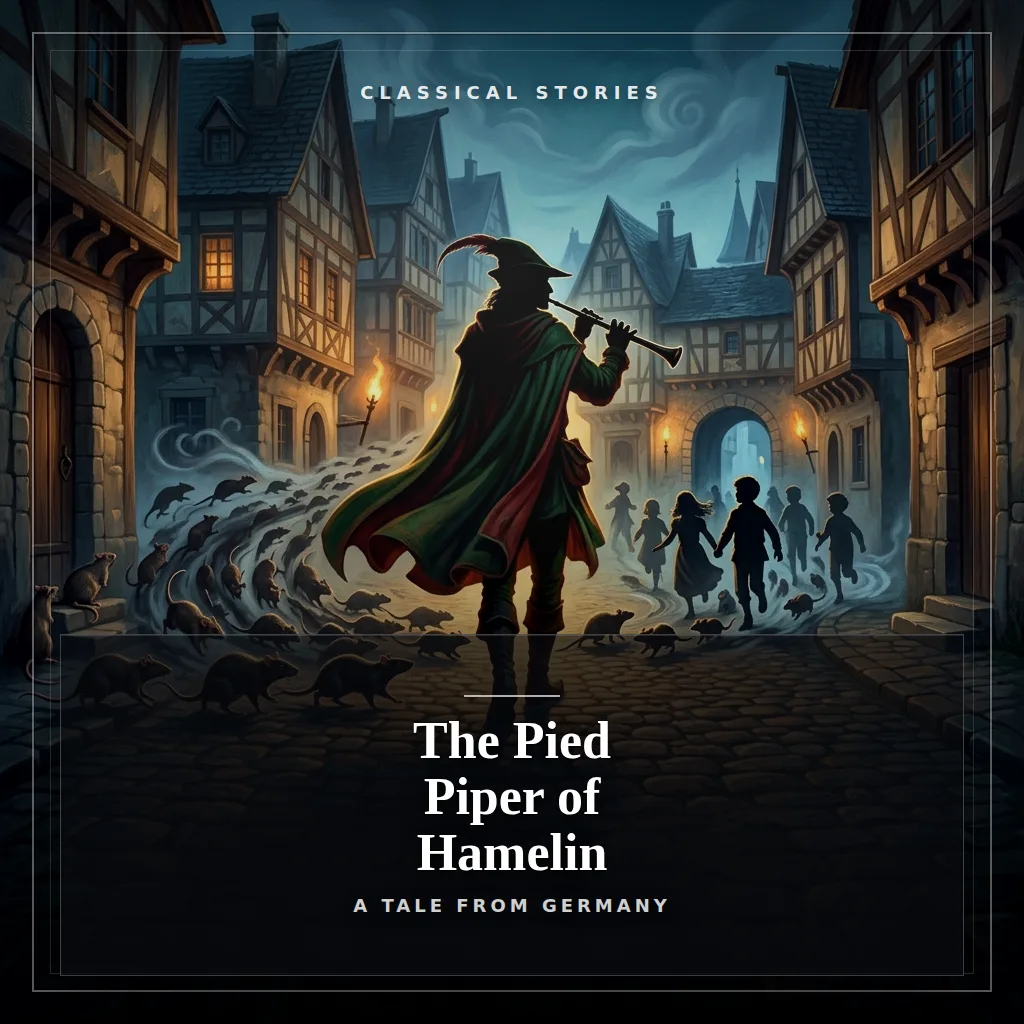
The town of Hamelin is plagued by rats — everywhere, into everything — until a stranger in a coat of many colors arrives and offers, for a fee, to rid them of the rats entirely. The town council agrees to a rich reward. The piper plays a haunting tune, and every rat in Hamelin follows him out of town and into the river, drowned. But when he returns for his payment, the council, safe now, laughs and offers a fraction of what they promised. So the piper plays again — a sweeter, stranger melody — and this time it is the children of Hamelin who come dancing out of their houses and follow him out of the town, through a door in the mountainside that closes behind them, gone. Only one or two children, left behind, remain to tell what a broken promise cost.
Why it's worth a listen
A town overrun with rats hires a strange piper in patchwork clothes who charms the rats away with a magical tune — and then refuses to pay him. So the piper plays a different melody, and this time it is not the rats who follow him out of Hamelin. A genuinely eerie medieval legend, unsettling and unforgettable, with a whisper of true history behind it.
What listeners will learn
Subjects: world stories, literature, cultural literacy.
- character
- setting
- conflict
- choice
- consequence
- theme
- retelling
- pied
- piper
- hamelin
Questions for after listening
- Retell the central conflict in order.
- Name one important choice and what happened because of it.
- How did the setting or tradition shape the story?
A question to keep
What is owed when a promise is broken — and who ends up paying it?
Chapters
- The Gray Tide
- The Stranger in Patchwork
- The Song of the River
- The Broken Promise
- The Second Tune
- Into the Mountain
- The Silent Town
Read a transcript preview
If you were to close your eyes and listen to the darkness of the town of Hamelin in the spring of the year 1284, you would hear a sound like dry autumn leaves scraping across stone. But there was no wind that spring, and the leaves had long since rotted into the earth. The sound was alive. It was hungry, and it was everywhere. This is a story from Germany, preserved for over 700 years in the quiet valleys of the Lower Saxony region. Like all great tales that have traveled down the long winding road of human history, it has been told in many ways. Sometimes as a fairy tale to whisper at bedtime, sometimes as a dark warning, and sometimes as a song. But at its heart, it is a story about the weight of a word, and what happens when the people who hold power forget that a promise is a sacred thing. To understand the tragedy that befell Hamelin, you must first picture the town as it was before the gray tide came. It was a beautiful, prosperous place, nestled comfortably on the banks of the river Weser. Its houses were built of strong oak timbers and white plaster, with high steep roofs that reached toward the gray German sky. The citizens of Hamelin were proud, hard-working, and above all, comfortable. Their granaries were bursting with wheat. Their cellars were stocked with heavy wheels of cheese and barrels of salted fish. Their merchants wore coats of fine wool and carried heavy purses of silver. But wealth has a way of attracting those who wish to share in it without working for it. At first, the people of Hamelin barely noticed the newcomers. A scratch behind the wainscot in the pantry, a small dark shape darting across the rafters of the barn, a sack of flour in the bakery that seemed to have a small jagged hole chewed through the canvas. Within a few months, however, the scratch became a rattle, and the rattle became a roar. The rats had arrived. They did not come in dozens, or even in hundreds. They came in thousands, and then in tens of thousands, pouring down from the surrounding hills and up from the damp banks of the river. They were not the small, timid field mice of the meadows. These were great, bold, gray rats with long, hairless tails, sharp yellow teeth, and eyes that gleamed like tiny drops of hot pitch in the dark. Before long, there was no corner of Hamelin free from their presence. They nested in the Sunday bonnets of the ladies. They licked the sweet butter straight from the churns. They chewed through the leather of the shoemaker's finest boots. If a cook left a pot of soup simmering on the hearth, she would return to find a gray rat sitting on the lid, peering down at the steam. They ran across the tables during dinner, snatching bread crumbs from the hands of the merchants. They even climbed into the wooden cradles where the babies slept, their cold pink feet leaving tiny tracks on the linen sheets. The town's people tried everything. They brought in cats, but the rats were so large and fierce that they banded together, hissed, and drove the terrified cats up into the apple trees. They brought in packs of sharp-nosed terriers, but the rats outnumbered the dogs a hundred to one, biting their paws and sending them howling into the streets. They set iron traps, but for every rat that was caught, ten more seemed to spring from the floorboards. They laid out plates of poisoned grain, but the rats grew clever, smelling the venom and leaving the plates untouched, turning instead to eat the leather bindings of the town's law books. The people of Hamelin were at their wits' end. The constant scratching, squeaking, and scurrying wore away their sleep and their patience. Neighbors began to argue in the streets. The baker blamed the butcher for attracting the pests. The butcher blamed the brewer, and everyone blamed the town council. Every morning, a crowd of angry citizens gathered outside the town hall, shaking their fists at the high…
Editorial review
Quality reviewed · 96/100 on . Certificate EL-8D51-C90B is bound to the exact narrated script.
The review checks factual care, audience fit, teaching quality, structure, tone and source honesty. Read the editorial standards.
Published 2026-07-11 · Updated