- Who is it for?
- Ages 8–14
- How long is it?
- 40 min
- What does it include?
- Synced read-along and a quiz
- What does it cost?
- Free — no sign-up required
About this audiobook
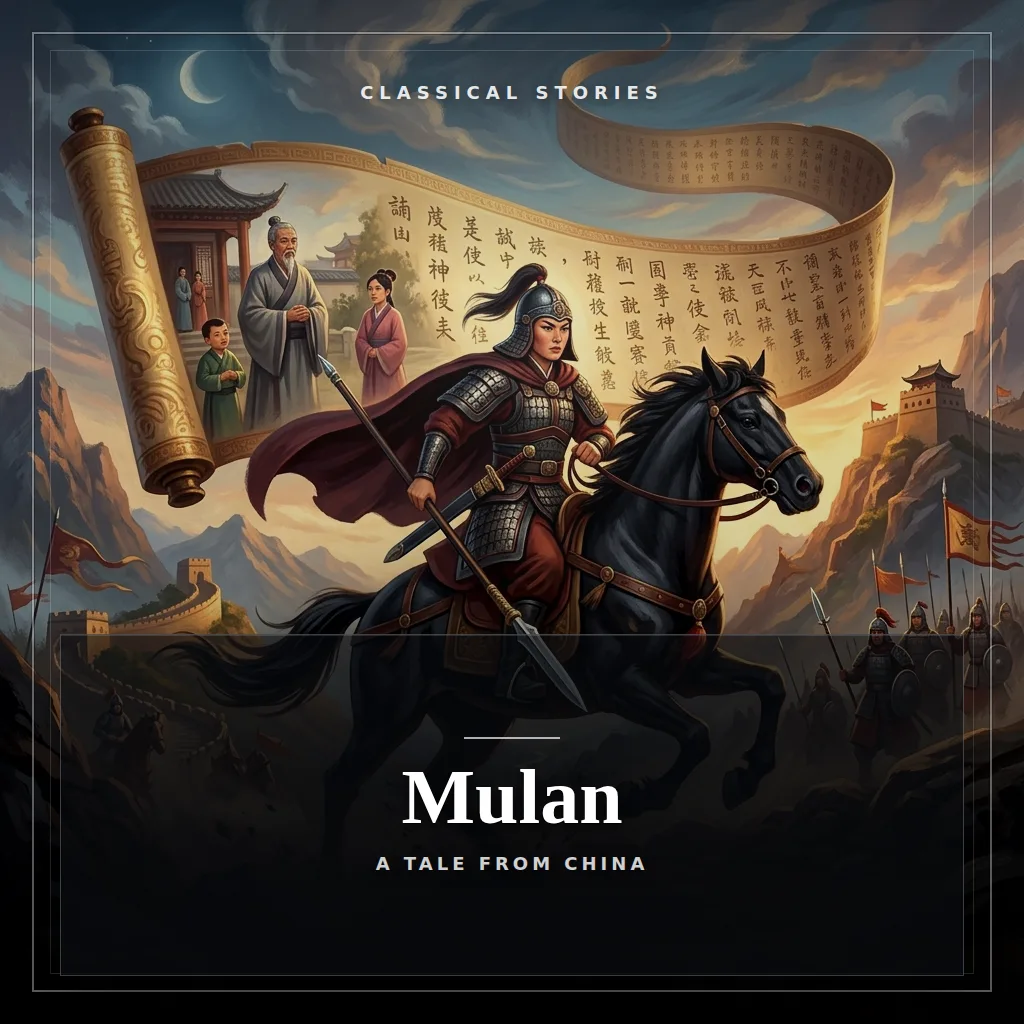
The conscription scrolls come to the village, and on every one of them is her father's name — a father too old for war, with no grown son to send. So Mulan buys a horse at the east market, a saddle at the west, a bridle at the south, a whip at the north, and rides to the frontier in her father's name. Twelve years of campaigns follow — cold light on iron armour, generals falling, comrades saved — before the Emperor himself offers her any reward she names. She asks only for a swift camel to carry her home.
Why it's worth a listen
Twelve years at war, and nobody knew. The ballad of Mulan is fifteen centuries old and still one step ahead of every listener: it has armour and mountain passes and camp fires, but its finest moment is quiet — comrades meeting a friend they never really saw. No film version; this is the original, and the original is better.
What listeners will learn
Subjects: world stories, literature, cultural literacy.
- character
- setting
- conflict
- choice
- consequence
- theme
- retelling
- mulan
- classical
- stories
Questions for after listening
- Retell the central conflict in order.
- Name one important choice and what happened because of it.
- How did the setting or tradition shape the story?
A question to keep
How much of who you are is what people see — and how much is what you do?
Chapters
- The Loom and the Scroll
- Four Markets by Day, Two Rivers by Night
- Cold Light on Iron Armor
- The Hall of the Son of Heaven
- The Door by the Mulberry Trees
- A Question to Keep
Read a transcript preview
Click, clack, click, clack. If you were to walk down the narrow dirt path of a certain village in Northern China, some 1500 years ago, that is the sound you would hear echoing from the open window of almost every small mud brick house. It was the rhythm of the loom. It was the music of daily life, the steady, patient work of turning raw silk and rough hemp into cloth to keep families warm, and to pay the taxes owed to the distant emperor. But on a certain spring morning, when the apricot trees were just beginning to show their pale pink blossoms, the loom in the Hua family home was quiet. The wooden shuttle, smooth from years of sliding through threads, lay still on the half-finished cloth. Instead of the steady click and clack, there came another sound, a long, heavy sigh. Hua Mulan sat with her hands resting on the wooden frame of the loom, her head bowed. She was a young woman of the northern frontier, strong-limbed from helping in the fields, her face tanned by the sun and wind that swept down from the great steps. She loved the work of her hands, but today, her mind was far from the warp and weft of the fabric. Her heart felt as heavy as a river stone. This story, which has been sung in China for a millennium and a half as the ballad of Mulan, begins in this very room with a sigh that was heard across generations. It is a story about duty, about the wild and dusty frontier, and about a question that each of us must ask ourselves sooner or later. How much of who you are is what people see when they look at you, and how much is what you actually do? The quiet of the house was broken not by a voice, but by the heavy, dragging step of an old man in the courtyard outside. Mulan turned her head toward the window. She saw her father, Hua Hu, walking slowly toward the stable. He walked with a limp, his left leg stiff from a wound he had received in his youth, fighting in the emperor's cavalry. He was a man who had once ridden like the wind, but now, even carrying a bucket of water made him pause to catch his breath. Suddenly, the silence of the village was shattered by the sharp, metallic clang of a bronze gong. Mulan started. The sound came from the village square, where the imperial messengers had just arrived on lathered, dusty horses. In those days, during the Northern Way Dynasty, the empire was constantly threatened by nomadic raiders from the north, the Rouran, who swept down on swift horses to burn villages and carry away the harvest. When the emperor needed to defend the border, he sent out conscription lists. Mulan rose from her loom, her heart hammering against her ribs, and hurried out into the street. The village square was already crowded. Farmers with soil still clinging to their hands, grandmothers holding crying toddlers, and young men with pale faces stood in a tight circle around the imperial post. Nailed to the wooden board were 12 scrolls of yellow paper, stamped with the heavy red ink of the emperor's seal. A military officer, his iron plates of armor clinking as he moved, stood by the post, reading the names aloud in a booming, merciless voice. Mulan squeezed through the crowd, her eyes scanning the yellow scrolls. She did not need to wait for the officer to reach her family's name. There, on the very first scroll, written in bold, black brush strokes, was the name of her father, Hua Hu. She looked to the second scroll, Hua Hu. She looked to the third, the fourth, the fifth. On every single one of the 12 military registers, her father's name was written. The emperor was calling up a massive army, and every family on the frontier registry was required to send one grown man to horse. There were no exceptions. There was no buying one's way out of this duty. Mulan felt the world tilt around her. She looked back toward…
Editorial review
Quality reviewed · 96/100 on . Certificate EL-0055-2ED1 is bound to the exact narrated script.
The review checks factual care, audience fit, teaching quality, structure, tone and source honesty. Read the editorial standards.
Published 2026-07-10 · Updated