- Who is it for?
- Ages 8–14
- How long is it?
- 27 min
- What does it include?
- Synced read-along and a quiz
- What does it cost?
- Free — no sign-up required
About this audiobook
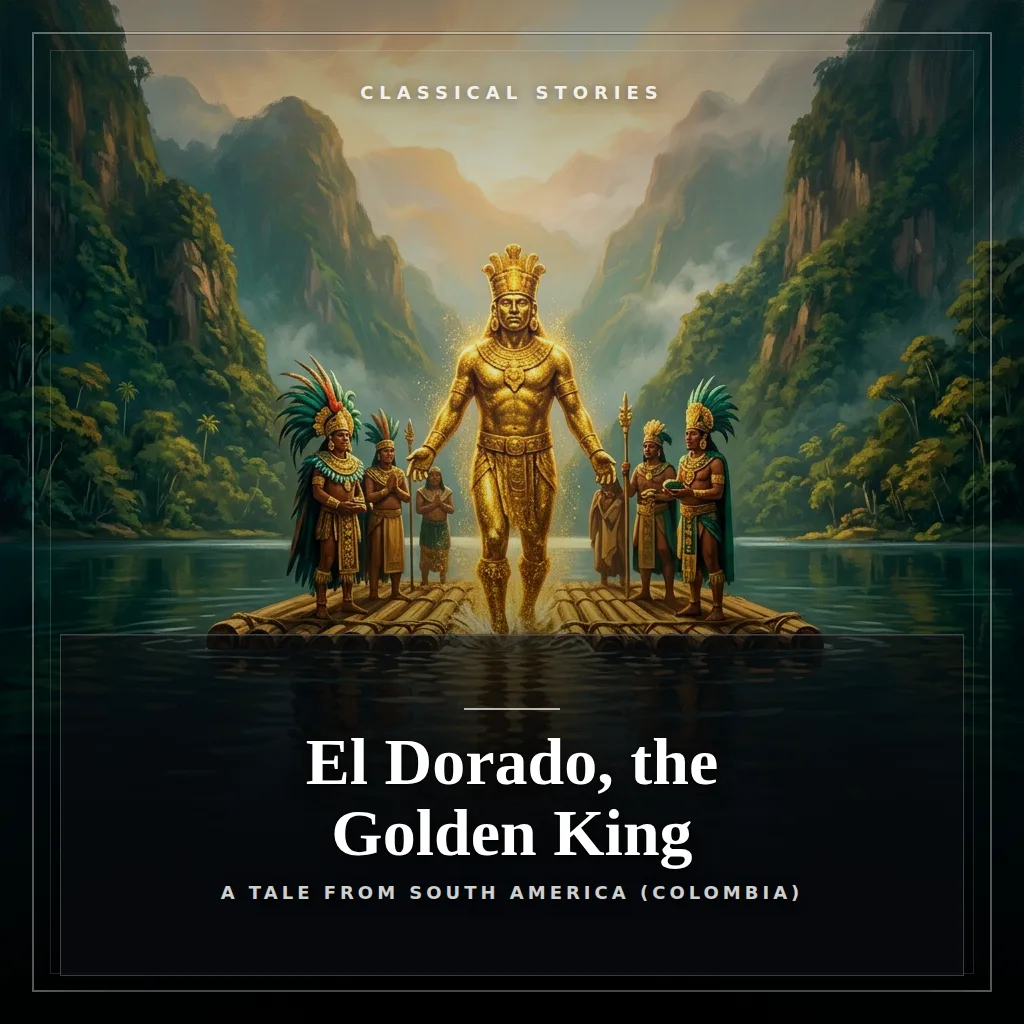
High in the mountains of what is now Colombia, the Muisca people held a sacred rite: each new ruler was covered in sticky earth and blown over with gold dust until he gleamed, then rowed on a raft to the middle of the holy Lake Guatavita, where he cast offerings of gold and emeralds into the water and washed the gold from his own body as a gift to the gods. To the Muisca it was worship. But when the story reached outsiders as 'El Dorado — the gilded one,' it twisted into a rumor of a whole city of gold, and expedition after expedition set out to find it, draining the lake, crossing deadly jungles, ruining themselves in pursuit of a place that was never there — while the real treasure lay quietly at the bottom of a mountain lake.
Why it's worth a listen
There really was an El Dorado — not a lost city but a ceremony: a new Muisca king coated head to toe in gold dust, rowed to the center of a sacred lake to offer treasure to the gods, washing the gold from his body into the water. This is the true story behind the legend, and the tale of how a garbled rumor of 'the golden one' sent centuries of outsiders searching for a city that never existed.
What listeners will learn
Subjects: world stories, literature, cultural literacy.
- character
- setting
- conflict
- choice
- consequence
- theme
- retelling
- dorado
- golden
- king
Questions for after listening
- Retell the central conflict in order.
- Name one important choice and what happened because of it.
- How did the setting or tradition shape the story?
A question to keep
What does a story of gold do to the people who hear it — the ones who lived it, and the ones who chase it?
Chapters
- The Lake at the Top of the World
- The Gilded King
- The Gift in the Water
- The Whispering Wind
- The Fever of the Seekers
- A Question to Keep
Read a transcript preview
High in the Andes mountains, where the air is so thin and sharp, it feels like breathing cold glass. There is a lake that looks like a fallen piece of the sky. It sits perfectly round inside the crater of an ancient sleeping volcano, ringed by steep, emerald green cliffs. This is Lake Guatavita, and long before any mapmaker from across the sea ever drew its shape, it was the beating heart of a world. To find this place, you must travel in your mind to the high, misty valleys of what we now call Colombia in South America. If you stood on the rim of that crater hundreds of years ago, you would hear the wind singing through the paramo, the cold, high altitude grasslands, where the plants look like giant furry candles, and the clouds drift so low, they brush against your cheeks. The air here is quiet, heavy with moisture and the scent of damp earth. It is a place that feels very close to the heavens, and very far from the ordinary world below. For the Muisca people, who lived in these mountain valleys for generations, this lake was not just water. It was a holy place, a sacred portal where the earth met the sky, and where the gods of the water and the sun kept watch over the living. The Muisca were a peaceful and deeply spiritual people. They did not build massive stone pyramids like the Maya or the Aztecs, nor did they construct vast empires of stone roads like the Inca. Instead, they built their homes and temples from wood, clay, and thatch, living in harmony with the fertile soil of the high plains. They grew maize, potatoes, and beans. They wove beautiful cotton blankets with intricate geometric patterns, and they traded blocks of salt from their great salt mines for things they could not find in the mountains. But there was one thing the Muisca possessed that would eventually change their world forever. They were master metal workers. To the Muisca, metal was not money. They did not have coins, and they did not buy and sell things with gold. To them, gold was something far more precious than wealth. It was the physical representation of the sun's light. It was the color of the life-giving warmth that chased away the freezing mountain nights. When they looked at a piece of gold, they did not see power or greed. They saw a fragment of the divine, a sacred substance that belonged to the gods. They combined gold with copper to create a beautiful reddish gold alloy they called tumbaga. They worked this metal with incredible skill, hammering it into thin sheets or casting it using the lost wax method to create delicate figures of frogs, snakes, birds, and human beings. In the Muisca tradition, which has been told in many different ways through the generations, there came a time when a new leader had to be chosen to guide the people. The ruler, known as the Zipa, was not simply a king who ruled by force. He was a spiritual guardian, a bridge between his people and the unseen forces of the universe. But before he could wear the mantle of leadership, before he could sit on the wooden throne and speak for his people, he had to perform a sacred duty. He had to go to the lake at the top of the world, and he had to give everything back to the earth. Farewell. The preparation for the ceremony took years. The young man chosen to be the next Zipa could not simply step into his role. He had to prove his discipline, his strength, and his devotion. For six years, he lived in a secluded cave, away from the sight of the sun and the warmth of his family. He ate only the simplest foods, drank only pure water, and spent his days in silent meditation, guided by the Shaques, the wise priests of the Muisca. He learned the laws of his ancestors, the movements of the stars, and the songs of creation. He learned that to rule was not to take, but to serve. When the long…
Editorial review
Quality reviewed · 96/100 on . Certificate EL-CA7C-C0F0 is bound to the exact narrated script.
The review checks factual care, audience fit, teaching quality, structure, tone and source honesty. Read the editorial standards.
Published 2026-07-11 · Updated