- Who is it for?
- Ages 8–14
- How long is it?
- 33 min
- What does it include?
- Synced read-along and a quiz
- What does it cost?
- Free — no sign-up required
About this audiobook
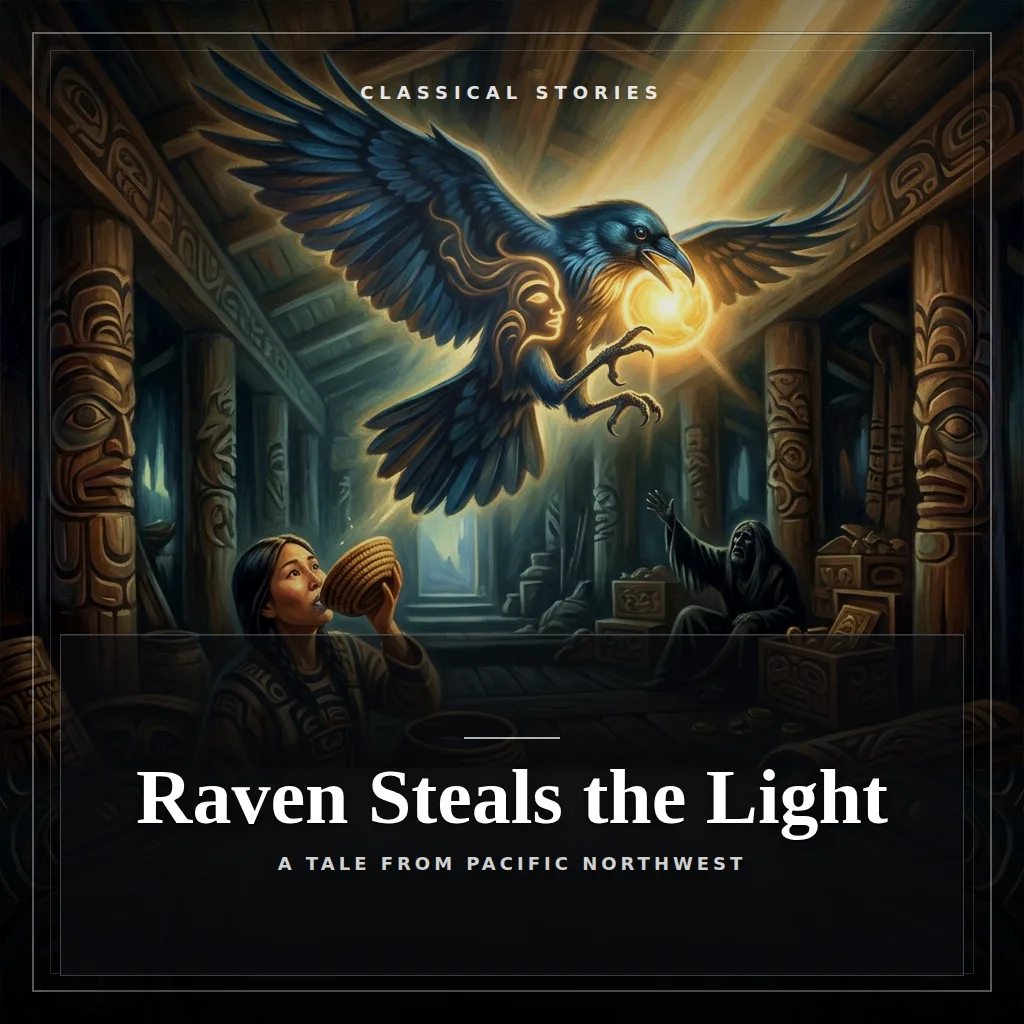
Before daylight, the world fumbled in the dark — people fished by touch and met each other by voice. The light existed; it simply belonged to one old chief who kept it nested in boxes within boxes in his house by the river, seen by no one. The Raven, who existed before most things and wanted most things, decides the light would look better in the sky — or at least in his beak. His plan is patient and outrageous: become a hemlock needle in a basket of drinking water, be swallowed by the chief's daughter, and be born, some months later, as the most adored, most demanding grandchild the dark world has ever heard cry.
Why it's worth a listen
In the beginning the world was dark, because an old chief kept all the light locked in a box, inside a box, inside a box. The Raven — shape-shifter, glutton, genius — wants it, so he arranges to be born as the old man's own grandson. From the peoples of the Pacific Northwest coast comes one of the world's great trickster tales: how daylight got loose, why ravens are black, and how selfishness and generosity can ride in the same beak.
What listeners will learn
Subjects: world stories, literature, cultural literacy.
- character
- setting
- conflict
- choice
- consequence
- theme
- retelling
- raven
- steals
- light
Questions for after listening
- Retell the central conflict in order.
- Name one important choice and what happened because of it.
- How did the setting or tradition shape the story?
A question to keep
Can a selfish trick still be a gift to the whole world?
Chapters
- Introduction
- The World of the Great Shadow
- The Bird of a Thousand Minds
- The Needle in the Water Basket
- The Art of the Great Cry
- The Flight of the Blackened Bird
- The Scattering of the Sky
- A Question to Keep
Read a transcript preview
Number 26. Raven Steals the Light. Imagine a world where you have never seen your mother smile, only felt the curve of her cheek in the dark. Imagine a world where the sea is a cold, invisible rushing sound, and the forest is a wall of whispers you must navigate with your hands outstretched. Long ago, before the sun and the moon took their places in the sky, this was how the world was, a place of endless velvety shadow. This is a story that belongs to the beautiful misty coast of the Pacific Northwest. It is kept in the voices and carved into the towering cedar poles of the Haida, the Tlingit, and their neighboring first nations. For hundreds of years, and still to this day, their descendants have told of this dark time. They tell it in long houses while the rain beats against the roof, and they tell it to remind us of how the world we see came to be. There are many ways to tell this tale, for oral traditions are like rivers with many branches. But this is one telling, offered with deep respect for the people who have carried it through the generations. In those ancient days, the people lived in villages along the water's edge, and they were incredibly brave and clever. They had to be. To catch a fish, you could not look for the silver flash of scales beneath the waves. Instead, you sat in a cedar canoe, floating on a black sea beneath a black sky, and lowered a line made of twisted kelp. You had to feel the water through your fingers. You waited for the tiniest shudder in the line, a vibration that told you a halibut was tasting the bait far below. When the fishermen returned to the shore, they found their way by listening to the rhythm of the waves breaking on the pebbles, or by the smell of the smoke rising from the village hearths. Inside the houses, the only light came from the dim red embers of wood fires. In that soft, glowing twilight, people knew each other by the sound of their footsteps and the timber of their voices. If you wanted to know what your brother looked like, you reached out and ran your fingers over his forehead, his nose, and his chin. Yet, even in this great shadow, the people were artists. They carved massive posts of cedar to stand outside their homes, shaping the wood into eagles, bears, and killer whales. They did this entirely by touch, feeling the grain of the wood with their palms, knowing exactly how deep to bite into the cedar with their stone tools to make an eye or a claw. They lived in harmony with the dark, but they always wondered what lay beyond it. For there was a rumor. It was a whisper carried by the wind through the tops of the hemlock trees, a story told around the low burning fires. The rumor said that light actually existed. It was not a myth, it was real. But it did not belong to the sky, and it did not belong to the people. Instead, the light was kept by a great and powerful chief, who lived far up the Nass River. This chief was wealthy beyond measure, but his greatest treasure was the light itself. He did not keep it to use it, nor did he keep it to share. He kept it simply because he was rich, and because he could. He kept it nested in boxes, within boxes, within boxes, in the deepest, darkest corner of his massive timber home. And there, in the dark, the light slept, unseen by anyone. Now, we must meet Raven. In those days, Raven was not the jet black bird you see today, sitting on telephone poles or hopping along the beaches, croaking at the wind. According to the old stories, Raven was once a magnificent creature of pure white. His feathers were as pale as fresh snow, and when he flew through the endless night, he looked like a drifting cloud or a streak of seafoam. But if his feathers were white, his…
Editorial review
Quality reviewed · 96/100 on . Certificate EL-2E60-BA46 is bound to the exact narrated script.
The review checks factual care, audience fit, teaching quality, structure, tone and source honesty. Read the editorial standards.
Published 2026-07-10 · Updated