- Who is it for?
- Ages 8–14
- How long is it?
- 42 min
- What does it include?
- Synced read-along and a quiz
- What does it cost?
- Free — no sign-up required
About this audiobook
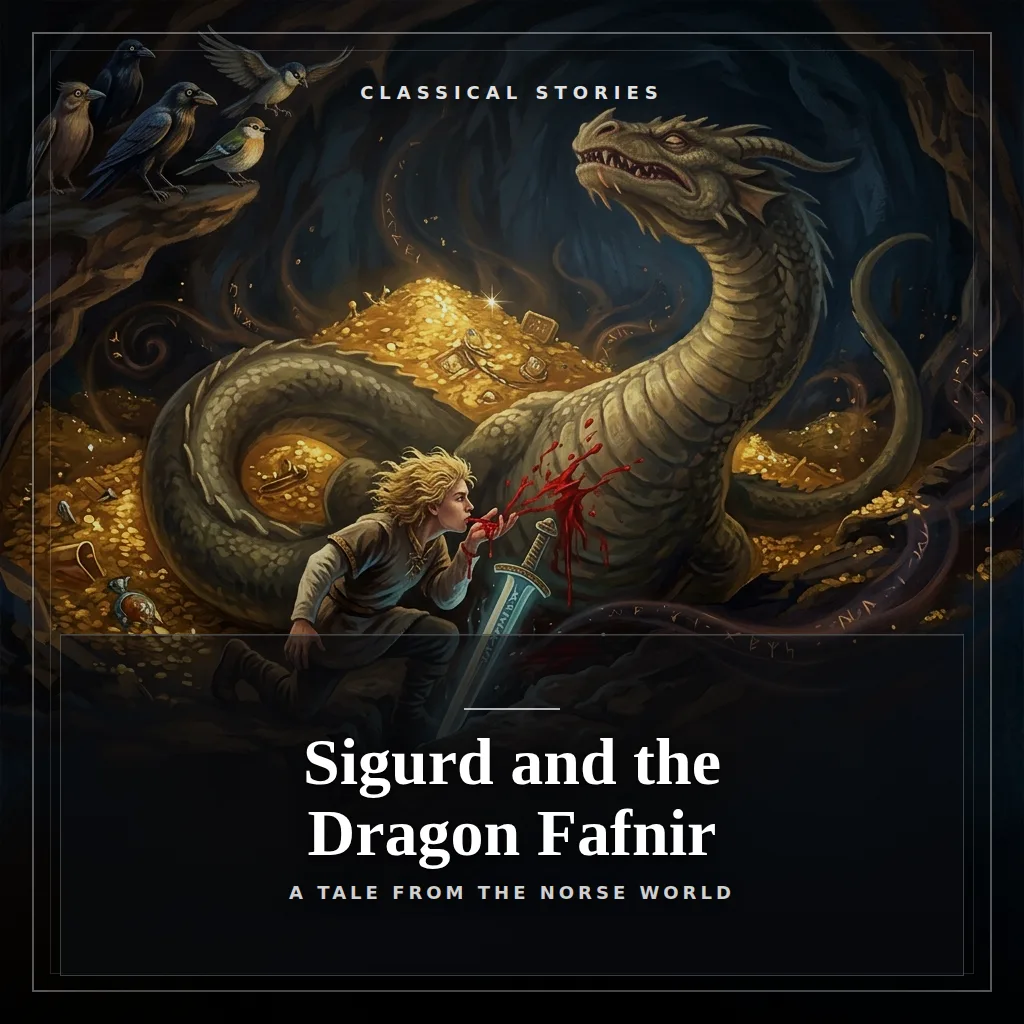
Fafnir was once something like a man, but greed for a cursed hoard of gold twisted him into a monstrous dragon that coils upon his treasure. The young hero Sigurd, guided (and secretly used) by the smith Regin, reforges the shattered sword of his father, digs a trench across the dragon's path to the river, and strikes upward as the great beast passes over. When he roasts the dragon's heart and burns his thumb, he licks it — and the blood lets him understand the birds, whose chatter warns him that the smith who sent him means to betray him for the gold. Sigurd takes the hoard and the curse along with it, and the birds sing of all the sorrow still to come.
Why it's worth a listen
A young hero reforges his father's broken sword, digs a pit on a dragon's path, and slays the great worm Fafnir — then tastes the dragon's blood by accident and suddenly understands the warning-song of the birds. The Norse dragon-slaying that shaped a thousand later stories, wrapped around a hoard of gold that ruins everyone who touches it.
What listeners will learn
Subjects: world stories, literature, cultural literacy.
- character
- setting
- conflict
- choice
- consequence
- theme
- retelling
- sigurd
- dragon
- fafnir
Questions for after listening
- Retell the central conflict in order.
- Name one important choice and what happened because of it.
- How did the setting or tradition shape the story?
A question to keep
If a treasure is cursed, does taking it make the curse yours too?
Chapters
- The Weight of Gold
- The Sparks of the Forge
- In the Path of the Beast
- The Strike in the Dark
- The Language of the Wind
- A Question to Keep
Read a transcript preview
Long ago, in the cold, pine-scented lands of the far north, there was a time when the world was younger, harder, and filled with a strange, wild magic. This is a story from the Norse world, the lands of Scandinavia, where the winters are long, the mountains are carved by ice, and the sea crashes against towering stone cliffs. The people of this world, whom we sometimes call the Vikings, sat around roaring fires in great timber halls to listen to their poets, the scalds. They told stories of gods and giants, of courage and fate, and of the choices that define a human life. The story they loved best of all was the legend of the Volsungs, a family of great heroes, and of a young man named Sigurd. But to understand Sigurd, we must first understand the dragon he was destined to meet. And to understand the dragon, we must understand that he was not always a monster. Once, long before Sigurd was born, there was a family of three brothers. They were not quite men, but rather of an older magical race that could shapeshift and work wonders. The youngest brother was named Otter, because he loved nothing more than to swim in the cold rivers, catching fish in the form of a sleek brown otter. The middle brother was Regin, a master blacksmith whose hands could shape iron and bronze into things of breathtaking beauty and terrible power. The eldest brother was Fafnir, a man of immense strength and a cold, protective heart. One afternoon, a terrible mistake occurred. The great gods of the Norse world, Odin, the one-eyed father of all, Loki, the clever and mischievous trickster, and Honer, the quiet traveler, were wandering near the river. Loki, seeing what he thought was an ordinary otter eating a salmon on a rock, threw a stone. His aim was true, and the otter was killed. When the gods sought shelter that night at the hall of Hreidmar, the father of the three brothers, they showed off the beautiful otter pelt they had taken. Hreidmar and his sons recognized the skin of their beloved otter instantly. Overcome with grief and fury, they bound the gods with magic ropes that even Odin could not break. To buy their freedom, the gods had to agree to a ransom. They must cover the inside and the outside of Otter's skin with pure gold. It was Loki who went to find the ransom. He knew of a dark pool deep beneath a waterfall where a dwarf named Andvari lived. Andvari had turned himself into a fish to guard his secret treasure, a mountain of gold, and most precious of all, a small golden ring that had the power to multiply wealth. Loki, using a net woven by the sea gods, captured Andvari and forced him to hand over every single coin, every cup, every crown, and finally, the tiny ring itself. As Loki snatched the ring from the dwarf's finger, Andvari cried out a terrible curse. "That gold," the dwarf hissed, "will be the ruin of whoever owns it. The ring will bring death to its master, and the treasure will bring only betrayal, sorrow, and greed." Loki did not care. He took the gold back to Hreidmar's hall. The gods stuffed the otter skin with gold and piled more gold around it until not a single hair could be seen. But Hreidmar, looking closely, saw one tiny whisker still showing. To cover it, Odin had to place Andvari's golden ring over the spot. The ransom was paid, the gods were freed, and Loki laughed as he left, warning them of the curse. The curse did not wait long to do its work. The gold sat in the middle of the hall, glowing with a warm amber light that seemed to whisper to anyone who looked at it. Hreidmar refused to share a single coin with his surviving sons, Regin and Fafnir. He sat on his bench, staring at the gold, his eyes wide and unblinking. One night, as Hreidmar slept, Fafnir crept into his father's chamber. The curse had already taken root in Fafnir's heart. He did not see his…
Editorial review
Quality reviewed · 96/100 on . Certificate EL-5853-5C71 is bound to the exact narrated script.
The review checks factual care, audience fit, teaching quality, structure, tone and source honesty. Read the editorial standards.
Published 2026-07-11 · Updated