- Who is it for?
- Ages 8–14
- How long is it?
- 37 min
- What does it include?
- Synced read-along and a quiz
- What does it cost?
- Free — no sign-up required
About this audiobook
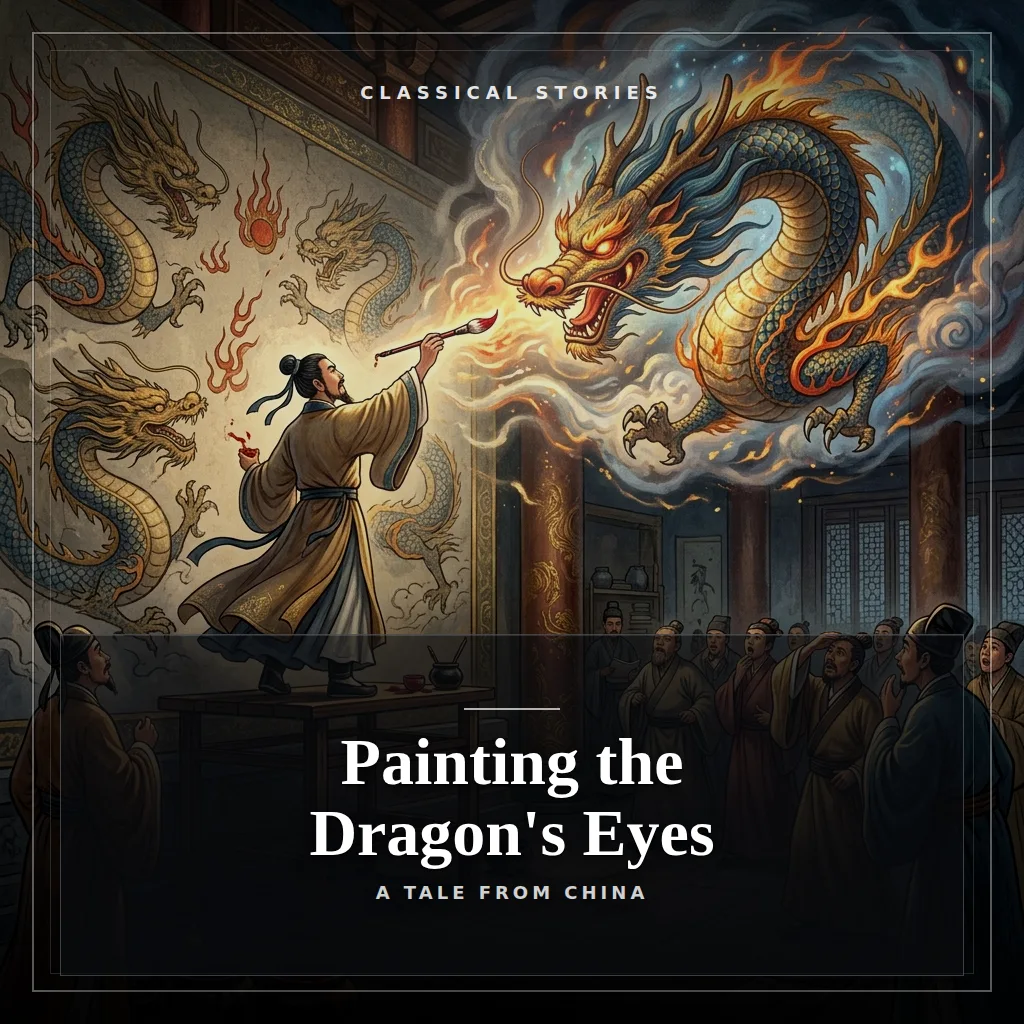
The great painter Zhang Sengyou paints four dragons on the wall of a temple in the ancient city — dragons so lifelike they seem to breathe, coiling among painted clouds. But he leaves all four eyeless. When people ask why, he says that if he paints in the eyes, the dragons will fly away. They laugh at him and press him to finish. At last he gives in and dots the eyes of two of the four. The moment the brush lifts, the sky darkens, lightning splits the air, and the two eyed dragons burst from the wall and soar into the storm-clouds, gone forever — while the two still eyeless dragons remain on the wall to this day. The city learns, too late, that the master was not boasting.
Why it's worth a listen
A master painter covers a temple wall with four magnificent dragons — and leaves every one of them without eyes. When mocked and finally badgered into finishing two of them, he lifts his brush, dots the pupils, and thunder cracks: the two dragons tear from the wall and vanish into the storm. The origin of a Chinese saying still used today for the final touch that brings something to life.
What listeners will learn
Subjects: world stories, literature, cultural literacy.
- character
- setting
- conflict
- choice
- consequence
- theme
- retelling
- painting
- dragon
- eyes
Questions for after listening
- Retell the central conflict in order.
- Name one important choice and what happened because of it.
- How did the setting or tradition shape the story?
A question to keep
What is the one small thing that turns good work into something alive?
Chapters
- The Wall in the Anle Temple
- The Blankness in the Gaze
- The Whispers of the Doubters
- The Promise of the Brush
- The Spark of Life
- A Question to Keep
Read a transcript preview
If you had walked through the gates of the Enli Temple in the ancient city of Jinling 1500 years ago, you would have smelled two things above all else: the sweet, woody scent of burning incense and the sharp, wet smell of fresh ink. At that time, China was a land divided by wars and dynasties, but inside the temple walls, the world was quiet. The temple stood in what is now the modern city of Nanjing, but in those days, it was a place of willow trees, winding canals, and quiet gardens where the cicadas sang in the heavy heat of summer. It was a time of great faith, great poetry, and, above all, great art. The people of this culture believed that the world was not just made of wood, stone, and earth, but of a living, breathing energy called Chi. They believed that a truly great artist did not just paint the shape of a thing. They captured its spirit. And there was no master of the brush more famous for capturing that spirit than a man named Chang Sangyu. Zhang Sangyu was not a young man. His hair was the color of river mist, and his hands, though steady when he held a brush, were lined with the creases of many years. He had spent his life studying the way water moved around rocks, the way wild geese cut through the autumn clouds, and the way the wind bent the bamboo in the hills. He did not paint quickly. He would sit before a blank wall or a silk scroll for hours, sometimes days, without making a single mark. He would close his eyes, breathing in the quiet, until he could feel the very essence of what he wanted to paint moving through his own fingers. Only then would he dip his brush. The abbot of the Onley Temple had invited Zong Sangyu to paint on the great white wall of the temple's main hall. The wall was vast, made of smooth white plaster that had been dried and polished until it gleamed like the inside of a seashell. It was a blank canvas that cried out for something grand. For three days, Zong Sangyu did nothing but stand before the wall. The young monks of the temple whispered among themselves as they passed the doorway. They watched the old master stand with his hands tucked into his wide sleeves, his eyes fixed on the empty plaster. On the fourth morning, Zong Sangyu finally moved. He did not begin with a pencil or a charcoal sketch. He simply called for his assistant to prepare the ink. In ancient China, preparing ink was a slow, meditative ritual. The assistant took a solid stick of ink, made from the soot of burned pinewood mixed with deerhorn glue, and began to grind it against a flat, heavy stone called an inkstone. He added water, drop by drop, from a small porcelain vessel shaped like a sleeping frog. As the black stick circled the stone, a thick, glossy pool of dark ink began to form. It smelled of deep forests and old earth. Zong Sangyu selected his brush. It was a large brush, its tip made of soft goat hair and resilient wolf hair, bound tightly to a hollow bamboo handle. He held the brush not as a modern writer holds a pen, but vertically, his fingers wrapped around the bamboo, his wrist loose and flexible. When he stepped up to the white wall, a small crowd of monks and travelers had gathered at the door. They held their breath. With a sudden, sweeping motion of his arm, Zong Sangyu struck the wall. The brush did not crawl, it danced. The master's arm moved with the strength of a soldier throwing a spear, yet with the grace of a ribbon falling through the air. Black ink splattered in tiny, perfect droplets that looked like stars. Under his hand, thick, dark lines began to coil across the white plaster. He was painting dragons. Not just one, but four magnificent coiled beasts. In China, the dragon was not a monster to be feared, but a sacred creature of water and cloud. Dragons…
Published 2026-07-11 · Updated