- Who is it for?
- Ages 8–14
- How long is it?
- 47 min
- What does it include?
- Synced read-along and a quiz
- What does it cost?
- Free — no sign-up required
About this audiobook
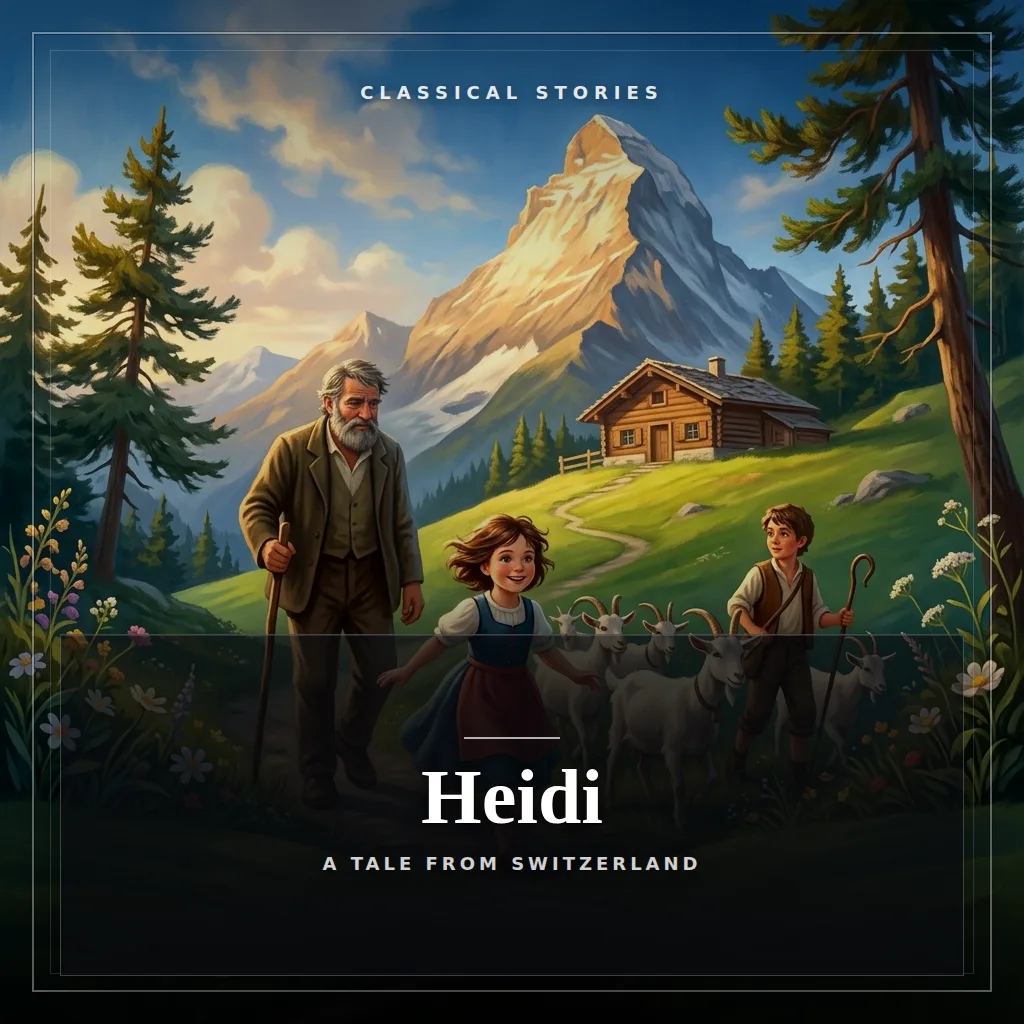
Little orphaned Heidi is brought to live with her stern, reclusive grandfather in his hut on a high Alpine pasture, where the villagers fear the gruff old 'Alm-Uncle.' But Heidi's warmth and delight in everything — the goats, the wildflowers, the mountain sunsets, her friend Peter the goatherd — slowly melt the old man's hardness, and the two become devoted to each other. Then Heidi is taken away to the city of Frankfurt to be a companion to Clara, a kind, wealthy girl who cannot walk. Heidi and Clara become dear friends, but Heidi grows pale and sleepwalks, wasting away with a homesickness so deep it becomes a real illness, until a wise doctor says the only cure is to send her home. Back on her mountain, Heidi blooms again — and when Clara comes to visit, the fresh air, goat's milk, and Heidi's joy work a gentle miracle, and Clara, step by trembling step, learns to walk.
Why it's worth a listen
A cheerful orphan is left with her gruff, solitary grandfather in a hut high in the Swiss Alps — and her sunny warmth thaws the old man's heart, until she is taken away to the city and pines so badly for the mountains that she falls ill with homesickness itself. Johanna Spyri's beloved classic about the healing power of home, kindness, and open mountain air.
What listeners will learn
Subjects: world stories, literature, cultural literacy.
- character
- setting
- conflict
- choice
- consequence
- theme
- retelling
- heidi
- classical
- stories
Questions for after listening
- Retell the central conflict in order.
- Name one important choice and what happened because of it.
- How did the setting or tradition shape the story?
A question to keep
What does a person need to truly thrive — and can homesickness itself be a kind of illness?
Chapters
- Up to the Alm
- Wind in the Pines, Gold in the Grass
- The City of Stone and Rules
- The Shadow on the Stairs
- The Only Cure
- The Mountain Heals Its Own
- A Question to Keep
Read a transcript preview
If you climb high enough into the mountains of Switzerland, past the valleys where the blue rivers rush over smooth gray stones and the cowbells chime like distant music, the air begins to change. It grows cooler, sharper, and so clean that every breath feels like a drink of cold water from a mountain spring. This is a land of towering rock, of dark pine forests, and of green pastures that seem to tilt right up into the sky. It is from this beautiful, rugged corner of the world that our story comes. Written down long ago by a Swiss writer named Johanna Spyri, it is a tale that has been told in many different ways, in many different languages, all over the earth. But every telling begins in the very same way, with a little girl climbing up a steep mountain path on a warm, sunny morning. The little girl's name was Heidi. She was only five years old, but she was currently carrying a very heavy burden. Her aunt, a busy, hurried woman named Dete, had dressed Heidi in all the clothes she owned, one layer on top of another, so that Dete wouldn't have to carry them up the steep trail. Heidi wore two thick woolen dresses, a heavy red shawl wrapped around her shoulders, and stout, clunky mountain shoes that made her feet feel like lead. Her face was flushed and damp with sweat, but she did not complain. Her dark curly hair escaped from under her red shawl, and her bright brown eyes darted everywhere, taking in the red wild flowers peeking out from the grass and the great gray rocks towering above. They were walking up toward the Alm, the high mountain pasture that looked down upon the village of Dorfly. As they passed through the lower slopes, the villagers watched them with dark, worried looks. They knew where Dete was taking the child. "Are you really going to leave her up there, Dete?" called out a woman from her garden. "With the Alm uncle? He'll never take in a child. He hasn't spoken a kind word to anyone in years." "He is her grandfather," Dete called back, keeping her face set straight ahead. "It is his turn to look after her. I have taken care of her since her mother died, but now I have a job in the city, and I cannot take a child with me." The villagers shook their heads and whispered. The Alm uncle, as they called him, was a mystery and a terror to the valley. No one knew why he had turned his back on the world, but many years ago, he had climbed up to the highest pasture, built himself a wooden hut under three great pine trees, and stayed there. He never came down to the village church. He never spoke to his neighbors. He was a tall, fierce-looking old man with bushy gray eyebrows, a long, silvery beard, and a gaze that could cut like winter ice. People said he was wild, that he hated everyone, and that a little orphan girl would stand no chance in his lonely cabin. But Heidi knew nothing of the villagers' fears. As they climbed higher, the heat of the double dresses became too much to bear. While her aunt was talking to a passing acquaintance, Heidi quietly slipped off her heavy red shawl. Then she unbuttoned her top woolen dress, slipped out of it, and laid it in a neat pile on the grass. Beneath it, she wore only her light summer underdress. Finally, she kicked off her heavy shoes and stockings. When Dete turned around and saw her niece running barefoot and free over the sharp mountain grass, she gasped. "Heidi, what have you done? Your new shoes, your warm dresses, you must carry them." "I don't need them," Heidi said, her voice bubbling with laughter. "I can run much faster now." And indeed, she looked like a little wild bird, darting here and there, her bare feet finding the soft patches of moss, and her arms spread wide to catch the wind. At last, the path flattened out into a high, wide meadow. There, standing…
Editorial review
Quality reviewed · 98/100 on . Certificate EL-BBCA-3702 is bound to the exact narrated script.
The review checks factual care, audience fit, teaching quality, structure, tone and source honesty. Read the editorial standards.
Published 2026-07-11 · Updated