- Who is it for?
- Ages 8–14
- How long is it?
- 43 min
- What does it include?
- Synced read-along and a quiz
- What does it cost?
- Free — no sign-up required
About this audiobook
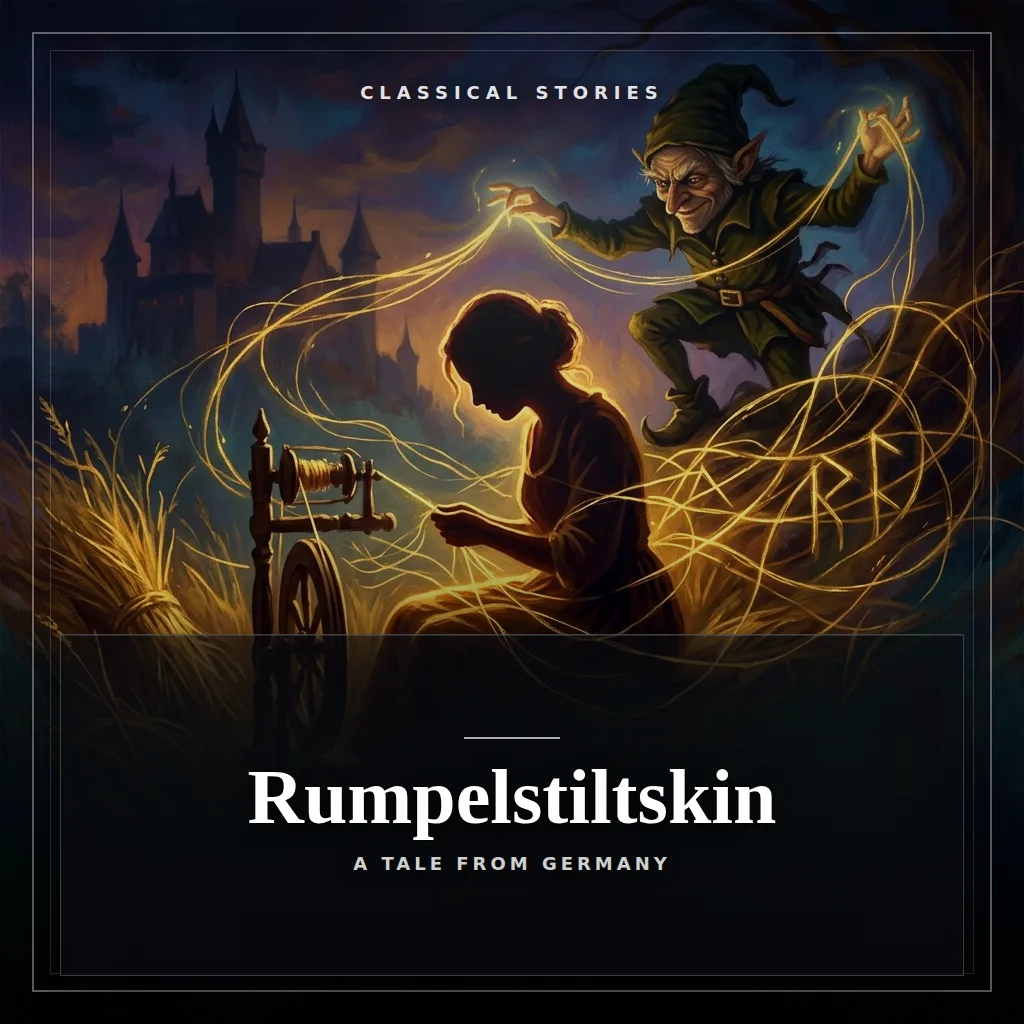
A miller boasts to the king that his daughter can spin straw into gold, and the greedy king locks her in a room full of straw and commands her to do it or die. Each night a strange little man appears and spins the straw to gold for her — for a price: first her necklace, then her ring, and on the third night, when she has nothing left, a promise of her first-born child. She agrees, is made queen, and forgets — until a year later the little man returns to collect. Horrified, she begs; he relents just enough to set a game: if she can guess his name in three days, the child is hers to keep. She sends servants far and wide, and on the last night one overhears the little man dancing round his fire, singing his own secret name aloud.
Why it's worth a listen
A miller's foolish boast lands his daughter in a locked room, ordered to spin straw into gold on pain of death — and the strange little man who does it for her charges more each night, until his final price is her future child. The only way out is a riddle: guess his name. A fairy tale about desperate bargains, and the odd, ancient power of knowing what someone is called.
What listeners will learn
Subjects: world stories, literature, cultural literacy.
- character
- setting
- conflict
- choice
- consequence
- theme
- retelling
- rumpelstiltskin
- classical
- stories
Questions for after listening
- Retell the central conflict in order.
- Name one important choice and what happened because of it.
- How did the setting or tradition shape the story?
A question to keep
When a bargain traps you, can knowing the right secret set you free?
Chapters
- The Weight of a Foolish Word
- The First Thread of Gold
- The Price of a Ring
- The Unbearable Promise
- The Three-Day Game
- The Song in the Forest
- A Question to Keep
Read a transcript preview
If you have ever stood inside an old mill when the great wooden wheel is turning, you know the sound of a secret being ground into dust. It is a heavy, rhythmic rumble that shakes the floorboards beneath your boots. A sound of water and oak and stone, working together to turn hard grain into soft white flour. Our story begins in just such a mill, nestled in a green valley where the hills rise up like sleeping giants. This is a tale from Germany, a land of deep dark forests and ancient rivers, where people have sat by winter fires for hundreds of years, telling stories to keep the cold at bay. The famous collectors of stories, the Brothers Grimm, wrote this tale down long ago. But like all true stories, it had lived in the voices of grandmothers and travelers for generations before it ever met the ink of a printing press. They knew, as we know now, that a story can change its coat depending on who is telling it, but its heart remains the same. In this particular German valley, the miller was a man who loved the sound of his own voice almost as much as he loved the sound of his mill wheel. He was not a bad man, but he was a foolish one. He had a habit of puffing out his chest and boasting about things he had never done, places he had never been, and treasures he had never owned. But the miller's greatest pride was his daughter. She was a quiet girl, sensible and kind, with hands that were always busy and eyes the color of rain. While her father stood at the tavern door telling tall tales, she was the one who actually ran the mill, swept the flour from the rafters and kept the accounts. Her father loved her dearly, but his love was like a fire that burned too hot. It was loud, boastful, and dangerous. One afternoon, the king of the land came riding through the valley. This king was young, but his heart was already growing cold and heavy, like a coin kept too long in a dark pocket. He loved gold more than he loved justice, and he loved power more than he loved his people. He rode with a great train of horses and soldiers, their armor clinking like silver bells. The miller, seeing the royal procession, ran out to the roadside. He wanted the king to look at him. He wanted to be seen as someone important, not just a dusty man who ground wheat for peasants. He bowed so low his nose nearly touched the dirt, and when the king halted his horse, looking down with a bored, distant expression, the miller's mouth began to run before his brain could stop it. "Your majesty!" the miller cried, his voice trembling with a mixture of fear and pride. "You see before you a humble man, but one blessed with a daughter of miraculous talents. She is no ordinary maid, sire. Why, she is so clever, so wondrously skilled that she can spin simple straw into pure, glittering gold." The king's horse shifted, its hooves crunching on the gravel. The king himself leaned forward, his eyes narrowing. In his mind, he did not see a lovely, hard-working girl. He saw mountains of treasure, chests overflowing with yellow metal, and power that would make him the envy of every monarch in the world. "Is this the truth?" the king asked, his voice low and sharp as a needle. The miller felt a sudden cold spike of dread in his chest. He realized too late the terrible weight of the lie he had just uttered. But pride is a stubborn trap. Once you walk into it, it is very hard to turn back. "It is indeed, your majesty!" the miller stammered, trying to smile. "By morning, she can turn a barnyard pile into a king's ransom." "Then she shall come to my castle tonight," said the king. "If she is as clever as you say, she has nothing to fear. But if you have lied to me, miller, the penalty for mocking the crown is…
Editorial review
Quality reviewed · 95/100 on . Certificate EL-EA7D-EFEB is bound to the exact narrated script.
The review checks factual care, audience fit, teaching quality, structure, tone and source honesty. Read the editorial standards.
Published 2026-07-11 · Updated