- Who is it for?
- Ages 8–14
- How long is it?
- 38 min
- What does it include?
- Synced read-along and a quiz
- What does it cost?
- Free — no sign-up required
About this audiobook
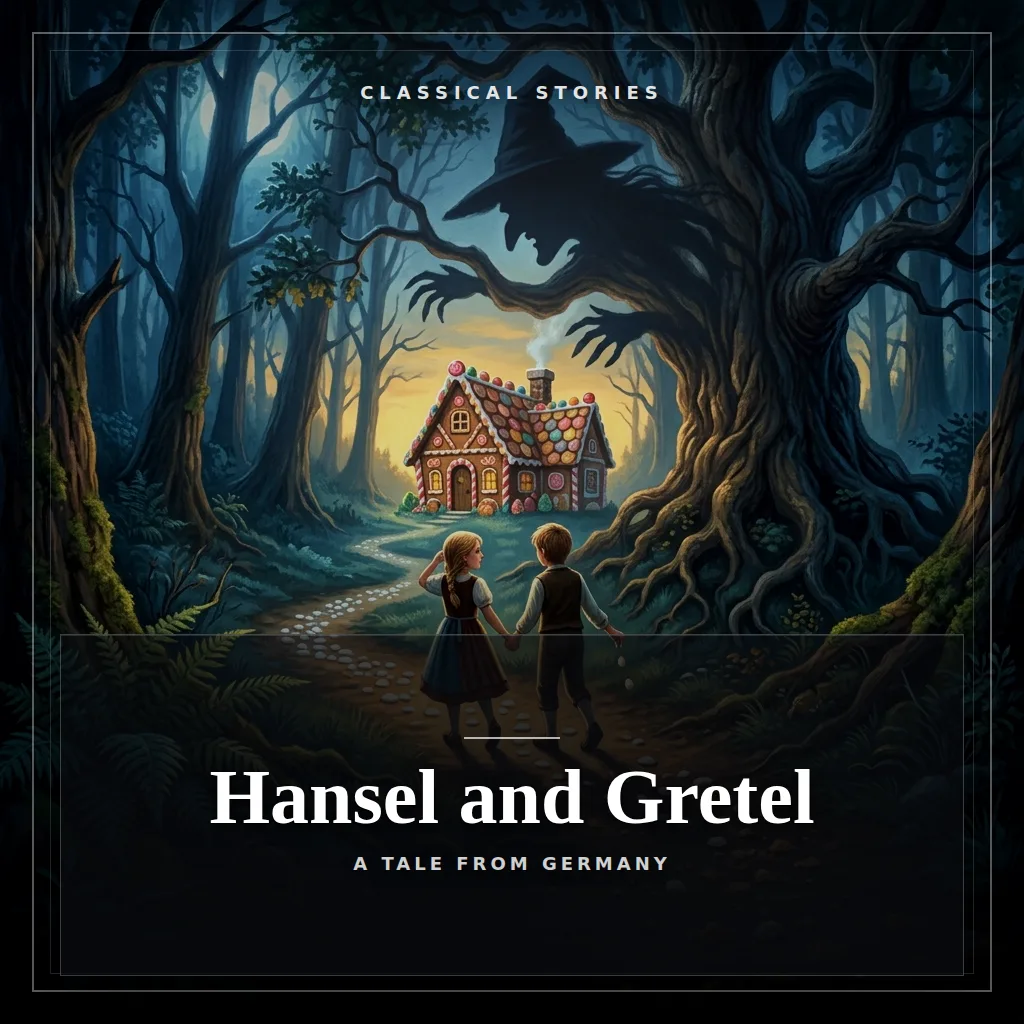
In a time of famine, Hansel and Gretel are left deep in the forest. Clever Hansel first drops white pebbles that shine in the moonlight and leads them home — but the second time he has only breadcrumbs, and the birds eat the trail. Truly lost, the children find a cottage built of gingerbread, cake, and spun sugar, and fall hungrily upon it — which is exactly the trap of the witch who lives there and lures children with sweets. She cages Hansel to fatten him; but Gretel keeps her wits, plays along, and when the witch bends to check the oven, Gretel's quick courage turns the witch's own trap against her. The children free themselves, find the witch's treasure, and follow a helpful duck back across the water to home.
Why it's worth a listen
Lost in a vast forest by a trail of breadcrumbs the birds ate, a brother and sister stumble on a cottage made of gingerbread and sugar — and the kind old woman who lives there is not kind at all. But this is a story where the children are the clever ones: Gretel's quick thinking saves them both. A classic told with just enough shiver and a whole lot of courage.
What listeners will learn
Subjects: world stories, literature, cultural literacy.
- character
- setting
- conflict
- choice
- consequence
- theme
- retelling
- hansel
- gretel
- classical
Questions for after listening
- Retell the central conflict in order.
- Name one important choice and what happened because of it.
- How did the setting or tradition shape the story?
A question to keep
When the grown-ups can't save you, can two children save each other?
Chapters
- The Shadow of the Great Forest
- A Trail of Moonlit Silver
- The Hungry Birds of the Wood
- The House Built of Sweetness
- The Cage and the Iron Door
- Across the Shining Water
- A Question to Keep
Read a transcript preview
If you were to travel back in time, deep into the heart of Germany, you would find a land where the forests do not simply grow, they rule. Centuries ago, these vast woods of pine and oak were so thick that the sunlight only touched the forest floor in scattered golden needles. It was a place of deep silence, broken only by the crack of a dry branch, the call of a blackbird, or the whispering of the wind through the high canopy. It was here, in this ancient landscape, that the storytellers known as the Brothers Grimm walked from village to village, listening to the tales that grandmothers spun by the fireside. They wrote down these stories so they would never be forgotten. And of all those tales, there is one that has traveled further and stayed longer in the hearts of children than almost any other. It is the story of a brother, a sister, and a path made of silver. At the very edge of this great forest, lived a poor wood cutter with his wife and his two children, a boy named Hansel and a girl named Gretel. The wood cutter was a gentle man who loved his children fiercely, but he was also a man who carried a heavy weight upon his shoulders. He was very poor. In those days, a great famine had fallen over the land. The earth had grown hard and dry, the crops had withered in the fields, and the price of bread had risen so high that the coins in the wood cutter's pocket could buy nothing but a few meager crusts. Day after day, the family's bowls grew emptier, and the fire in their hearth burned lower. One evening, as the wind howled through the cracks in the wooden walls of their cottage, the wood cutter lay in bed, tossing and turning. His stomach rumbled with a hollow, aching emptiness, but the ache in his heart was far worse. Beside him, his wife, who was the stepmother to the children, lay awake as well. She was not a cruel woman by nature, but hunger is a beast that changes people. It strips away patience and replaces love with a cold, sharp fear of tomorrow. She turned to her husband in the dark, her voice a low, desperate whisper. "Husband, listen to me," she said. "We cannot go on like this. There is no food left in the larder. By next week, we will all four die of starvation. We must make a choice." The wood cutter groaned. "What choice is there to make? I work from sunrise to sunset, and yet the forest yields no bread." "Then we must lighten our load," she whispered, her voice trembling but firm. "Tomorrow morning, early, we will take the children deep into the thickest part of the forest, where the trees are dark and the paths are tangled. We will build a fire for them, give each of them one last piece of bread, and then we will go to our work and leave them there. They will not be able to find their way home, and we shall be saved." The wood cutter sat up in bed, his heart seizing with horror. "No!" he cried softly, trying not to wake the children sleeping in the next room. "How can you ask me to do such a thing? How could I leave my own flesh and blood to the mercy of the wild beasts in the forest? I would rather starve with them." "Then you are a fool," his wife said, her voice turning cold as ice. "If you do not do this, all four of us will starve. You may as well start hammering the wood for our coffins right now." She spoke to him with such urgency, painting pictures of their slow, painful demise, that the wood cutter's resolve began to crumble. Hunger had weakened his mind, and fear had clouded his judgment. At last, with a heavy sob, he bowed his head and agreed to her plan, though his soul wept for what he was about to do. But the children were not asleep. Hunger keeps children awake just…
Published 2026-07-11 · Updated