- Who is it for?
- Ages 8–14
- How long is it?
- 36 min
- What does it include?
- Synced read-along and a quiz
- What does it cost?
- Free — no sign-up required
About this audiobook
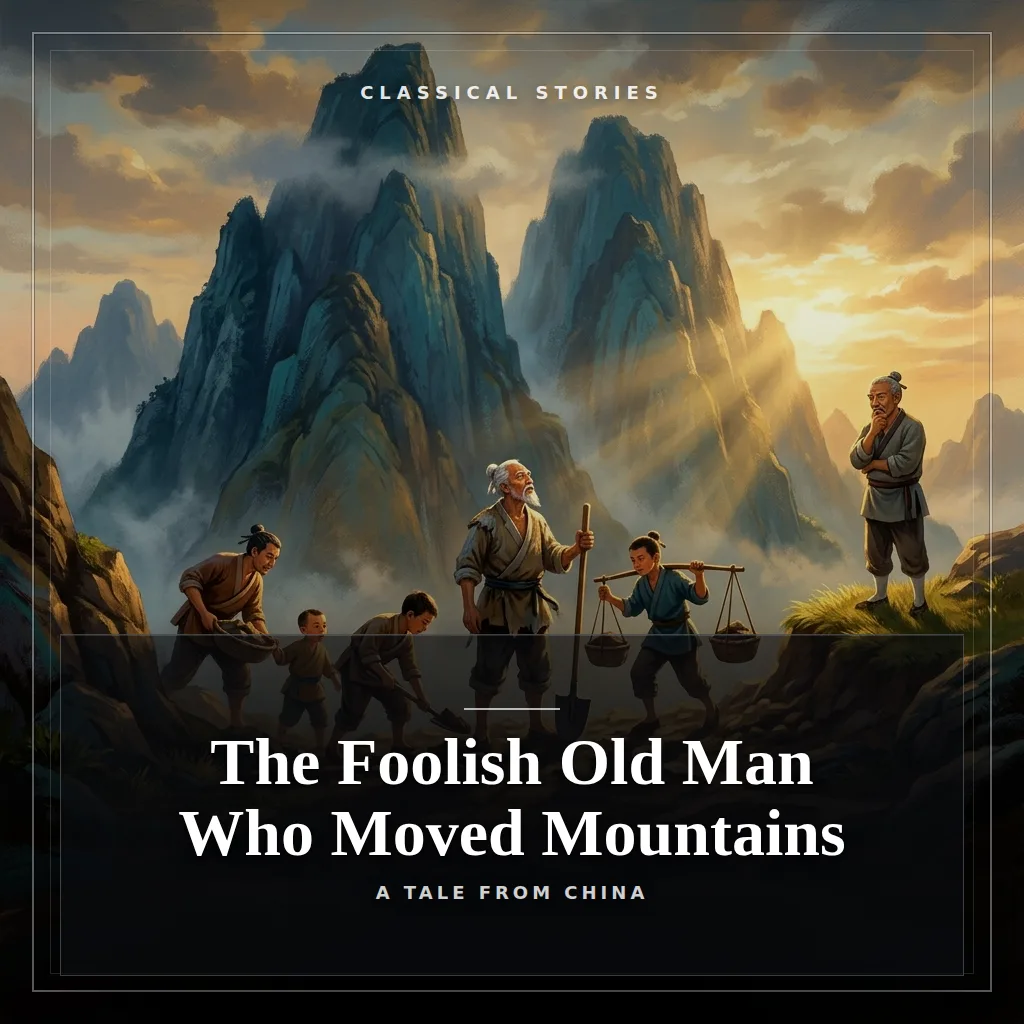
Ninety-year-old Yu Gong, the 'Foolish Old Man,' is tired of his family always having to walk the long way around two vast mountains that stand before their door. So he gathers his sons and grandsons and declares they will dig the mountains away and carry the earth to the sea. A clever neighbor mocks him: you're old and weak, you couldn't dent a hillside, let alone move a mountain. Yu Gong answers calmly that when he dies, his sons will continue, and their sons after them, and their sons after them — the mountains cannot grow any higher, but his family's work will never stop, so one day the way will be clear. And the story says even the gods, moved by such resolve, lent a hand.
Why it's worth a listen
An old man, tired of walking around two enormous mountains that block his family's way, announces he will simply dig them away — basket by basket — even though everyone laughs and says he'll be dead long before he makes a dent. His answer about who will finish the work has echoed through China for over two thousand years. A tiny parable with a mountain-sized idea.
What listeners will learn
Subjects: world stories, literature, cultural literacy.
- character
- setting
- conflict
- choice
- consequence
- theme
- retelling
- foolish
- moved
- mountains
Questions for after listening
- Retell the central conflict in order.
- Name one important choice and what happened because of it.
- How did the setting or tradition shape the story?
A question to keep
Can patience and persistence really outlast something that seems impossible?
Chapters
- The Shadow of the Giants
- A Bold Plan at the Hearth
- One Basket at a Time
- The Wisdom of the Wise Neighbor
- The Mountains That Could Not Grow
- A Question to Keep
Read a transcript preview
If you stood at the front door of the old man's house, you would not see the sunrise, nor would you see the sunset. You would see only stone. To the left, rising so high that its pine-capped peaks tore the bellies of the low-passing clouds, stood Mount Taihong. To the right, equally massive, its sheer cliffs of gray granite catching the first and last of the winter snows, stood Mount Wangwu. Together, these two giants spanned hundreds of miles, their roots sunk deep into the earth, their shoulders blocking out the sky. They were silent, cold, and utterly immovable. In the valley between them, in a modest house of timber and clay, lived an old man named Yu Gong. This story comes to us from China, from a collection of ancient tales written down more than 2,000 years ago by a philosopher named Liezi. In China, stories are like the rivers. They have flowed through the landscape for generations, smoothing down the rough edges of history until only the truest, most polished wisdom remains. And of all the stories told around charcoal braziers on cold winter nights, this is perhaps the one that has traveled the farthest, because it speaks to something deep inside every human heart. The question of what we do when we are faced with a barrier that seems too big to climb, too wide to walk around, and far too heavy to move. For Yu Gong, that barrier was not a metaphor. It was made of actual granite, dirt, and stubborn shrubbery. Yu Gong was 90 years old. His hair was as white as the cotton of his winter coat, and his face was lined with as many creases as the dry hillsides in summer. He had lived in the shadow of Taihong and Wangwu his entire life. When he was a little boy, he had watched the shadows of the peaks swallow his family's courtyard before the afternoon was even half over. When he was a young man, working the fields, he had felt the cold winds that swept down from the snow fields, freezing the young crops before their time. And now, as an old man, he was tired. He was tired because every single task, no matter how simple, required a journey that could break a younger man's spirit. If Yu Gong wanted to buy salt from the market town, he could not simply walk down the road. The road did not exist. Instead, he and his family had to pack their carts, lace up their straw sandals, and begin the long, weary detour. To go north, they had to walk miles to the east, winding through narrow, treacherous gorges where the loose stones slipped underfoot and the mountain bandits sometimes watched from the ridges. To go south, they had to climb high up the rocky shoulders of Wangwu, where the air grew thin and cold before descending into the fertile plains. A simple trip to visit a cousin or sell a bundle of firewood turned into a multi-day expedition. One evening, as the autumn wind began to whistle through the cracks in the wooden shutters, the family gathered around the central hearth. The firelight flickered across their faces. Yu Gong, his wife, his three strong sons, their wives, and a handful of grandchildren, ranging from sturdy teenagers to a little boy who was barely old enough to carry a bucket of water. They were all rubbing their aching legs. The eldest son had spent the day hauling a cart of barley around the eastern spur of Mount Taihong, and his shoulders were bruised raw by the hemp harness. "My back feels as though it is made of dry twigs," the eldest son muttered, leaning his head against the wall. "One more trip like today, and I think I shall snap in half." "The mountain does not care about your back," his mother said gently, stirring a pot of millet porridge. "It was here before your grandfather's grandfather was born, and it will be here to block your grandchildren's path when we are all gone. It is simply the way things are." Yu Gong sat quietly in his corner, his hands resting…
Editorial review
Quality reviewed · 94/100 on . Certificate EL-C1A1-2FEB is bound to the exact narrated script.
The review checks factual care, audience fit, teaching quality, structure, tone and source honesty. Read the editorial standards.
Published 2026-07-11 · Updated