- Who is it for?
- Ages 8–13
- How long is it?
- 6 min
- What does it include?
- Synced read-along and a quiz
- What does it cost?
- Free — no sign-up required
About this audiobook
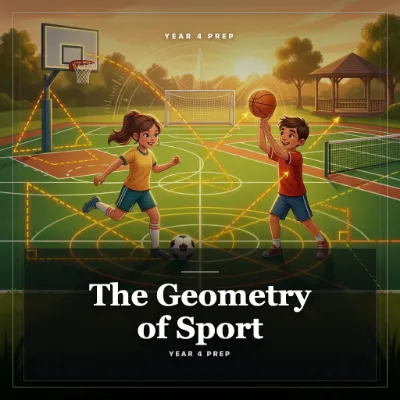
Fractions in Motion is a Year 4 Prep maths audiobook designed to help young learners explore essential mathematical concepts through a sporty lens. This guide covers key topics including halves, quarters, thirds, tenths, and the concept of fair shares. Narrated with a focus on learning and vocabulary, the content connects maths with motion and sport. It serves as a practical preparation tool for Year 4 students, helping them understand how fractions work in active, real-world scenarios. Listeners will build their vocabulary and mathematical confidence through clear explanations.
Why it's worth a listen
This audiobook connects maths concepts to the active world of sports, making it easy for families to understand fractions together. Listen to see how dividing a game or sharing a team's resources can make numbers click in a whole new way.
What listeners will learn
Subjects: learning, vocabulary.
- fractions
- motion
- sporty
- halves
- quarters
- thirds
- tenths
- fair
- shares
- year
Questions for after listening
- What is the most important idea from this book?
- Name one new word and explain what it means.
- Explain one idea from this book to a younger child.
Chapters
- Introduction
- The Pitch Is One Whole
- Fair Shares After Training
- Tenths, Hundredths, and Race Times
- Equivalent Fractions Are Different Kits
- The Cool-Down Challenge
Read a transcript preview
Fractions in Motion: A sporty guide to halves, quarters, thirds, tenths, and fair shares. ## Introduction Evan, fractions are not tiny broken numbers. They are how fair shares, time, distance, and tactics work. ## The Pitch Is One Whole Start with one whole football pitch. If you divide it into two equal parts, each part is one half. If you divide it into four equal parts, each part is one quarter. The important word is equal. Fractions are not just pieces. They are equal pieces of a whole. If a player runs from one goal line to the halfway line, he has run one half of the pitch. If he runs from one goal line to the quarter mark, he has run one quarter. Two quarters reach the halfway line, so two quarters is the same distance as one half. That is an equivalent fraction: different name, same amount. Year 4 fractions become easier when you keep asking, what is the whole? Half a pizza is not the same size as half a grape. One quarter of an hour is fifteen minutes because the whole hour is sixty minutes. One quarter of a class of twenty four pupils is six pupils because the whole class is twenty four. The fraction only makes sense when the whole is clear. ## Fair Shares After Training Imagine twelve orange slices after training. Four players share them equally. Each player gets three slices. That is division. But it is also fractions. Each player gets one quarter of the orange slices, and one quarter of twelve is three. Now imagine fifteen energy bars shared by three teams. Each team gets five bars, so one third of fifteen is five. If the question asks for two thirds of fifteen, first find one third, then double it. One third is five. Two thirds is ten. This one-unit-first method is powerful. To find three quarters of twenty, find one quarter first. Twenty divided by four is five. Three quarters is three lots of five, so fifteen. To find four fifths of thirty, find one fifth first. Thirty divided by five is six. Four fifths is twenty four. Fractions are not asking you to panic. They are asking for a calm routine: divide by the bottom number, multiply by the top number. ## Tenths, Hundredths, and Race Times In races, small parts matter. A second can be split into tenths. One tenth is one out of ten equal parts. Decimal numbers are another way to write fractions with tenths, hundredths, and thousandths. Zero point five is five tenths, which is the same as one half. Zero point two five is twenty five hundredths, which is one quarter. You do not need to master every decimal at once, but it helps to know the friendly ones: one half is zero point five, one quarter is zero point two five, three quarters is zero point seven five, and one tenth is zero point one. Place value is the key. In the number three point four, the three means three wholes and the four means four tenths. In three point zero four, the four means four hundredths. That zero is not decoration. It holds the tenths place open. When you measure a sprint, a swim, or a jump, decimals help you compare close results. Sport makes fractions visible because winning often lives inside small parts of a whole. ## Equivalent Fractions Are Different Kits A team can wear a home kit or an away kit and still be the same team. Equivalent fractions are like that. One half, two quarters, three sixths, and four eighths can all describe the same amount. You can make equivalent fractions by multiplying the top and bottom by the same number. One half times two over two becomes two quarters. One half times four over four becomes four eighths. The value stays the same because you changed the number of pieces and the number selected in the same way. You can also simplify. Six eighths can be divided by two on the top and bottom to become three quarters. Simplifying is like using the clearest team name. Here is a quick sport picture. If a match…
Editorial review
Quality reviewed · 98/100 on . Certificate EL-D581-8846 is bound to the exact narrated script.
The review checks factual care, audience fit, teaching quality, structure, tone and source honesty. Read the editorial standards.
Published 2026-07-06 · Updated