- Who is it for?
- Ages 8–14
- How long is it?
- 46 min
- What does it include?
- Synced read-along and a quiz
- What does it cost?
- Free — no sign-up required
About this audiobook
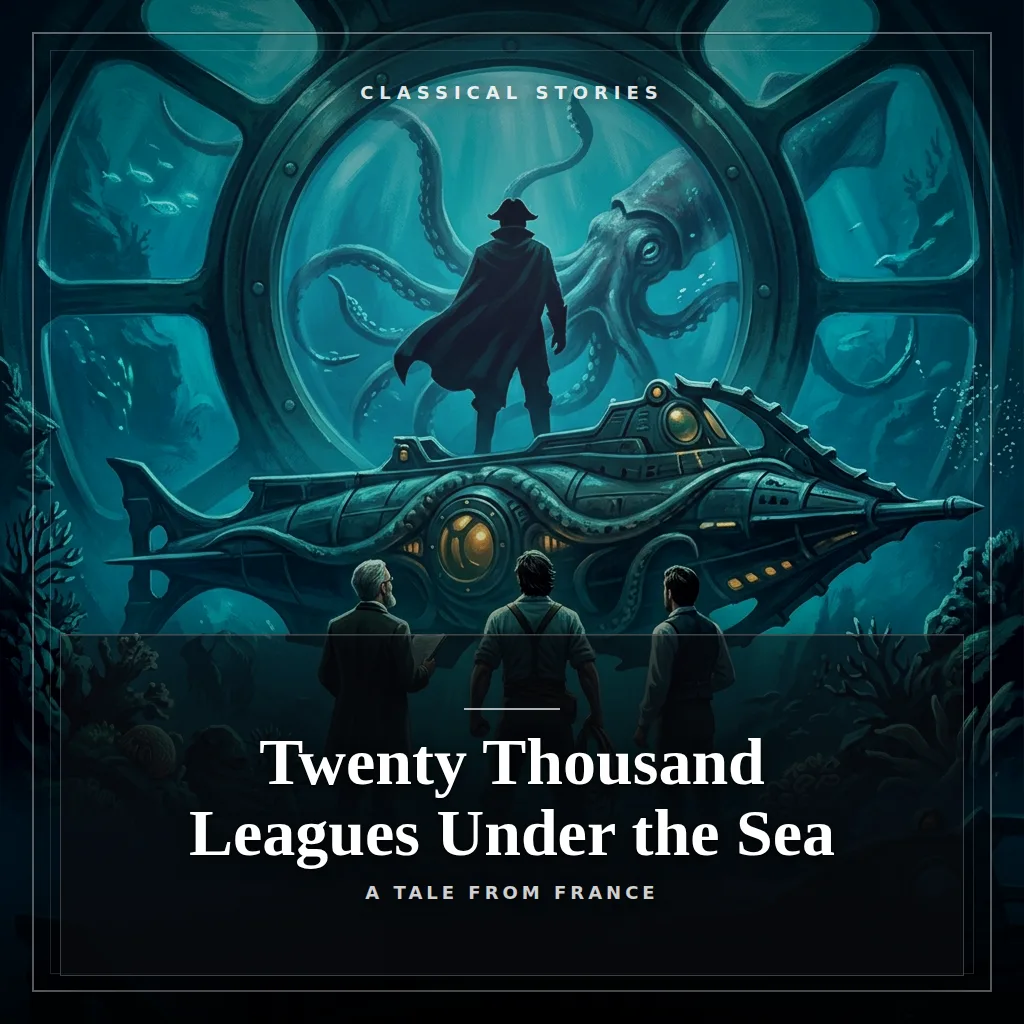
When ships begin to be attacked by what seems a giant sea-monster, a French professor, his loyal servant, and a Canadian harpooner join the hunt — only to be flung overboard and rescued (and captured) by the 'monster' itself: the Nautilus, a magnificent electric submarine built and captained by the mysterious Captain Nemo. Aboard, they become permanent guests who may explore but never leave, and Verne takes them on a wondrous underwater journey — through pearl-beds and coral forests, past the ruins of Atlantis, under polar ice, and into a nightmarish battle with a giant squid. Nemo is a genius and a generous host, but also a haunted, dangerous man carrying some old grief and rage against the surface world, and the professor comes to see his captor as both a marvel and a warning, longing to escape even as he never wants the wonders to end.
Why it's worth a listen
Sailors hunting a mysterious sea-monster that has been sinking ships discover it is no monster at all but the Nautilus — a marvelous submarine decades ahead of its time, commanded by the brilliant, bitter Captain Nemo, who takes them aboard as guests who may never leave. From Jules Verne's classic, a voyage through the wonders of the deep — coral forests, sunken ruins, a giant squid — steered by one of literature's most fascinating and troubling captains.
What listeners will learn
Subjects: world stories, literature, cultural literacy.
- character
- setting
- conflict
- choice
- consequence
- theme
- retelling
- twenty
- thousand
- leagues
Questions for after listening
- Retell the central conflict in order.
- Name one important choice and what happened because of it.
- How did the setting or tradition shape the story?
A question to keep
Can someone be both a genius and a danger, both a wonder and a warning?
Chapters
- The Monster of the High Seas
- Captured by the Steel Monster
- The Wonders of the Deep
- The Shadow of the Captain
- Ice and Tentacles
- The Maelstrom and the Flight
- A Question to Keep
Read a transcript preview
In the year 1866, a whisper began to circle the globe. A whisper that soon grew into a roar of terror. Ships of all nations, crossing the vast, lonely stretches of the Atlantic and Pacific Oceans, began to encounter something monstrous. It was not a reef, for it moved with terrifying speed. It was not a whale, for it was far too large and breathed not with a soft blowhole, but with great spouting geysers of water that hissed like steam engines. Some captains reported a strange phosphorescent glow beneath the waves, a light so bright, it illuminated the dark water for miles around. Others spoke of 300-foot holes of iron being pierced as if they were made of nothing but pinewood. The world was gripped by a single question. What was this thing that ruled the deep? From the imaginative heart of France, a brilliant writer named Jules Verne looked out at the vast, unexplored oceans of our world and dreamed up a story to answer that question. A story that would help invent what we now call science fiction. Over the past century and a half, this tale has been told in many ways, but its heart remains the same. A journey into the great silent depths where humanity had never dared to go. Our story begins with Pierre Aronnax, a professor from the Paris Museum of Natural History. He was a man of science, a lover of facts, and a scholar who had spent his life studying the secrets of the sea. When the mystery of the sea monster began to threaten international trade, the United States government prepared a grand steam frigate called the Abraham Lincoln to hunt the beast down and rid the seas of its shadow. Because of his great expertise, Professor Aronnax was invited to join the expedition. "We shall find it, Monsieur," said Conseil, the professor's loyal servant, as they packed their trunks in a bustling New York Harbor. Conseil was a young man of extraordinary calmness. He loved nothing more than classifying animals into their proper families, genera, and species. He was the kind of person who, if the world were ending, would politely ask if he should classify the falling meteors before they hit the ground. "And when we find it, you will write a magnificent book about it." "If it is indeed an animal, Conseil," Aronnax replied, adjusting his spectacles. "But I confess, the reports defy all known laws of nature. No living creature of such size could move with such velocity." On board the Abraham Lincoln, they met the third member of our traveling trio, Ned Land. Ned was a Canadian harpooner, a giant of a man with a fierce, weather-beaten face, eyes like a hawk, and a temper that flared as easily as dry tinder. He did not believe in sea monsters. He believed in whales, in seals, and in things he could pierce with his trusty steel harpoon. "There is no monster, professor," Ned grumbled one evening, leaning over the ship's railing as they scanned the gray horizon. "It's a fable. Ships hit reefs or they have bad boilers, and the captains make up stories to save their reputations. If there was a beast that size in the water, my harpoon would have found it by now." "But Ned," Aronnax argued. "What of the steel plates of the Scotia? They were clean cut, pierced by some incredible force. What animal could do that?" "Only a very sharp, very fast piece of iron," Ned muttered, spitting into the sea. "And last I checked, iron doesn't grow fins." For months, the Abraham Lincoln combed the Pacific, searching the endless blue planes. The crew grew weary, the officers grew impatient, and even the professor began to lose hope. Then, on a dark, moonless night off the coast of Japan, a voice shattered the silence from the high crow's nest. "Look out! Off the starboard bow! The light! The light!" Aronnax and Conseil rushed to the deck, followed by Ned Land, who clutched his heavy harpoon. A mile away, a magnificent, terrifying spectacle unfolded. Beneath the black water, a massive oval shape glowed with an intense, cold blue-white light. It…
Editorial review
Quality reviewed · 98/100 on . Certificate EL-B99A-5E88 is bound to the exact narrated script.
The review checks factual care, audience fit, teaching quality, structure, tone and source honesty. Read the editorial standards.
Published 2026-07-11 · Updated