- Who is it for?
- Ages 8–14
- How long is it?
- 42 min
- What does it include?
- Synced read-along and a quiz
- What does it cost?
- Free — no sign-up required
About this audiobook
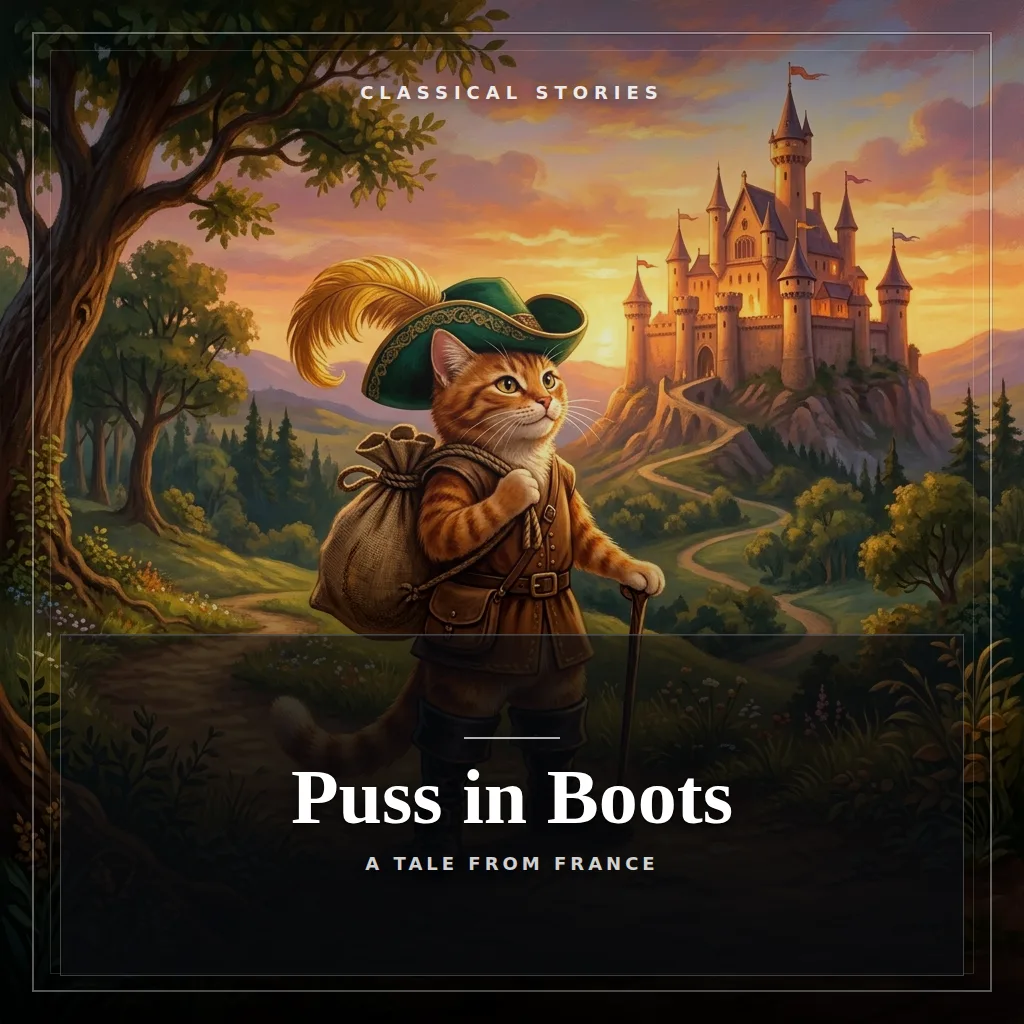
When a miller dies, his youngest son inherits only the family cat and despairs — but this cat can talk, and asks merely for a fine pair of boots and a bag. Thus equipped, Puss sets to work: he catches game and presents it to the king as gifts from his invented master, the grand 'Marquis of Carabas'; he stages a rescue that puts his master before the king in borrowed finery; and he goes ahead to a rich ogre's castle, where he flatters the ogre into showing off his shape-shifting powers — and tricks him into becoming a mouse, which Puss promptly eats. The castle, the lands, and the princess all fall to the penniless miller's son, all on the strength of one clever cat in boots.
Why it's worth a listen
A miller dies and leaves his youngest son nothing but a cat — a poor inheritance, the boy thinks, until the cat asks for a pair of boots and a sack and proceeds to talk, trick, and bluff his master all the way to a castle and a princess. The most charming con-artist in fairy tales, proving that confidence and quick wits can spin gold out of a single cat.
What listeners will learn
Subjects: world stories, literature, cultural literacy.
- character
- setting
- conflict
- choice
- consequence
- theme
- retelling
- puss
- boots
- classical
Questions for after listening
- Retell the central conflict in order.
- Name one important choice and what happened because of it.
- How did the setting or tradition shape the story?
A question to keep
How much can cleverness and confidence create out of almost nothing?
Chapters
- The Inheritance of a Cat
- A Pair of Boots and a Sack
- The Gifts of the Marquis
- A Splendid Bath in the River
- The Whispering Fields and the Ogre’s Keep
- A Question to Keep
Read a transcript preview
A dry crust of bread, a cold hearth, and a cat with a very sharp mind. Sometimes, that is all it takes to build a kingdom. This is a story that comes to us from the green rolling hills of France, written down more than 300 years ago by a writer named Charles Perrault. But like all the best tales, it was told by grandmothers and travelers next to roaring fires, long before it ever found its way into the pages of a book. It is a story about how far a little confidence can take you, even when you have absolutely nothing else left in the world. Our story begins in a quiet corner of the French countryside, where an old miller lived with his three sons. For many years, the mill wheel turned, splashing water into the air, grinding grain into flour, and keeping the family warm and fed. But the miller was old, and when his time came to leave this world, he had very little to pass down to his children. He had only three things of any value at all: his mill, his gray donkey, and his cat. There was no lawyer called to read the will, and no grand court to decide who received what. The brothers simply sat around the wooden kitchen table and divided the property themselves. It was a very short conversation. The eldest son, being the oldest, took the mill. It was the grandest prize, for the mill would always grind grain, and grain would always bring in gold. The second son took the donkey. It was a sturdy beast, perfect for hauling sacks of flour to the market town, and with it, he could easily find work as a carrier. That left the youngest son, whose name was Pierre. Pierre looked at the table, then at his brothers, and finally, down at the floor, where a sleek, orange-furred cat was busy grooming its left ear. "Well, Pierre," the eldest brother said, not unkindly, but with the hurried tone of a man who has work to do. "The mill is mine, and the donkey is his. That leaves the cat for you. He is a very good mouser, mind you. Not a single rat dares to cross the threshold when he is awake." With that, the two older brothers went out into the sunshine to begin their new lives, leaving Pierre alone in the dusty, quiet cottage. Pierre sat down on a three-legged stool, put his chin in his hands, and sighed a long, heavy sigh. He looked at the cat, who had finished cleaning his ear and was now staring up at him with large amber eyes that seemed entirely too bright for a common animal. "My brothers," Pierre lamented to the empty room, "can join forces and make a handsome living. Together, they have a mill to grind the wheat and a donkey to carry the flour. They will never go hungry. But as for me, what am I to do? Once I have eaten this poor cat, and perhaps made a warm muff out of his fur to keep my hands warm in the winter, I shall surely die of hunger." The cat had been sitting quietly by the hearth, but at these words, his ears pricked up. He did not look frightened. In fact, he looked slightly insulted. He stood up, stretched his front legs, then his back legs, and walked over to Pierre with a slow, deliberate grace. "My good master," the cat said. Pierre jumped off his stool, his heart hammering against his ribs. He looked around the room, expecting to see a neighbor playing a trick, but there was no one. He looked back down at the cat. "Did you, did you just speak?" Pierre whispered. "Of course I spoke," the cat replied, his voice smooth, cultured, and perfectly calm, like that of a wealthy merchant or a polished courtier. "And I must ask you not to speak of eating me, or turning my lovely coat into a muff. It is terribly bad for my morale. More to the point, it is a very poor business decision." Pierre rubbed his eyes. "A business…
Editorial review
Quality reviewed · 95/100 on . Certificate EL-9880-9C6C is bound to the exact narrated script.
The review checks factual care, audience fit, teaching quality, structure, tone and source honesty. Read the editorial standards.
Published 2026-07-11 · Updated