- Who is it for?
- Ages 8–14
- How long is it?
- 40 min
- What does it include?
- Synced read-along and a quiz
- What does it cost?
- Free — no sign-up required
About this audiobook
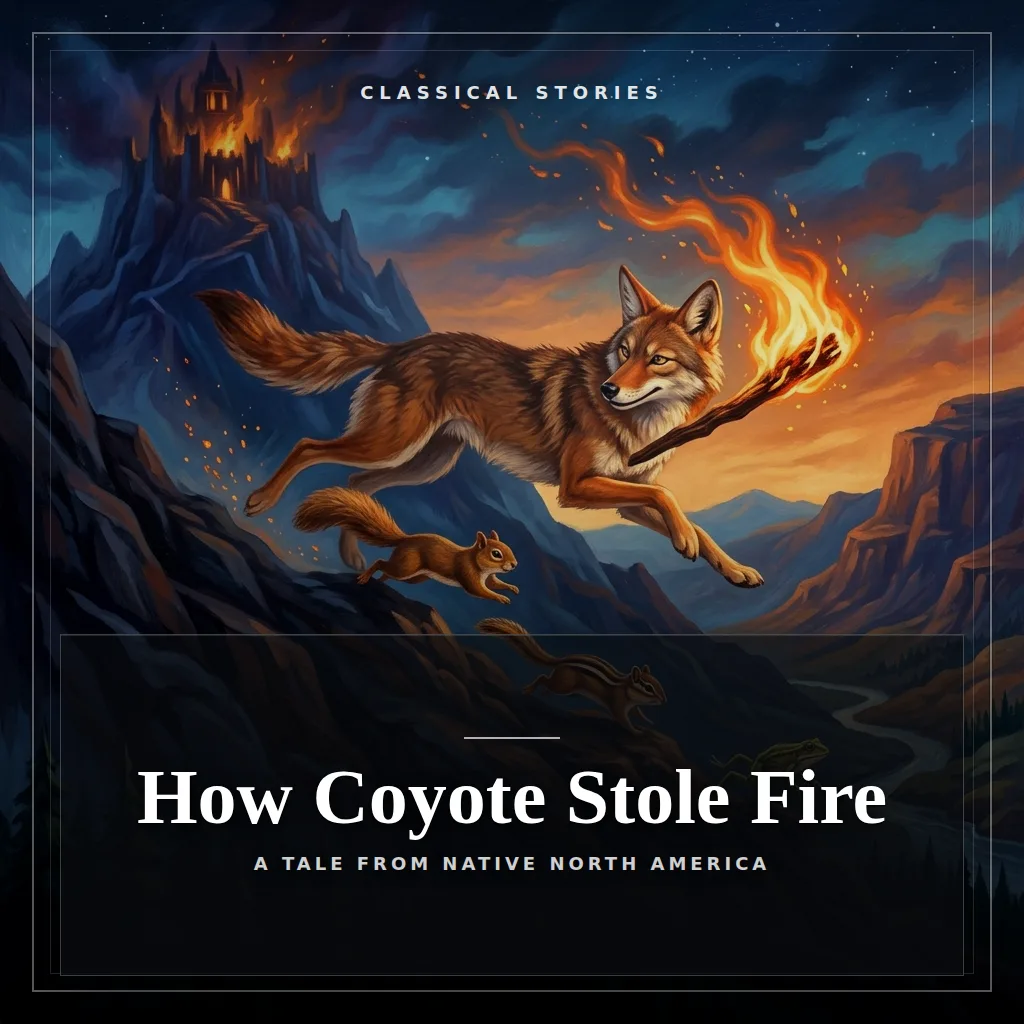
In the cold time, the people suffer because three Fire Beings keep all the fire for themselves atop a high mountain and let none escape. Coyote, watching the people shiver, decides to steal it — but he cannot do it alone, so he enlists the animals into a relay. He snatches a burning brand and runs; when the Fire Beings nearly catch him, he passes it to squirrel, who runs until her tail curls from the heat, then to chipmunk, who gets a clawed stripe down his back, then to frog, who loses his tail leaping away, and finally the fire is given to wood — which swallows it and holds it safe, which is why fire still lives inside wood and can be coaxed out by rubbing. The people are warm at last.
Why it's worth a listen
The people are freezing through the winters because three fearsome Fire Beings hoard all the fire on a mountaintop and guard it night and day. So Coyote — the trickster who actually cares — organizes a wild relay: himself, then squirrel, chipmunk, frog, and wood, each carrying the stolen ember a stretch farther down the mountain as the Fire Beings give chase. A rollicking Native American trickster tale about cleverness, teamwork, and why animals look the way they do.
What listeners will learn
Subjects: world stories, literature, cultural literacy.
- character
- setting
- conflict
- choice
- consequence
- theme
- retelling
- coyote
- stole
- fire
Questions for after listening
- Retell the central conflict in order.
- Name one important choice and what happened because of it.
- How did the setting or tradition shape the story?
A question to keep
What can a whole community do together that no one could do alone?
Chapters
- The Night Without Stories
- The Gap in the Guard
- The Gathering of the Runners
- The Snatch
- The Relay of the Wild
- The Gift Inside the Bark
- A Question to Keep
Read a transcript preview
Long ago, before the world became the busy, brightly lit place we know today, winter did not just visit the land, it ruled it. The cold was a heavy gray blanket that never seemed to lift, and the nights were so dark that you could lose your own hand if you held it out in front of your face. In those ancient days, the human beings lived in the deep, shadow-filled valleys, shivering in shelters made of pine boughs and animal skins, with nothing to warm them but their own breath and the crowded warmth of each other's shoulders. This is a story that has been told for generations by the native peoples of North America, especially those who lived in the Pacific Northwest and the high wind-swept plateau. Peoples like the Klamath, the Karuk, and the Nez Perce. Because it is a story that belongs to the land itself, it has been carried through the years by many different voices, and it has many different ways of being told. But in every telling, at the very heart of the tale, there is a cold world, a clever plan, and a group of friends who decided that no one should have to shiver in the dark alone. In those early times, the winters were longer and sharper than they are now. When the frost came down from the north, it did not just dust the leaves, it locked the rivers in cages of thick, green ice. It froze the ground so hard that it rang like iron under a moccasin. The people had no blankets of wool, no glass windows to keep out the draft, and worst of all, they had no fire. They did not know the bright, dancing spirit of the flame. They did not know the comfort of a hot meal, or the way a golden light can chase the shadows from the corner of a room. When the sun went down behind the jagged mountains, the world became silent, cold, and terribly still. There were no stories told in the evenings, because it is hard to speak when your teeth are chattering, and it is hard to dream when your fingers are numb. But high above the shivering valleys, on the very peak of the tallest, sharpest mountain, there was light. On that summit lived the three fire beings. They were ancient, strange creatures, made of soot and shadow, with eyes that burned like orange embers, and fingers like charred birch twigs. They were not human, and they were not animals. They were the keepers of the world's only flame. They lived in a great stony fortress, surrounded by towering walls of ice, and in the center of their courtyard, burned a magnificent fire. It was a roaring, leaping beast of gold, red, and brilliant yellow. It crackled with life, throwing off showers of sparks that drifted up into the dark sky like new stars. The heat of it was so great that the snow on the mountaintop melted before it could touch the stones of their courtyard. The fire beings loved their fire, but they did not love it because it was beautiful, or because it kept them warm. They loved it because they were selfish. They believed that the fire belonged to them and them alone, and they guarded it with a fierce, jealous fury. They knew that if the humans in the valleys ever got a single spark of that flame, the world would change. The dark would not be so dark anymore, and the cold would lose its power. So, the fire beings kept a constant watch. They never left the fire unattended, not even for a moment. They took turns, night and day, circling the flames like hungry wolves. When the first fire being grew tired, she would tap the second on the shoulder, and the second would take her place. When the second grew weary, he would wake the third. Their smoky eyes were always open, searching the snowy slopes for any sign of an intruder. They had no pity for the people below. To them, the shivering of the humans was just a distant sound, no more important than…
Editorial review
Quality reviewed · 96/100 on . Certificate EL-628F-CECB is bound to the exact narrated script.
The review checks factual care, audience fit, teaching quality, structure, tone and source honesty. Read the editorial standards.
Published 2026-07-11 · Updated